
Gambel's Quail Identification Guide
A desert specialist of the American Southwest, Gambel's Quail is known for the male's forward-curling black head plume, chestnut cap, and bold black belly patch.
Read the full Gambel's Quail encyclopedia entry →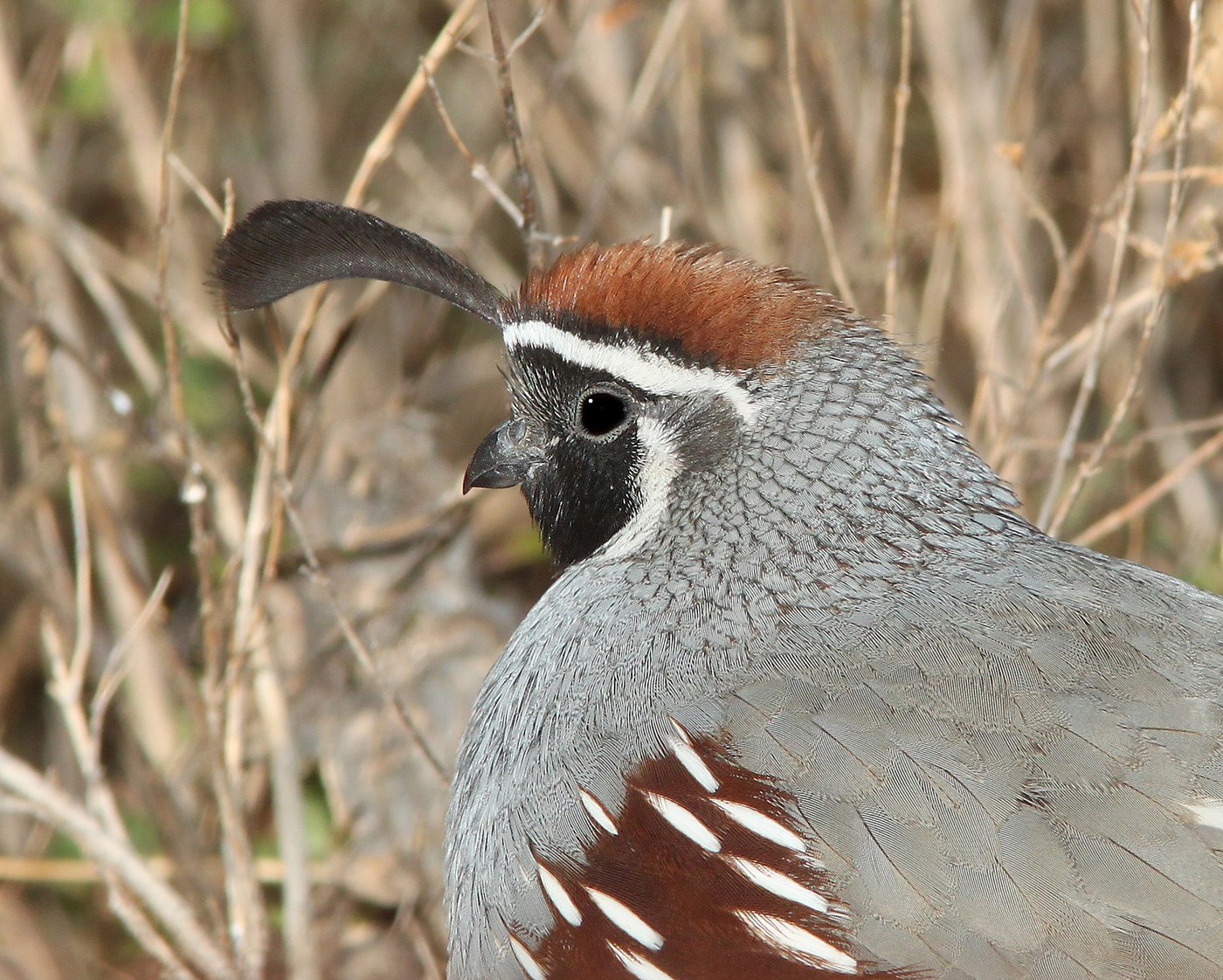
Key Field Marks
- Size: A plump, ground-dwelling quail about 25–28 cm (10–11 in) long with a short black comma-shaped topknot plume that curves forward over the forehead.
- Male: Gray back and breast, chestnut crown, black face outlined in white, chestnut flanks streaked white, and a bold solid black patch on the lower belly.
- Female: Overall dull grayish-brown, a shorter plume, and no black face patch or black belly patch — much plainer than the male.
- Bill: Short, stout, black, and downcurved, built for picking seeds and vegetation off the ground.
- Legs: Grayish, adapted for running rather than flying.
Separating It From Similar Species
- California Quail is the closest look-alike where ranges meet in parts of the Southwest. Male Gambel's Quail has a plain gray-buff belly interrupted by a solid black patch, while male California Quail shows a scaly, scalloped pattern across the entire belly with no solid black patch. Female Gambel's Quail also lacks the scaled belly pattern of the female California Quail.
- Habitat helps too: Gambel's Quail favors hotter, drier desert scrub, while California Quail favors somewhat more vegetated, coastal, or oak-woodland habitats, though there is overlap in the Southwest.
- Both sexes of Gambel's Quail show a plain (unscaled) belly aside from the male's black patch, a reliable structural difference from California Quail at any age.
Where and When to Find It
- Habitat: Sonoran and Chihuahuan desert scrub, mesquite bosques, washes, and arid brushland, almost always near a reliable water source such as a wash, spring, or backyard feeder.
- Range: Resident year-round (non-migratory) across Arizona, southern Nevada, southeastern California, southern New Mexico, western Texas, and northern Mexico.
- Behavior: Highly social, forming coveys of a dozen to several dozen birds outside the breeding season. Prefers to run for cover rather than fly, though it will flush explosively when pressed.
Voice
- The signature call is a loud, four-syllable "chi-CA-go" or "ka-KAA-ka-ka," often given from an exposed perch such as a fence post or cactus.
- Coveys also give soft contact clucks to stay in touch while foraging.
Frequently asked questions
What is the black feather on a Gambel's Quail's head called?
It's called a topknot or plume, made of a small cluster of curved feathers that arch forward over the forehead — most pronounced and glossy black in males.
How do I tell a male from a female Gambel's Quail?
Males have a chestnut cap, black face outlined in white, and a solid black belly patch; females are plain grayish-brown with a shorter plume and no black facial or belly markings.
What's the difference between Gambel's Quail and California Quail?
Gambel's Quail has a plain belly with (in males) a solid black patch, while California Quail shows a scaly, scalloped pattern across the whole belly in both sexes.
Where do Gambel's Quail live?
They are desert residents of the Sonoran and Chihuahuan deserts across Arizona, southern Nevada, southeastern California, New Mexico, and northern Mexico, always near water.