
Fulvous Whistling-Duck Identification Guide
A tawny, long-necked, long-legged duck with an upright goose-like posture, identified by its rich cinnamon-buff body, pale flank stripe, and habit of whistling in flight at night.
Read the full Fulvous Whistling-Duck encyclopedia entry →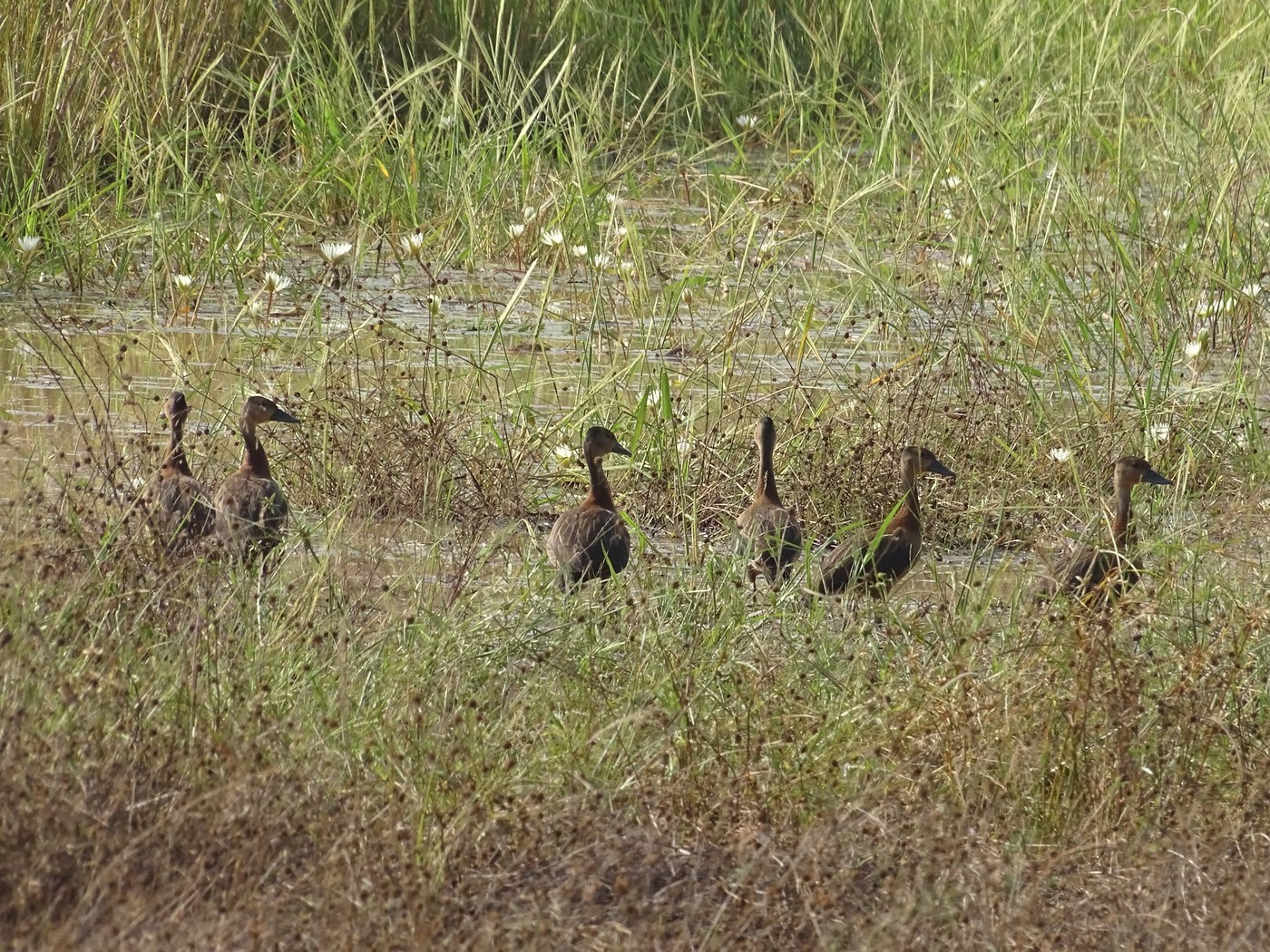
Key Field Marks
- Size & shape: A large, long-legged, long-necked duck with an upright stance more reminiscent of a small goose than a typical dabbling duck; legs extend noticeably beyond the tail in flight.
- Plumage: Rich tawny-cinnamon (fulvous) body overall, with a darker brown back and crown, and a pale creamy-buff stripe along the flanks formed by elongated feathers — a key field mark visible on standing and swimming birds.
- Head & neck: Long neck is uniformly tawny with a thin dark line down the back of the neck (nape stripe), and the face lacks strong facial markings, giving a plain-headed look.
- Bill & legs: Dark grayish bill; long, blue-gray legs and feet that trail well past the tail in flight, unlike most ducks.
- In flight: Broad, dark, rounded wings without a pale speculum patch, slow wingbeats, and a distinctive white U-shaped rump/uppertail-covert band contrasting with the dark tail — visible from above in flight.
Similar Species
- Black-bellied Whistling-Duck (range overlap in the southern U.S. and Mexico) has a bright red-orange bill and legs, a gray face, and a black belly, all lacking in the plainer, all-tawny Fulvous Whistling-Duck.
- Female domestic/farmyard ducks or Mallards in eclipse plumage are stockier, lack the long neck/leg proportions, and don't show the pale flank stripe or white rump band.
- The uniformly tawny body combined with the pale flank stripe and long trailing legs in flight is diagnostic among regularly occurring waterfowl in its range.
Where & When to See It
- Range: Widely but patchily distributed — found in the southern United States (notably Texas, Louisiana, Florida), Mexico, Central America, parts of South America, sub-Saharan Africa, and the Indian subcontinent, reflecting a broad pantropical distribution.
- Habitat: Shallow freshwater marshes, flooded rice fields, and vegetated wetland edges with abundant emergent and aquatic vegetation.
- Season: Largely non-migratory in tropical portions of its range, though northern populations (e.g., U.S. Gulf Coast) may shift seasonally; most active at dusk and during the night.
Voice & Behavior Cues
- Highly vocal, especially in flight at night — gives a distinctive two- or three-note whistling call, often rendered as "pa-chee-chee" or a squealing whistle, which gives the whistling-ducks their name.
- Gregarious and often nocturnal or crepuscular in its foraging habits, frequently heard calling overhead in the dark before being seen.
Frequently asked questions
How do I tell a Fulvous Whistling-Duck from a Black-bellied Whistling-Duck?
Fulvous Whistling-Duck is uniformly tawny-cinnamon with a pale flank stripe and dark bill/legs, while Black-bellied Whistling-Duck has a red-orange bill and legs, gray face, and black belly.
What is the most reliable flight identification feature?
Look for the long legs trailing well beyond the tail, dark unmarked wings, and a white U-shaped band across the rump contrasting with the dark tail.
When are Fulvous Whistling-Ducks most active?
They are often most vocal and active at dusk and during the night, when their distinctive whistling calls can be heard overhead even when the birds aren't visible.
What habitat should I search for this species?
Shallow freshwater marshes, flooded rice fields, and densely vegetated wetland margins across its patchy tropical and subtropical range.