
Franklin's Gull Identification Guide
A small, dark-hooded prairie gull best identified by its compact build, white eye crescents, and reddish bill and legs, often seen in large flocks over agricultural fields far from the coast.
Read the full Franklin's Gull encyclopedia entry →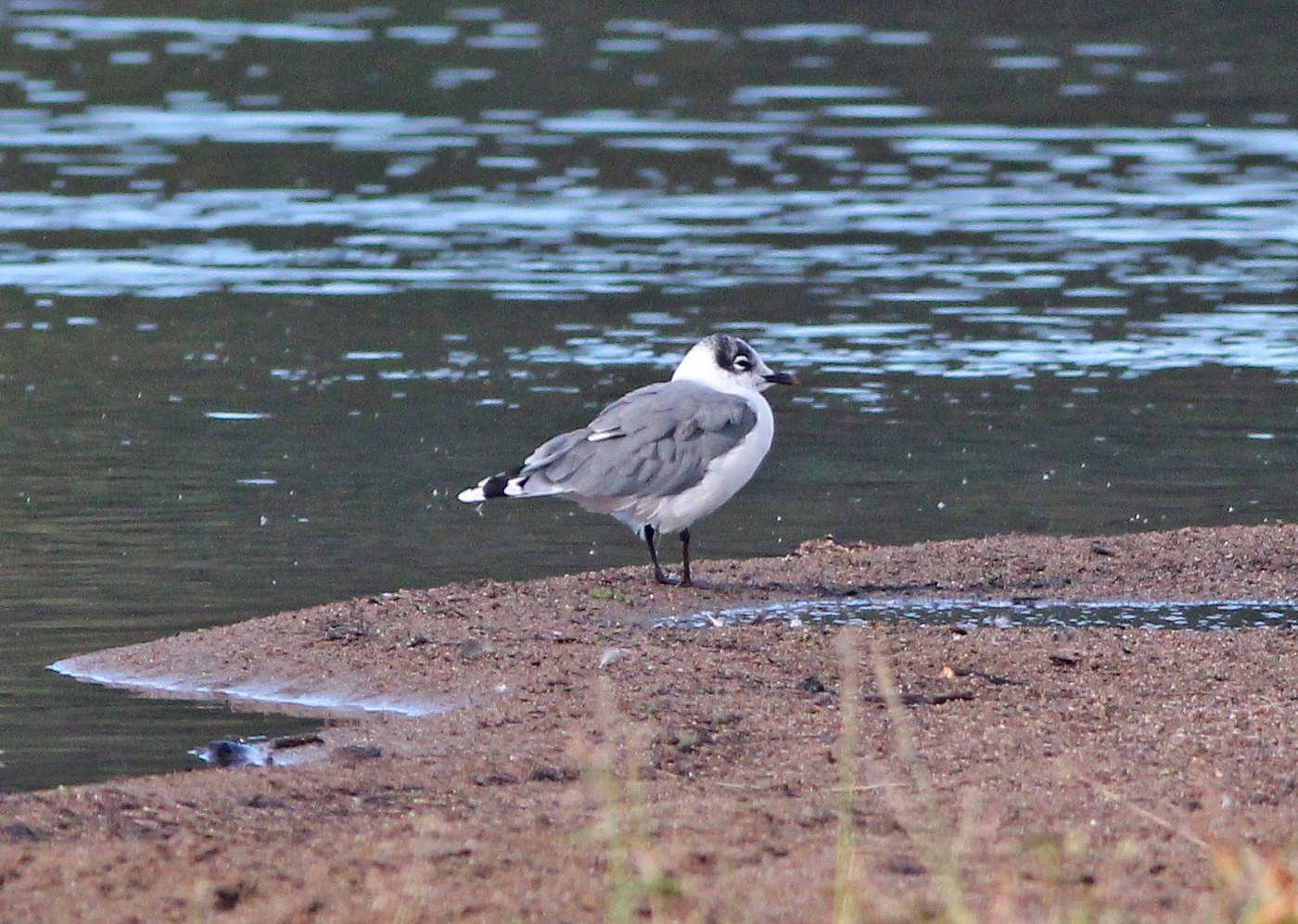
Key Field Marks
- Size & shape: A small gull, notably petite and buoyant, with a rounded head, short bill, and relatively long, pointed wings that give a graceful, tern-like flight.
- Breeding plumage: Full black hood, pale gray back, and a rosy blush on the white underparts (often fading quickly after collection); bold white crescents above and below the eye are diagnostic and visible even at a distance.
- Wingtip pattern: Black wingtips are separated from the gray of the wing by a white band, and show white spots ("mirrors") near the tip — an important mark distinguishing it from similar hooded gulls.
- Bill & legs: Dark red bill and legs in breeding adults, becoming duller in non-breeding birds; non-breeding adults lose the full hood, showing a dusky half-hood or smudge behind the eye instead.
- Behavior: Highly gregarious, often forming enormous flocks; frequently follows tractors plowing fields to catch disturbed insects, and forages over open water and mudflats in tight flocks.
Similar Species
- Laughing Gull is larger, longer-billed, lacks the bold white eye crescents, and has a more extensively black wingtip without the clean white band separating black from gray — range also differs, with Laughing Gull more coastal/southeastern.
- Bonaparte's Gull is smaller still, has a black (not dark red) bill, and shows a distinctive white leading wedge on the outer wing in flight, unlike Franklin's Gull's gray-and-black wingtip pattern.
- The combination of white eye crescents plus a white band isolating the black wingtip is the most reliable way to separate Franklin's Gull from both look-alikes.
Where & When to See It
- Range: Breeds in colonies on prairie marshes of the north-central United States and south-central Canada; winters primarily along the Pacific coast of South America, with some in Gulf Coast and interior areas during migration.
- Habitat: Prairie wetlands and marshes for breeding; agricultural fields, lakes, and coastal areas during migration and winter.
- Season: A long-distance migrant, moving through the Great Plains and interior U.S. in spring and fall in large, sometimes massive flocks; a notable spring migration spectacle in states like Nebraska and the Dakotas.
Voice & Behavior Cues
- Calls are high-pitched and somewhat squeaky, a nasal "weeh-ah" or laughing-like series, softer and higher than the harsher call of Laughing Gull.
- Migration flocks can number in the tens of thousands; watch for tight, swirling flocks over farmland, a strong behavioral cue during peak migration.
Frequently asked questions
What is the best field mark for Franklin's Gull?
Bold white crescents above and below the eye, combined with a white band separating the black wingtips from the gray upperwing, distinguish it from similar hooded gulls.
How is Franklin's Gull different from Laughing Gull?
Franklin's Gull is smaller, shows prominent white eye crescents that Laughing Gull lacks, and has a white band isolating its black wingtips rather than solidly black tips.
Where can I see large flocks of Franklin's Gulls?
Huge migratory flocks pass through the Great Plains, especially Nebraska and the Dakotas, in spring and fall, often over agricultural fields.
Does Franklin's Gull breed near the ocean?
No, it breeds inland in prairie marsh colonies across the north-central U.S. and south-central Canada, then migrates largely to Pacific coastal South America for winter.