
Fox Sparrow Identification Guide
A large, heavily marked North American sparrow with strong regional color variation, generally identified by its bulky shape, bold breast streaking often converging into a central spot, and vigorous double-scratch ground foraging.
Read the full Fox Sparrow encyclopedia entry →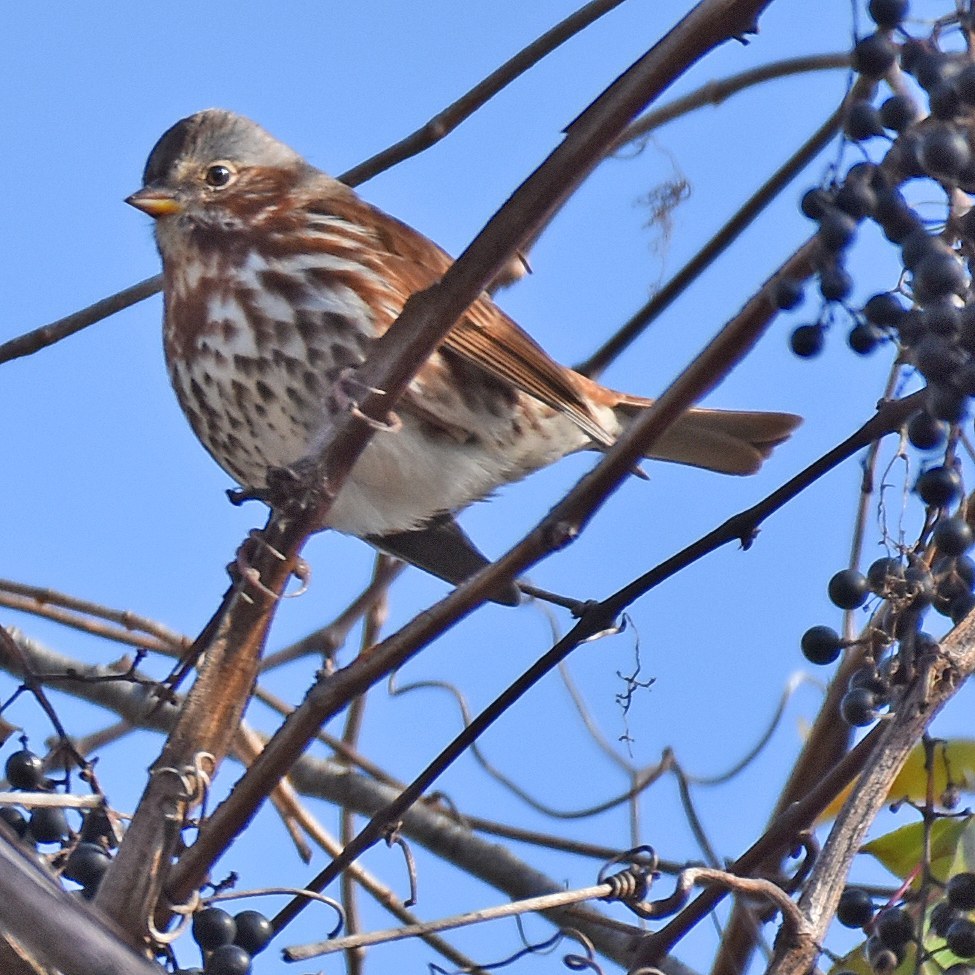
Key Field Marks
- Size & shape: One of the largest and chunkiest sparrows in North America, with a stout body, relatively short tail, and a thick conical bill.
- Plumage variation: Highly variable across four main regional groups — "Red" (rich rufous upperparts and heavily rust-streaked underparts, found in the east/boreal), "Sooty" (dark, uniformly brown, Pacific Northwest coast), "Slate-colored" (gray head and back with contrasting rufous wings/tail, interior west), and "Thick-billed" (grayish-brown with a notably large bill, California/Great Basin mountains).
- Underparts: Bold, heavy streaking or spotting on white underparts, typically coalescing into a dark blotch in the center of the breast — a helpful mark across all forms.
- Bill color: Varies by form from yellowish (Red) to dark gray (some Sooty/Slate-colored) to notably large and pale (Thick-billed) — bill shape and color help narrow down which regional group you're seeing.
- Behavior: Forages on the ground in leaf litter using a vigorous double-scratch (both feet kicked backward simultaneously), often heard before seen as it rustles through undergrowth.
Similar Species
- Song Sparrow is smaller, slimmer, with finer streaking and a longer tail that it pumps in flight; Fox Sparrow's streaking is bolder and the body noticeably bulkier.
- Hermit Thrush, sometimes confused by silhouette in low light, has a thin bill and lacks the sparrow's conical seed-eating bill.
- Separating the four Fox Sparrow forms from one another relies on overall color tone (red, gray, sooty-dark, or gray with a huge bill) combined with range, since some forms are now considered by many authorities as distinct species-level groups.
Where & When to See It
- Range: Breeds across a huge swath of North America — boreal forest and taiga (Red group), Pacific coastal forests (Sooty group), and western mountains (Slate-colored and Thick-billed groups).
- Habitat: Dense shrubby thickets, forest undergrowth, chaparral, and brushy edges; a secretive, ground-dwelling species usually detected by sound first.
- Season: Northern/boreal populations are highly migratory, wintering across the southern and eastern U.S.; Pacific coast Sooty populations are often present year-round or short-distance migrants; interior mountain forms show elevational migration.
Voice & Behavior Cues
- Song is rich, melodious, and variable — a series of clear, sweet whistled phrases, often considered one of the finest sparrow songs, delivered from a low shrub.
- Call note is a sharp, distinctive "smack" or "chip," useful for locating a bird skulking in dense brush before it's seen.
Frequently asked questions
Why does the Fox Sparrow look so different across its range?
It comprises four distinct regional groups — Red, Sooty, Slate-colored, and Thick-billed — that differ substantially in overall color and bill size, and some taxonomists treat them as separate species.
What is the best behavioral clue for finding a Fox Sparrow?
Listen for a loud rustling in leaf litter; Fox Sparrows forage with a vigorous double-scratch kick of both feet, often audible before the bird is visible.
How do I tell a Fox Sparrow from a Song Sparrow?
Fox Sparrows are noticeably larger and bulkier with bolder, heavier breast streaking that often forms a central blotch, compared to the finer streaking and slimmer build of a Song Sparrow.
Do all Fox Sparrows migrate?
Boreal 'Red' populations are long-distance migrants wintering in the eastern and southern U.S., while some Pacific coast 'Sooty' birds are year-round residents or short-distance migrants.