
Fork-tailed Drongo Identification Guide
An all-black African songbird with glossy plumage, red eyes, and a distinctive deeply forked tail, known for aggressive aerial hawking and mimicking alarm calls of other species.
Read the full Fork-tailed Drongo encyclopedia entry →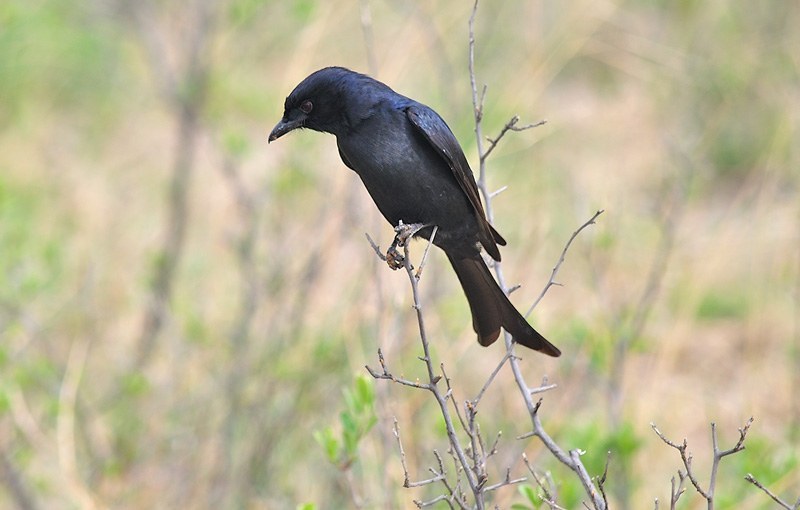
Key Field Marks
- Size & shape: A medium-sized passerine, about 25 cm long, with a slender body and long tail that ends in a deep, obvious fork — the single best field mark.
- Plumage: Entirely glossy black with a blue-green sheen in good light; no white patches or bars anywhere on the body.
- Eye: Bright red iris, visible at close range and useful for separating adults from similar all-black birds.
- Bill: Black, fairly short, slightly hooked at the tip, adapted for catching flying insects.
- Behavior: Highly active and aggressive; perches conspicuously on wires, fence posts, or bare branches and makes sallying flights to snatch insects in mid-air, often flushed up by grazing animals or bushfires. Frequently mobs raptors and other predators far larger than itself.
Similar Species
- Square-tailed Drongo (range overlap in parts of Africa) has a shallower, less deeply forked tail and a stockier build; the depth of the tail fork is the most reliable separator.
- Common Fiscal (Fiscal Shrike) is also black-and-white but has obvious white in the wings, scapulars, and outer tail, plus a straight-edged (not forked) tail — easily ruled out.
- Black Cuckooshrike lacks the forked tail and has a more uniform, less glossy plumage with a different flight style (gliding versus sallying).
Where & When to See It
- Range: Widespread across sub-Saharan Africa, from savanna and woodland edge habitats through much of eastern and southern Africa.
- Habitat: Open woodland, savanna, farmland edges, and gardens; commonly seen perched on fences and utility wires near open ground.
- Season: Resident and non-migratory across most of its range, present year-round.
Voice & Behavior Cues
- A skilled vocal mimic — famous for imitating the alarm calls of other bird and mammal species (including meerkats) to scare them away from food, a well-documented kleptoparasitic behavior.
- Its own calls include harsh, metallic "chink" or "twang" notes and a variety of whistles mixed into its song, often given from an exposed perch.
Frequently asked questions
What is the main field mark for a Fork-tailed Drongo?
Its long, deeply forked tail combined with entirely glossy black plumage and a red eye distinguishes it from other black African birds.
How is a Fork-tailed Drongo different from a shrike?
Fiscal shrikes show obvious white in the wings and tail and have a straight-edged tail, while the Fork-tailed Drongo is uniformly black with a deeply forked tail and no white markings.
Is the Fork-tailed Drongo known for any unusual behavior?
Yes, it is well known for mimicking the alarm calls of other species, including meerkats, to scare them off food sources in a form of kleptoparasitism.
What habitat is best for finding Fork-tailed Drongos?
Open savanna, woodland edges, and farmland with scattered perches like fences and wires across sub-Saharan Africa.