
Florida Scrub-Jay Identification Guide
A pale-blue, crestless jay found only in Florida's shrinking scrub habitat, told from Blue Jays by its bold curiosity, gray back, and lack of a crest.
Read the full Florida Scrub-Jay encyclopedia entry →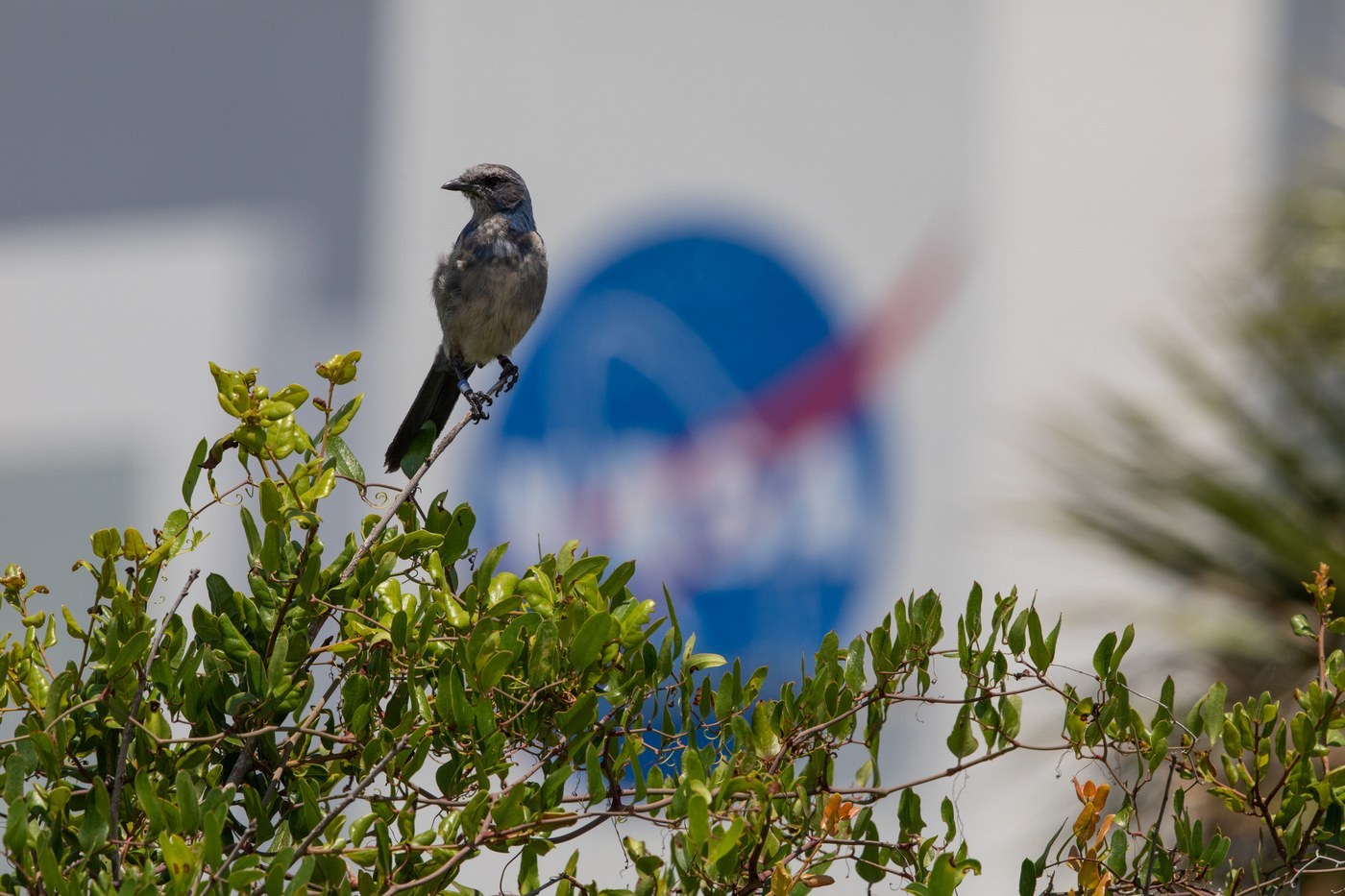
Key Field Marks
- Size & shape: A medium-sized jay, roughly 11 inches long, slimmer and longer-tailed than a Blue Jay, with no crest — the head is smoothly rounded.
- Plumage: Blue head, wings, and tail contrast with a pale gray-brown back and whitish-gray underparts. A distinct pale blue "necklace" of streaking crosses the upper breast, bordered below by whitish throat.
- Face: A blackish patch through and above the eye gives a masked look, set off by a whitish forehead and eyebrow.
- Bill & legs: Stout black bill; sturdy black legs used for hopping and walking on open sandy ground — this species forages on the ground more than most jays.
- Behavior: Bold, inquisitive, and often tame around people; lives in small cooperative family groups with helper birds at the nest, and individuals frequently perch conspicuously atop scrub oaks to watch for predators (a key behavioral cue).
Similar Species
- Blue Jay overlaps in range but has a prominent crest, black neck-barring, white wing bars, and much bluer, more uniformly patterned plumage; Blue Jays are also woodland birds and are shier, less habitually ground-foraging.
- Woodhouse's Scrub-Jay and California Scrub-Jay (western species, no range overlap) are nearly identical in pattern but are separated entirely by geography — any scrub-jay seen in peninsular Florida is, by range alone, this species.
- Overall, within its range this is the only crestless blue jay, making identification straightforward once the crestless head and gray back are noted.
Where & When to See It
- Range: Endemic to Florida — found nowhere else in the world. A federally threatened species with a fragmented, declining population.
- Habitat: Specializes in Florida scrub — low, fire-maintained oak scrub with sandy soil and scattered open patches, rarely found far from this habitat type.
- Season: Non-migratory, year-round resident; reliable sites include Merritt Island National Wildlife Refuge, Oscar Scherer State Park, and various scrub preserves in central Florida.
Voice & Behavior Cues
- Calls are harsh and varied: a rasping "kweesh" or "queedle," often given in a rising, questioning inflection, distinct from the Blue Jay's more strident "jay" scream.
- Family groups communicate with soft contact calls; a sentinel bird perched high and calling in alarm is a classic behavioral sign of this cooperatively breeding species.
Frequently asked questions
What's the easiest way to tell a Florida Scrub-Jay from a Blue Jay?
Look for the lack of a crest — Florida Scrub-Jays have a smooth, rounded blue head, a gray-brown back, and no white wing bars, unlike the crested, boldly patterned Blue Jay.
Is the Florida Scrub-Jay found anywhere outside Florida?
No, it is entirely endemic to Florida and is not found naturally anywhere else in the world.
What habitat should I search for Florida Scrub-Jays in?
Look specifically in Florida scrub habitat — low, sandy, fire-adapted oak scrubland; they are rarely seen away from this specialized habitat.
Do Florida Scrub-Jays migrate?
No, they are non-migratory permanent residents that stay in family territories year-round.
Why are Florida Scrub-Jays considered a conservation concern?
Habitat loss and fragmentation of Florida scrub, along with fire suppression that degrades their preferred low-scrub habitat, have made them a federally threatened species with a small, declining range.