
Flightless Cormorant Identification Guide
A large, flightless Galápagos endemic cormorant with tiny vestigial wings, best identified by its heavy body, hooked bill, and habit of drying stubby wings while perched on volcanic shoreline rocks.
Read the full Flightless Cormorant encyclopedia entry →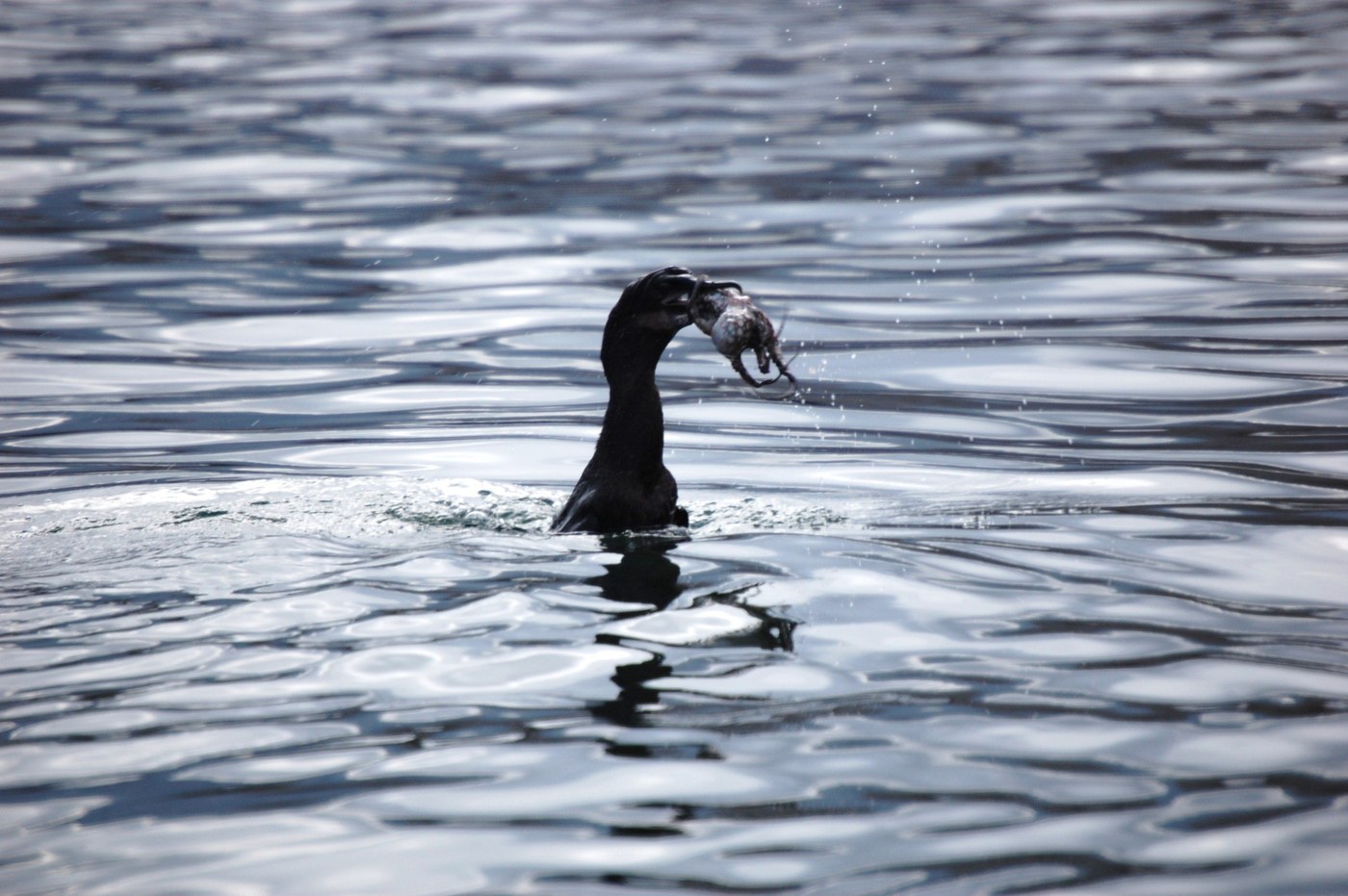
Key Field Marks
- Size & shape: One of the largest cormorants in the world by body mass, but with drastically reduced, stubby wings roughly one-third the size needed for flight. The body is thick-necked, low-slung, and reptilian in posture.
- Wings: The single most diagnostic feature — small, frayed-looking, almost useless wings held loosely at the sides, never spread for flight. Compare to any other cormorant/shag, all of which have full-length flight feathers.
- Plumage: Dull blackish-brown to sooty gray upperparts with a slightly glossy sheen; underparts often browner. Juveniles are duller and more uniformly brown.
- Bill & face: Long, thin, sharply hooked bill typical of cormorants; bare facial skin and throat pouch are dark, sometimes with a turquoise-blue eye that stands out at close range.
- Legs & feet: Large, black, fully webbed feet set far back on the body, used for powerful underwater propulsion; the bird walks with an awkward, waddling gait on land.
- Behavior: Swims low in the water like other cormorants, dives from the surface, and forages by pursuing fish, octopus, and eels along the seafloor using only its feet (wings are not used for swimming). Spends long periods perched on black lava rocks with wings held open or drooped to dry.
Similar Species
- Flightless Cormorant is unmistakable within its range: it is the only cormorant in the Galápagos Islands, and no other cormorant or shag species in the world is flightless, so any flying cormorant seen elsewhere can be ruled out immediately.
- Neotropic Cormorant (occasionally seen well beyond the Galápagos) is slimmer, has full-sized flight-capable wings, and readily flies — a Galápagos bird that flies is never this species.
- Galápagos Penguin, sharing the same rocky coastlines, is much smaller, upright when standing, and has a stubby non-hooked bill; the two are easy to tell apart once seen together.
Where & When to See It
- Range: Restricted entirely to the western Galápagos Islands (Ecuador), primarily Fernandina and the western coast of Isabela — one of the most range-restricted birds on Earth.
- Habitat: Rocky, cool-water shorelines and lava coastlines adjacent to the nutrient-rich upwelling of the Cromwell Current, which supports its bottom-feeding diet.
- Season: Present year-round as a non-migratory resident; best viewed from tour boats or panga landings at sites such as Punta Espinosa (Fernandina) and Punta Vicente Roca or Urbina Bay (Isabela).
Voice & Behavior Cues
- Generally silent away from the nest. At breeding colonies, males give low grunting or groaning calls and perform courtship displays that include a distinctive snake-like neck-weaving dance on the water, often visible from small boats.
- Listen for guttural croaks near nest sites built from seaweed and marine debris on bare lava.
Frequently asked questions
How can I tell a Flightless Cormorant from other cormorants?
Its tiny, withered-looking wings are the giveaway — no other cormorant species on Earth has reduced wings, and this is the only cormorant found in the Galápagos Islands.
Can Flightless Cormorants fly at all?
No. Their wing muscles and flight feathers are vestigial, leaving them permanently grounded and dependent on their strong webbed feet for swimming and diving.
Where is the best place to see a Flightless Cormorant?
They are found only on Fernandina Island and the western coastline of Isabela Island in the Galápagos, with reliable sightings at Punta Espinosa and Punta Vicente Roca.
Do Flightless Cormorants migrate?
No, they are non-migratory and remain year-round residents of their small home range along the cold-water western Galápagos coasts.
What does a Flightless Cormorant eat and how does it catch prey?
It dives from the surface and pursues bottom-dwelling fish, octopus, and eels using only its powerful webbed feet, since its wings cannot assist in swimming.