
Fish Crow Identification Guide
A coastal- and river-loving crow nearly identical in look to the American Crow but noticeably smaller and best told by its distinctive nasal, two-syllable "uh-uh" call.
Read the full Fish Crow encyclopedia entry →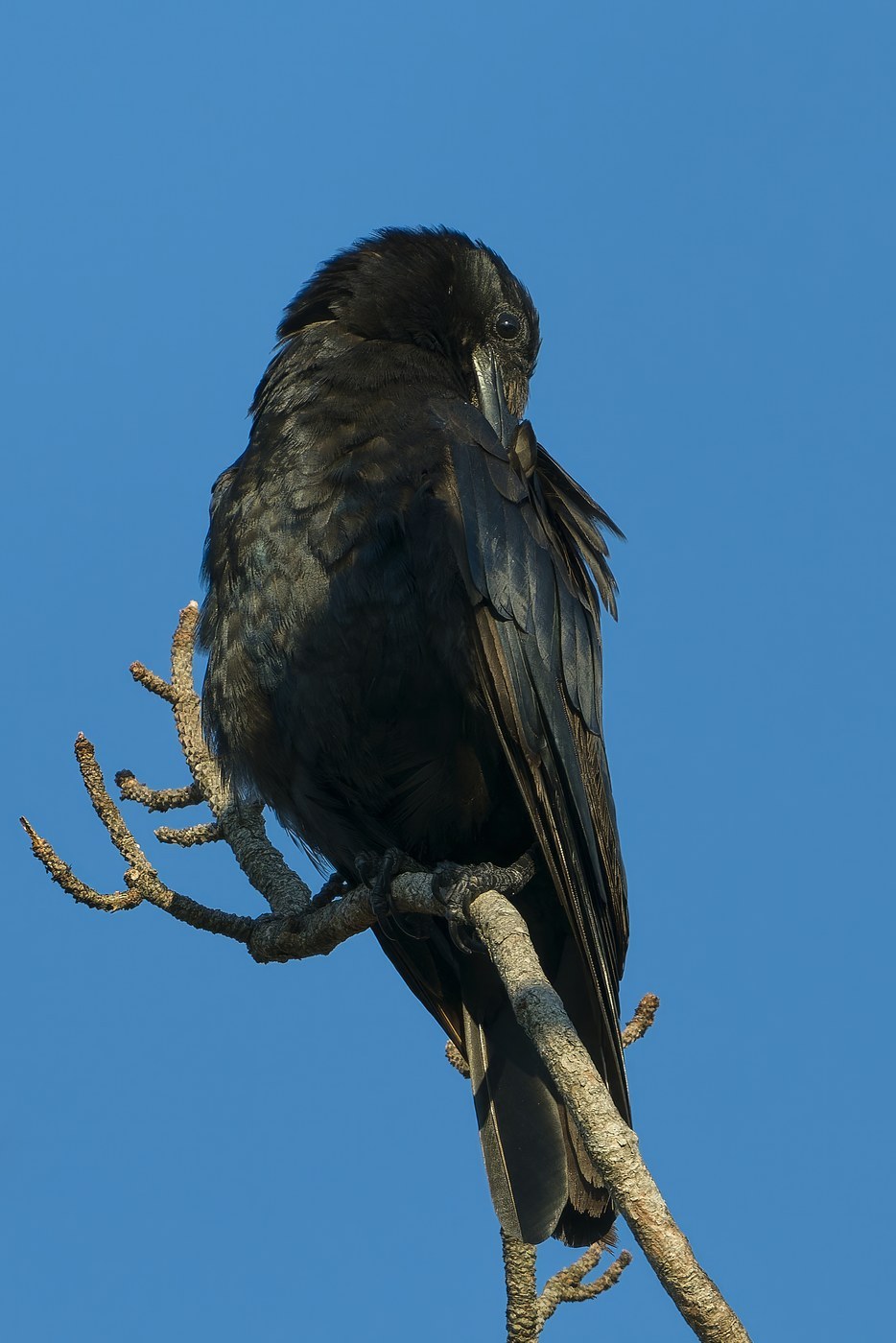
Key Field Marks
- Size & shape: Smaller and more slender than American Crow, with a proportionally smaller bill and head, and slightly more pointed wings, though size differences are subtle in the field and hard to judge without direct comparison.
- Plumage: All-black with a glossy sheen, essentially identical to American Crow — plumage is not a reliable way to separate the two species.
- Flight: Wingbeats are often described as quicker and shallower than American Crow's, and the wings can look slightly more pointed, but this is a subtle, experience-dependent mark.
- Best mark overall: Voice is by far the most reliable way to distinguish this species from American Crow in the field.
Behavior
Gregarious and often found in larger, looser flocks than American Crow, especially outside the breeding season; forages opportunistically on beaches, mudflats, marshes, and around human development, eating crustaceans, eggs, fish, and refuse in addition to typical crow fare. Frequently roosts communally in large numbers.
Similar Species
- American Crow: Visually almost identical; American Crow gives a familiar, full "caw-caw" call, versus Fish Crow's shorter, more nasal double or single note. Where ranges overlap (much of the U.S. East and Gulf Coasts, and increasingly inland along major rivers), voice is essential for a confident ID.
- Common Raven: Much larger, with a heavier bill, shaggy throat feathers, wedge-shaped tail, and deep croaking calls, easily separated from either crow species with practice.
Where & When to Find One
A year-round resident of the Atlantic and Gulf Coast lowlands of the eastern and southeastern United States, closely tied historically to coastal areas, tidal rivers, marshes, and beaches, though it has expanded inland along major river systems and into some urban areas in recent decades. Present in its range throughout the year with no strong migratory movement, so it can be looked (and listened) for in any season within its coastal and riverine range.
Voice
The key identification tool: gives a nasal, often two-syllable "uh-uh" or "ca-ha" call, quite different from American Crow's fuller, more resonant "caw"; juveniles of both species can give confusingly similar begging calls, so voice identification is most reliable with adult birds calling under normal circumstances.
Frequently asked questions
How do you tell a Fish Crow from an American Crow?
Voice is the most reliable clue: Fish Crow gives a short, nasal "uh-uh" or "ca-ha" call, while American Crow gives a fuller, more resonant "caw-caw"; plumage looks essentially the same in both species.
Is there any visual difference between Fish Crow and American Crow?
Fish Crow is somewhat smaller and slimmer-billed with slightly quicker, shallower wingbeats, but these differences are subtle and hard to judge without a side-by-side comparison, so call is far more dependable.
Where does the Fish Crow typically live?
It is closely associated with coastal areas, tidal rivers, marshes, and beaches of the Atlantic and Gulf Coast lowlands of the southeastern and eastern United States, though it has spread inland along some large river systems.
Does the Fish Crow migrate?
It is largely a year-round resident within its range, without the strong seasonal migration shown by some other crow relatives.
Can juvenile crow calls confuse identification between the two species?
Yes, begging calls of young Fish Crows and American Crows can sound similar, so it's best to rely on adult contact/alarm calls for a confident identification.