
Fischer's Lovebird Identification Guide
A small, vividly colored East African parrot with an orange-red face, olive-green collar, and a bright white eye-ring encircling a dark eye.
Read the full Fischer's Lovebird encyclopedia entry →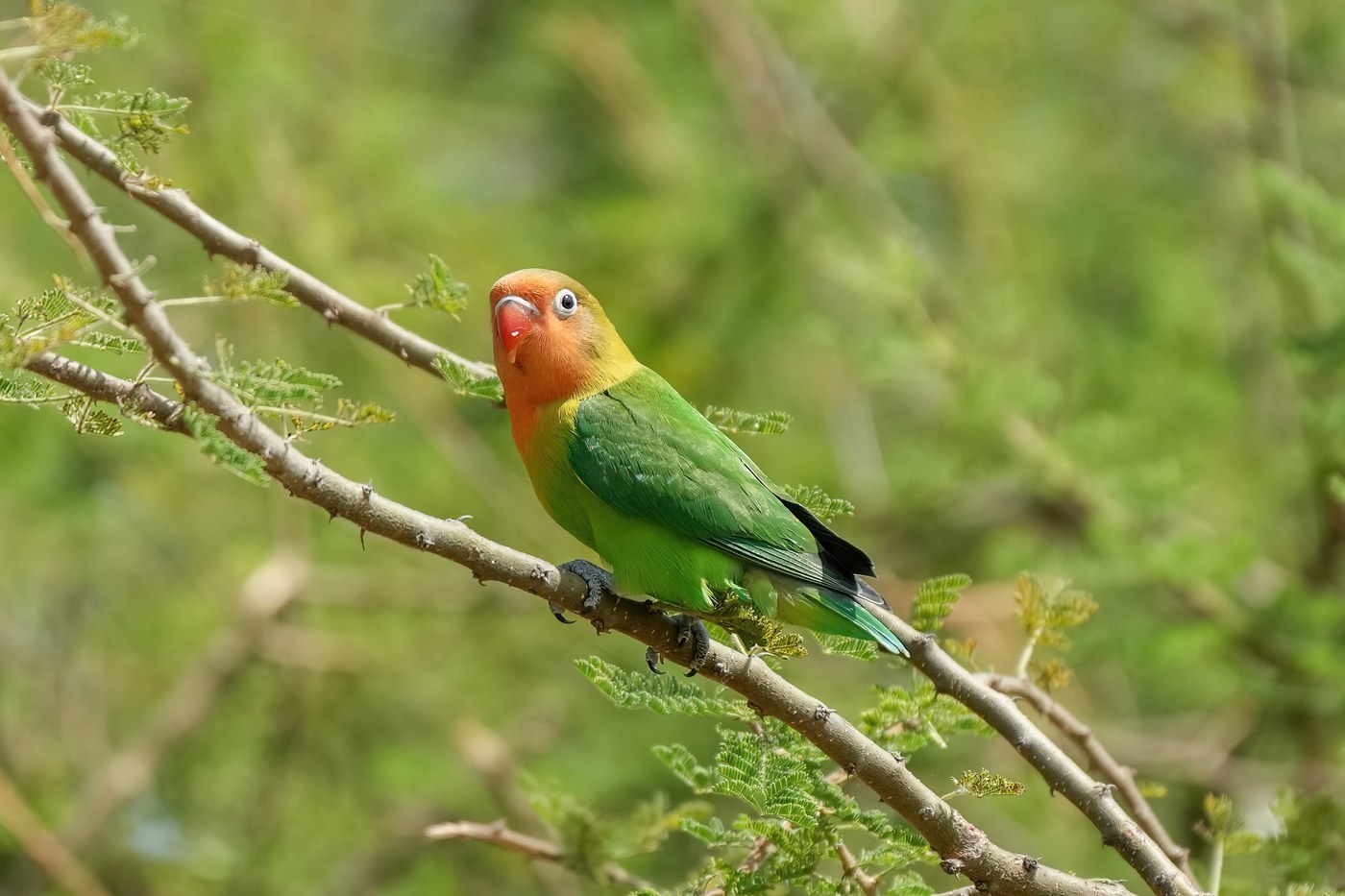
Key Field Marks
- Size & shape: Tiny, stocky parrot (about 14 cm) with a short, blunt tail and a large head-to-body ratio typical of lovebirds.
- Face & head: Bright orange to reddish-orange face and throat blending into an olive-yellow crown and nape.
- Eye-ring: Bold, bare white eye-ring surrounding the dark eye — one of the clearest field marks, especially useful for separating it from similar lovebird species.
- Body: Rich grass-green body overall, with a paler, more yellowish-green collar/mantle area separating the orange head from the green back.
- Bill: Bright red, short, and heavily hooked, typical of lovebirds.
- Rump: Blue rump patch visible in flight, contrasting with the green back and tail.
Behavior
Highly social, usually seen in noisy, fast-flying flocks; feeds on seeds, grasses, and cultivated grains, sometimes in agricultural areas. Nests colonially or in loose aggregations, building bulky stick nests in trees or cavities.
Similar Species
- Yellow-collared Lovebird: Similar white eye-ring, but has a black (not orange) head and a yellow collar rather than Fischer's orange-faced, olive-collared pattern; ranges overlap and hybrids occur where introduced together.
- Black-cheeked Lovebird: Also shows a white eye-ring, but has a dark brownish-black face/cheek rather than orange, and a more restricted range farther south.
- Peach-faced Lovebird: Lacks the white eye-ring entirely, has a more solidly peachy-pink face blending diffusely into the green body without the sharp collar contrast.
Where & When to Find One
Native to a fairly small range in north-central Tanzania (around Lake Victoria and the Serengeti region), inhabiting savanna, grassland, and areas near water with scattered trees for nesting and roosting. Escaped or released cage birds have established feral populations in a few other areas (including parts of Kenya, Burundi, and notably a well-known feral population in the Phoenix, Arizona area in the U.S.), where they can be seen year-round attending backyard feeders and cavities in buildings and saguaro cacti. In its native range it is a resident species, present year-round rather than migratory.
Voice
Calls are typical lovebird chatter — shrill, high-pitched screeching and twittering notes given constantly in flight and while perched in flocks, used to maintain contact among flock members; not markedly different in structure from calls of other Agapornis lovebirds, so voice alone is not diagnostic for species identification.
Frequently asked questions
What is the most distinctive feature of Fischer's Lovebird?
An orange-red face and throat combined with a bold white eye-ring and an olive-green collar separating the head from the green body is the clearest identifying combination.
How do you tell Fischer's Lovebird from a Yellow-collared Lovebird?
Fischer's has an orange face, while Yellow-collared Lovebird has a black head and a yellow (not olive) collar; both share the white eye-ring, so head color and collar color are the key differences.
Are Fischer's Lovebirds found outside Africa?
Yes, escaped cage birds have formed an established feral population in the Phoenix, Arizona metro area in the United States, in addition to their native range in north-central Tanzania.
What habitat does Fischer's Lovebird prefer?
Savanna and grassland with scattered trees, typically near water, within its native range around Lake Victoria and the Serengeti region of Tanzania.
Does the white eye-ring appear on young birds too?
Juveniles have a duller version of the adult pattern with a less vivid orange face, but the bare white eye-ring is generally present and remains a useful mark even on immature birds.