
Fiordland Penguin Identification Guide
A stocky New Zealand crested penguin distinguished by broad yellow head plumes that sweep back over the eye and distinctive white cheek streaks, breeding in dense coastal rainforest.
Read the full Fiordland Penguin encyclopedia entry →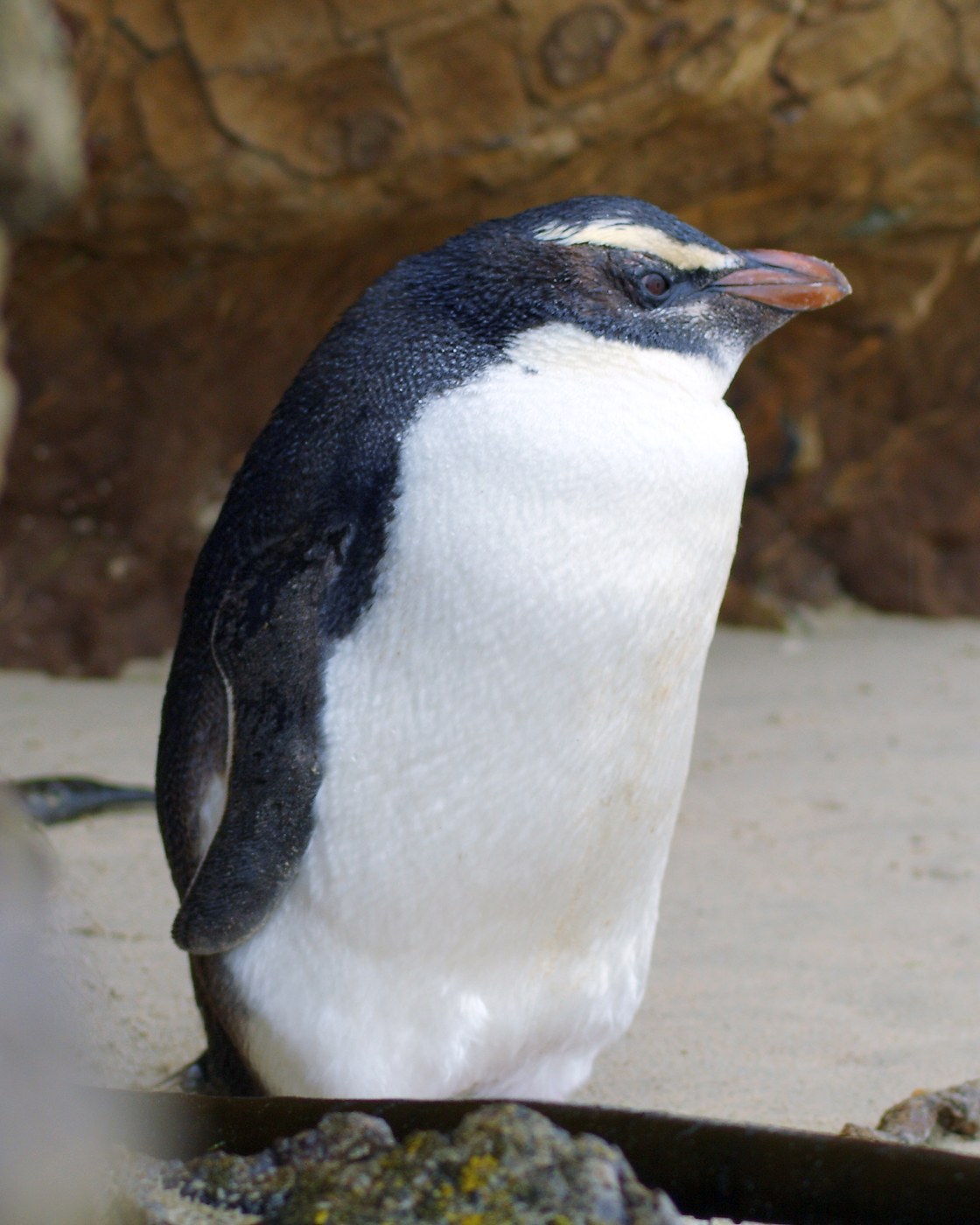
Key Field Marks
- Crest: Broad, drooping yellow eyebrow-stripes (crests) that begin at the base of the bill and sweep backward over the eye and down the neck, often looking somewhat unkempt or floppy compared to other crested penguins.
- Face: Black face with several thin white stripes/streaks running from the base of the bill across the cheek — a useful distinguishing detail at close range.
- Bill: Large, heavy, reddish-brown bill.
- Body: Slate-blue-black upperparts and white underparts typical of crested penguins; medium-sized and stocky, with pink feet.
- Overall structure: Bulkier and shorter-necked than the similar Snares Penguin, with a somewhat scruffier crest appearance.
Behavior
Unusual among penguins for nesting in dense temperate rainforest and under coastal vegetation, sometimes walking considerable distances inland and even climbing over roots and rocks to reach nest sites hidden under forest cover. Forms small, scattered breeding colonies rather than the vast aggregations of some other penguin species, and is generally shy and easily disturbed at the nest.
Similar Species
- Snares Penguin: Very similar crested pattern but lacks the white cheek streaks of Fiordland Penguin, has bare pink skin at the base of the bill, and breeds only on the Snares Islands, well outside Fiordland Penguin's range.
- Fjordland's crest vs. Erect-crested Penguin: Erect-crested Penguin has stiffer, more erect (rather than drooping) yellow crests and a different, more restricted breeding range on subantarctic islands.
- Rockhopper Penguin: Smaller, with thinner, more spiky yellow-and-black crests and red eyes, and a proportionally smaller bill.
Where & When to Find One
Breeds only along the rugged, forested coastline and offshore islands of Fiordland and Stewart Island in southwestern New Zealand, nesting under forest canopy, in caves, or among boulders close to the shore — one of the rarest and most range-restricted penguin species. Present at colonies mainly during the breeding season from roughly July through November, after which birds disperse to sea and are rarely seen, sometimes turning up as vagrants elsewhere in New Zealand or occasionally Australia outside the breeding period.
Voice
Gives loud, braying calls at the colony, including a harsh donkey-like display call between mates and contact calls exchanged between parents and chicks; mostly silent at sea, so voice is only useful for confirming identification near breeding sites.
Frequently asked questions
What is the best way to identify a Fiordland Penguin?
Look for broad, drooping yellow crests starting at the bill and sweeping over the eye, combined with fine white stripes across an otherwise black cheek — a combination unique among crested penguins.
How does the Fiordland Penguin differ from the Snares Penguin?
Fiordland Penguin shows thin white cheek streaks that Snares Penguin lacks, and Snares Penguin has bare pink skin at the base of the bill; the two also breed in entirely separate, non-overlapping areas.
Where can you see a Fiordland Penguin in the wild?
Only along the forested coasts and islands of Fiordland and Stewart Island in southwestern New Zealand, where it nests hidden under rainforest vegetation or among rocks near the shore.
Why does this penguin nest in a forest rather than on open beaches?
Fiordland Penguins have adapted to breed under dense coastal temperate rainforest cover, which provides shade and some protection, unlike many other penguins that nest on open ground or in exposed colonies.
When is the best time to see Fiordland Penguins at their colonies?
The breeding season, roughly July through November, is when birds are most reliably present ashore; outside this period they disperse widely at sea and are far harder to find.