
Fieldfare Identification Guide
A large, gregarious Eurasian thrush recognized by its gray head and rump contrasting with a chestnut-brown back and heavily spotted, buffy-orange breast, usually seen in noisy flocks.
Read the full Fieldfare encyclopedia entry →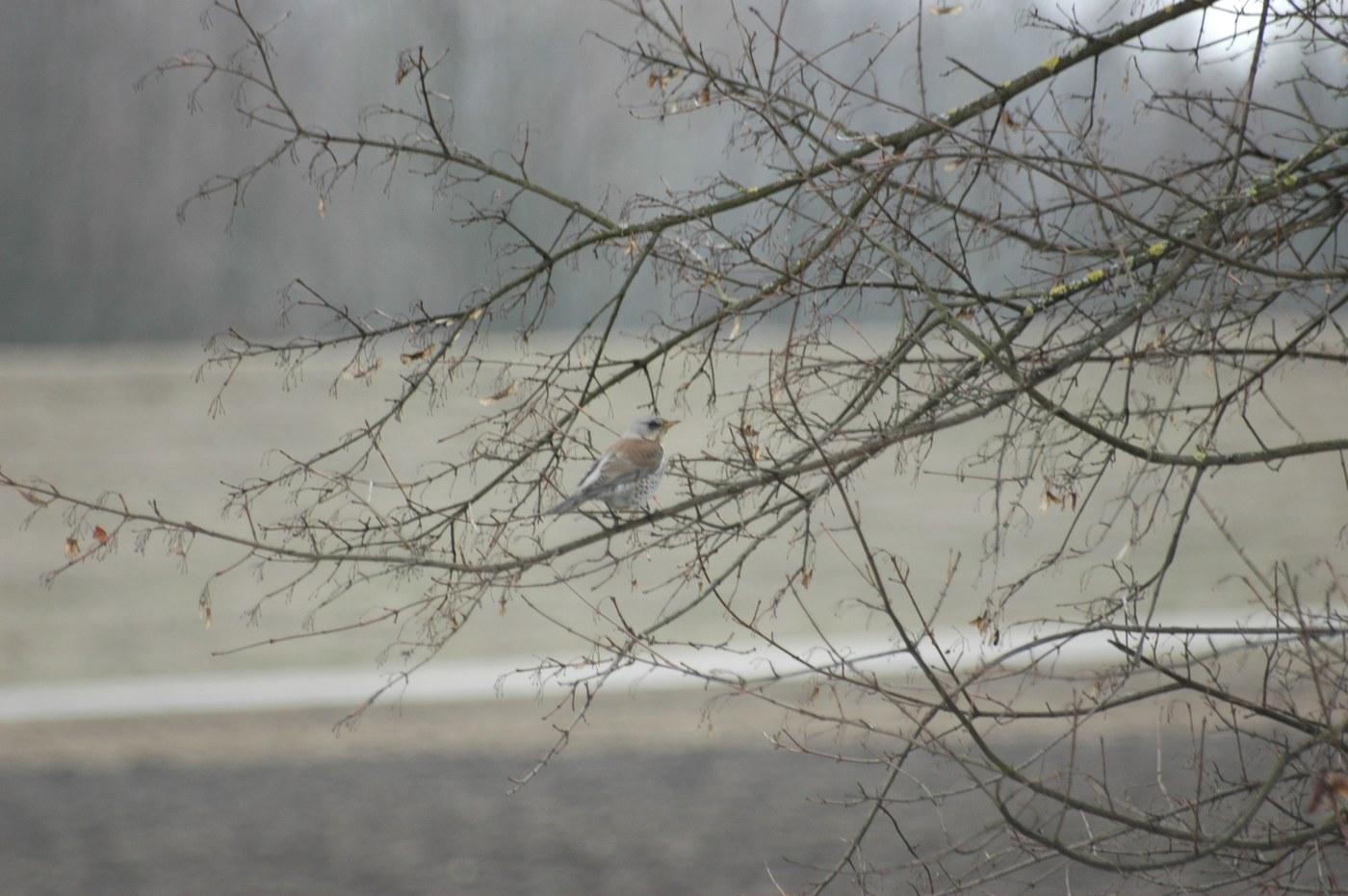
Key Field Marks
- Size & shape: A large thrush (about 25 cm), bulkier and longer-tailed than a European Robin, with an upright, alert stance.
- Head & rump: Blue-gray head and rump contrast strongly with a warm chestnut-brown back — a key combination not shared by other common thrushes in its range.
- Underparts: Orange-buff breast heavily marked with bold blackish spotting, becoming whiter and more sparsely marked toward the belly and flanks.
- Tail: Blackish tail contrasts with the gray rump, especially visible in flight.
- Flight: Flies with a distinctive undulating pattern typical of thrushes, often in loose flocks, showing pale grayish underwings.
Behavior
Highly social and often noisy, moving and feeding in flocks — sometimes large ones — especially in fall and winter, frequently associating with Redwings. Feeds on the ground in open fields and pastures for invertebrates, switching to berries (hawthorn, rowan) heavily in autumn and winter.
Similar Species
- Mistle Thrush: Larger and paler overall, lacks the gray head/chestnut back contrast, and has a plainer grayish-brown back with rounder breast spots.
- Song Thrush: Smaller, warm brown overall without the gray head and chestnut back, and has smaller, more uniformly distributed breast spotting.
- Redwing: Smaller, with a bold pale supercilium (eyebrow) and rusty-red flanks/underwing, quite different from the Fieldfare's gray-and-chestnut pattern, though the two species often flock together.
Where & When to Find One
Breeds across northern and eastern Europe and Asia in open woodland, scrub, and forest edge, often nesting semi-colonially. A strongly migratory and irruptive species in much of its range, it moves south and west in huge numbers for winter, becoming a familiar sight in farmland, hedgerows, orchards, and parks across much of central and western Europe (including Britain, where it is mainly a winter visitor) from October through March, often in large mixed-species flocks with Redwings feasting on berry-laden hedges or probing open pasture. Vagrant records occur well outside the normal range, including occasional sightings in North America.
Voice
A harsh, chattering "chack-chack-chack" flight call is very distinctive and often the first indication of an approaching or overhead flock; the song is a fairly quiet, unremarkable warbling mix of chuckles and whistles, seldom heard outside the breeding range.
Frequently asked questions
What color pattern best identifies a Fieldfare?
A gray head and rump contrasting with a chestnut-brown back and a boldly spotted orange-buff breast is the diagnostic combination for this large thrush.
How do I tell a Fieldfare from a Mistle Thrush?
Fieldfare shows a clear gray head and rump against a chestnut back, while Mistle Thrush is more uniformly pale grayish-brown without that contrasting head/back pattern and is noticeably larger.
What call helps identify a Fieldfare in flight?
A harsh, chattering "chack-chack-chack" given repeatedly in flight is very characteristic and often heard before the birds are seen, especially from flocks moving overhead in winter.
When and where are Fieldfares most likely to be seen in Britain and western Europe?
They arrive as winter visitors from about October to March, feeding in flocks on farmland, hedgerows, and berry bushes, often alongside Redwings, having bred farther north and east in Europe and Asia.
Do Fieldfares occur in North America?
They are not a regular North American species but have been recorded as rare vagrants, so any Fieldfare sighting there is notable and worth careful documentation.