
Ferruginous Pygmy-Owl Identification Guide
A tiny, fierce-looking desert and thornscrub owl known for its long, streaked tail, false "eyespots" on the nape, and habit of hunting by day.
Read the full Ferruginous Pygmy-Owl encyclopedia entry →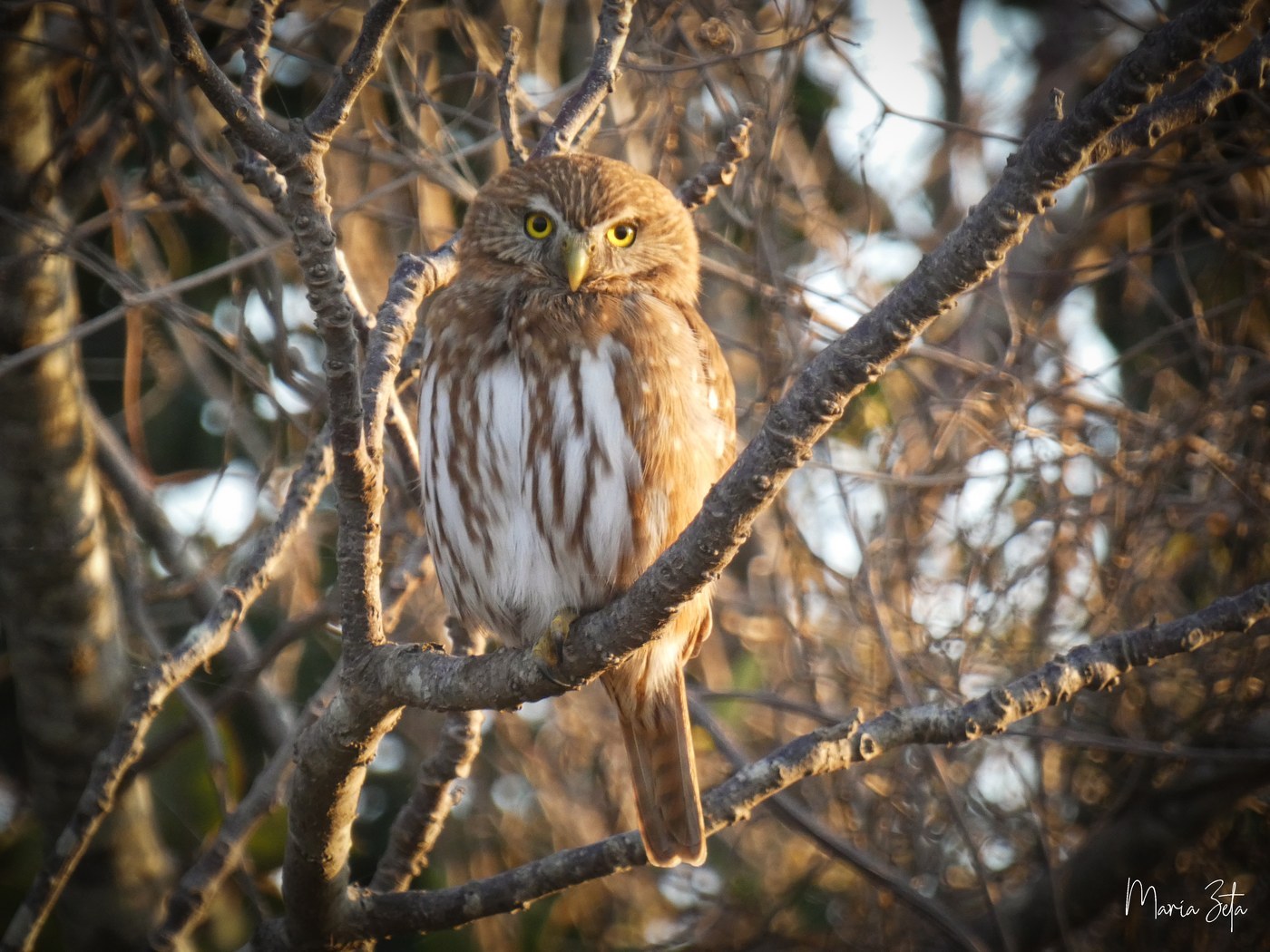
Key Field Marks
- Size: Very small, sparrow- to robin-sized (about 17 cm), one of the smallest owls in its range, with a rounded head lacking ear tufts.
- Tail: Relatively long for such a small owl, often cocked at an angle and flicked or pumped side to side — a useful behavioral cue.
- Nape spots: Two black "false eyes" (occipital spots) on the back of the head mimic a face, an anti-predator adaptation shared with several pygmy-owls.
- Plumage: Reddish-brown (rufous/ferruginous) to grayish-brown above with fine white streaking on the crown, and bold rufous streaking on a whitish breast and belly; overall coloration is variable but the rufous tones give the species its name.
- Eyes & bill: Piercing yellow eyes and a small yellowish bill, giving an intense, hawk-like facial expression despite the tiny size.
Behavior
Unlike most owls, it is largely diurnal and crepuscular, hunting actively in daylight for large insects, lizards, small birds, and rodents — small songbirds often mob it aggressively when found, which is frequently how birders locate one.
Similar Species
- Northern Pygmy-Owl: Very similar overall shape and nape spots, but ranges mostly do not overlap (Northern is a bird of higher-elevation forests farther north/west); Northern tends to be grayer/browner rather than as rufous, and has a different call.
- Elf Owl: Smaller still, lacks the long, actively pumped tail and rufous streaking, and is strictly nocturnal with different habitat (saguaro cactus and desert edges) and voice.
- Screech-owls: Larger, have visible ear tufts, and are strictly nocturnal, easily separated by size and lack of ear tufts on the pygmy-owl.
Where & When to Find One
In the U.S., found locally in southern Arizona (notably around Tucson) and the extreme lower Rio Grande Valley of Texas, in desert thornscrub, mesquite woodland, and riparian corridors; more widespread from Mexico south through Central and much of South America in similar arid scrub and woodland edge habitats. A year-round resident where present, so it can be looked for in any season, though early morning activity and mobbing songbird flocks are the best clues.
Voice
Song is a monotonous series of short, evenly spaced, hollow "poop-poop-poop..." or "took-took-took..." notes, repeated for long stretches, often given from an exposed perch in daylight — quite different from the softer toots of many other small owls.
Frequently asked questions
How can you tell a Ferruginous Pygmy-Owl is nearby without seeing it?
Listen for small songbirds mobbing and scolding loudly at a fixed point in a tree or shrub — this frequently reveals a roosting or perched pygmy-owl below the commotion.
What is the best way to distinguish it from a Northern Pygmy-Owl?
Range is the most reliable clue since the two barely overlap; where ranges are close, Ferruginous Pygmy-Owl tends to show more rufous tones and a slightly different, faster-paced tooting call than Northern Pygmy-Owl.
Why does the owl have spots on the back of its head?
The two dark occipital spots mimic a pair of eyes, which can startle or confuse potential predators approaching from behind and is a feature shared by other pygmy-owl species.
Is the Ferruginous Pygmy-Owl active at night or during the day?
It is unusually diurnal and crepuscular for an owl, hunting actively in daylight, which makes daytime sightings more likely than with most other owl species.
Where in the United States can this owl be found?
It occurs locally in desert thornscrub and riparian woodland of southern Arizona and the lower Rio Grande Valley of southern Texas, at the northern edge of a range that extends south through Latin America.