
Evening Grosbeak Identification Guide
A stocky, big-billed northern finch identified by its massive pale bill, bold black-and-yellow wing pattern, and irruptive flocking behavior at feeders.
Read the full Evening Grosbeak encyclopedia entry →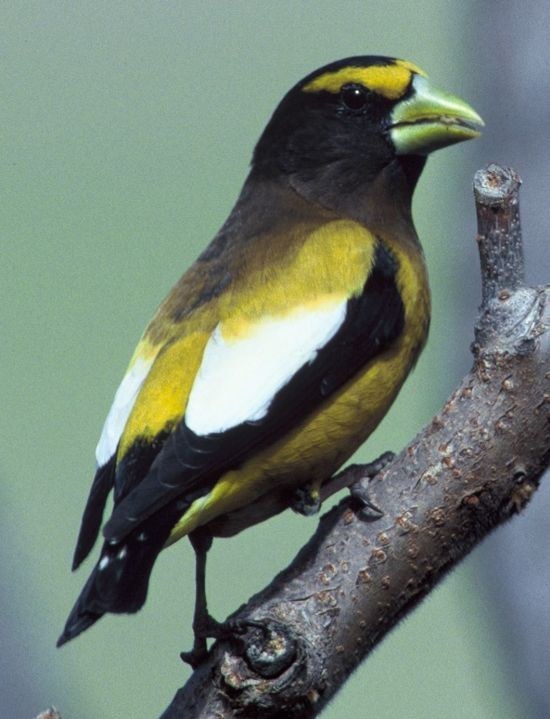
Key Field Marks
- Size & shape: A large, chunky finch (18–22 cm) with a short tail, big head, and a huge, conical bill that looks almost too big for the head.
- Bill: The single best field mark — thick, pale ivory-to-greenish-yellow (brighter in breeding males), unlike any similar-sized finch.
- Male plumage: Dark brown head with a bright yellow forehead and eyebrow stripe, brownish-olive body shading to yellow on the belly and rump, and bold white patches on the black wings that flash conspicuously in flight.
- Female/immature plumage: Overall silvery-gray with yellow wash on the neck and flanks, black-and-white wings, and a greenish-yellow bill; much subtler than the male but still shows the oversized bill and white wing markings.
- Flight: Flies in tight, undulating flocks; short tail and bull-necked silhouette are distinctive.
Behavior
Highly social outside the breeding season, often appearing in noisy flocks at sunflower-seed feeders, especially during irruption years. Feeds heavily on tree seeds (maple, ash, box elder) and buds, cracking hard seeds with its powerful bill.
Similar Species
- Pine Grosbeak: Larger and longer-tailed with a smaller, more curved black bill; males are rosy-red rather than yellow-and-black.
- American Goldfinch: Much smaller and slimmer with a tiny pink bill; lacks the Evening Grosbeak's bulk and huge pale bill.
- Female Purple/House Finch: Smaller, streaky, and lack the massive pale bill and white wing patches.
Where & When to Find One
Breeds in coniferous and mixed boreal forests across Canada, the northern U.S., and mountainous parts of the West. In winter it is a classic "irruptive" species — some years large numbers push south into the northern and central U.S. in search of tree seed crops, while other winters they stay largely in the north. Watch sunflower feeders in rural and wooded suburban areas during irruption winters (roughly November–March), and listen for flocks passing overhead.
Voice
- Common call is a short, ringing "clee-ip" or "peer", often given by flying flocks and audible well before the birds are seen.
- Song is infrequent and unremarkable, a short warbling series rarely heard away from breeding grounds.
Frequently asked questions
What is the easiest way to identify an Evening Grosbeak?
Look for a stocky finch with an oversized, pale ivory-green bill and bold white wing patches. No other North American finch combines that bill size with black-and-white wings.
How can I tell a male from a female Evening Grosbeak?
Males have a dark brown head with a bright yellow eyebrow and forehead and a yellow-olive body; females are mostly silvery-gray with only a light yellow wash and less contrasting wing pattern.
Why do Evening Grosbeaks sometimes disappear for years?
They are irruptive migrants whose winter movements track boreal tree seed crops; in years of poor seed production up north they wander south in large numbers, while in good seed years they may stay put.
Do Evening Grosbeaks come to bird feeders?
Yes, they are famous for descending on feeders in large, noisy flocks, especially platform or hopper feeders stocked with black-oil sunflower seed, during irruption winters.
What call should I listen for to detect a flock overhead?
A sharp, ringing "clee-ip" or "peer" note is given frequently in flight and is often the first clue a flock is passing before you spot them visually.