
Eurasian Wryneck Identification Guide
A cryptically patterned, bark-camouflaged relative of woodpeckers, best known for its snake-like neck-twisting display and its far-carrying, repetitive nasal call.
Read the full Eurasian Wryneck encyclopedia entry →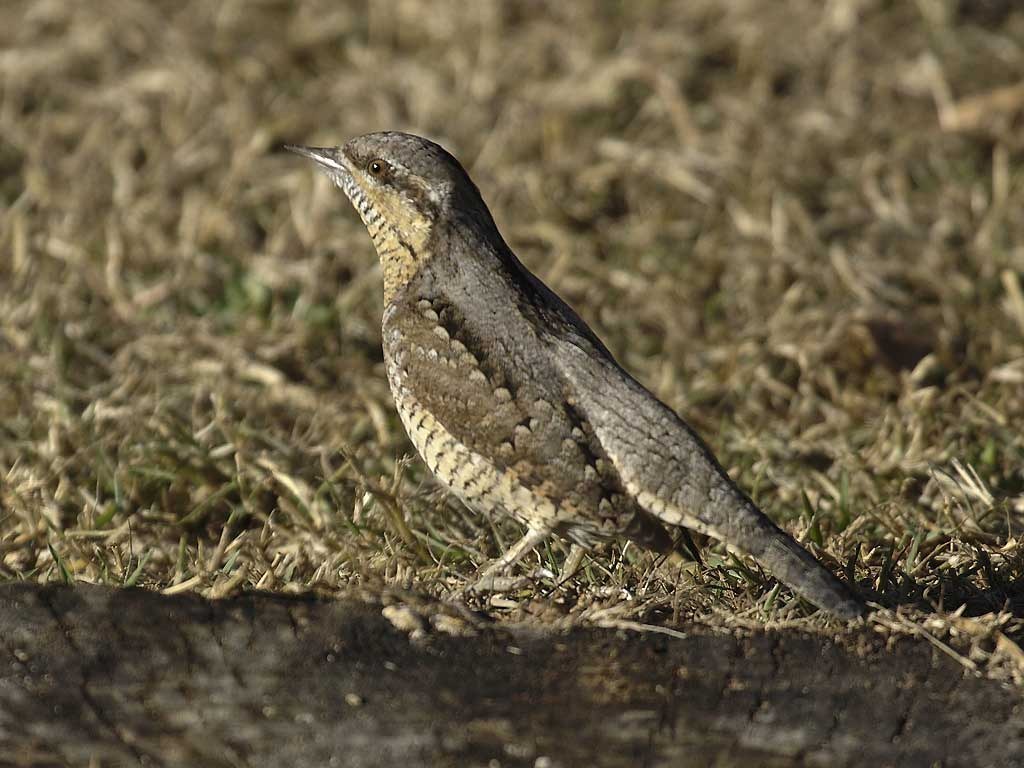
Key Field Marks
- Size & shape: A medium-small, slender bird about 16-17 cm long, superficially more like a large, long-tailed songbird than a typical woodpecker, with a fairly long tail (unlike most woodpeckers, not used as a prop) and a slim, pointed but relatively short, sharply pointed bill (not chisel-shaped like true woodpeckers).
- Plumage: Intricately patterned in grays, browns, and buffs resembling tree bark and dead leaves — a complex mix of vermiculations, streaks, and blotches provides exceptional camouflage when perched motionless against bark.
- Head pattern: A dark stripe runs from the crown down the back of the neck, bordered by paler tones, plus a dark line through the eye; overall the head lacks any bold, simple pattern, blending into the cryptic body plumage.
- Underparts: Pale buffy with fine dark barring and speckling across the breast and flanks.
- Behavior: Unlike true woodpeckers, rarely climbs trunks vertically or excavates wood; instead perches more horizontally on branches, often feeds on the ground (a specialist on ants, using its long sticky tongue to probe ant nests), and famously twists and contorts its head and neck in a slow, snake-like fashion when threatened at the nest hole — the source of both its common name and genus name (Jynx).
Separating It From Similar Species
- Nightjar: Superficially similar cryptic bark-like camouflage, but Nightjar is larger, flatter-headed, has a much wider gape and tiny bill, and is strictly nocturnal with a very different reeling call; Wryneck is diurnal and has a long, pointed (not tiny, wide) bill.
- True woodpeckers (e.g., Great Spotted Woodpecker): All show bold black-and-white or otherwise strongly patterned plumage, stiff props tails used for climbing, and chisel-shaped bills for excavating wood — Wryneck's cryptic bark-pattern plumage, non-propping tail, and more horizontal perching posture are quite different.
- Female/young thrushes or larks on the ground: When feeding on ants on open ground, a Wryneck's cryptic pattern can suggest a lark or pipit at a glance, but its longer tail, woodpecker-relative shape, and distinctive slow, deliberate movements (plus the diagnostic head/neck-twisting if disturbed) confirm the identification.
- Voice as the clincher: The far-carrying, repetitive nasal call is highly distinctive and rules out confusion with any similarly plumaged species once heard.
Where & When to See It
- Habitat: Open woodland, orchards, parkland, and scrubby habitats with short grass or bare ground nearby for ant-hunting; favors warm, dry, open habitats more than dense closed-canopy forest.
- Range: Breeds across much of Europe (though declining and now scarce or extinct in parts of the northwest, including much of Britain) eastward through temperate Asia; a long-distance migrant, wintering mainly in sub-Saharan Africa and South/Southeast Asia.
- Season: A summer migrant across most of its European breeding range, arriving in April-May and departing by September; in areas like Britain now mainly seen as a scarce passage migrant in spring and especially autumn.
Voice & Song Cues
- The song/call is a loud, nasal, far-carrying series of repeated notes, often rendered as "quee-quee-quee-quee" or "kweek-kweek-kweek," somewhat reminiscent of a small falcon (such as a Kestrel) or a Green Woodpecker's yaffle but more nasal and insistent, delivered in a steady, unhurried rhythm.
- Given from a perch, often before leaves fully emerge in spring, making it audible over long distances in open woodland.
- Because the bird's cryptic plumage makes visual detection difficult, its distinctive far-carrying call is frequently the best way to confirm its presence on breeding or migration sites.
Frequently asked questions
Why is the Eurasian Wryneck called a 'wryneck'?
It gets its name from its habit of slowly twisting and contorting its head and neck in a snake-like fashion as a threat display when disturbed at the nest hole.
Is the Eurasian Wryneck a true woodpecker?
It belongs to the woodpecker family (Picidae) but behaves quite differently — it does not excavate wood, rarely climbs trunks vertically, and instead feeds mainly on ants on the ground using a long, sticky tongue.
How can I detect a Eurasian Wryneck if it's so well camouflaged?
Voice is usually the best clue — listen for its loud, nasal, repetitive 'quee-quee-quee' call, which carries a long way and is given from a perch, especially in early spring.
Where does the Eurasian Wryneck spend the winter?
Most European breeding populations migrate to sub-Saharan Africa for the winter, while some Asian populations winter in South and Southeast Asia.
What habitat should I search for a Eurasian Wryneck?
Open woodland, orchards, and parkland with areas of short grass or bare ground nearby, since it hunts ants on the ground rather than foraging deep in dense forest.