
Eurasian Wigeon Identification Guide
A medium-sized dabbling duck with a rounded head, short bill, and a whistling call, males showing a striking chestnut head with a cream forehead stripe.
Read the full Eurasian Wigeon encyclopedia entry →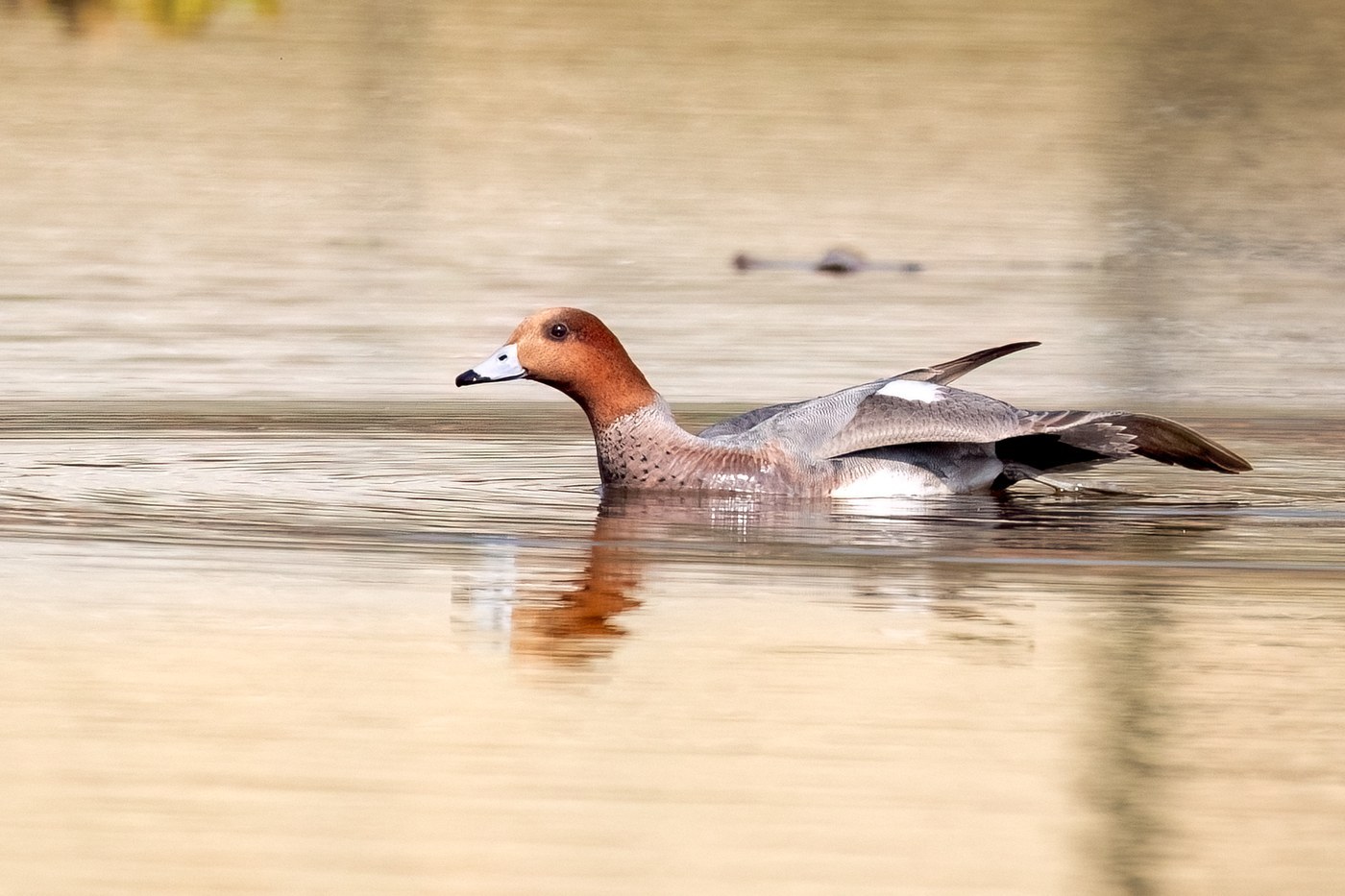
Key Field Marks
- Size & shape: A medium-sized duck about 45-51 cm long, with a rounded head, short neck, and notably short, stubby, blue-gray bill with a black tip — a compact, front-heavy profile compared to many dabbling ducks.
- Male (breeding) plumage: A rich chestnut head with a bold creamy-yellow stripe running from the forehead to the crown, a pinkish-gray breast, finely vermiculated gray flanks, a black rear end, and a white belly; in flight shows a large white patch on the upperwing (forewing) that flashes conspicuously.
- Female plumage: Mottled warm rufous-brown to grayer brown overall (there are rufous and gray morphs), with a plain head lacking strong pattern, a short dark bill, and a pale belly; in flight shows a pale gray-brown forewing (lacking the male's bold white patch) but a similar green speculum bordered with black and white.
- In flight: Pointed wings, fast flight, and (in males) the bright white wing patch are diagnostic; both sexes show a whitish belly contrasting with darker flanks.
- Behavior: Often grazes on land or in shallow water on grasses and aquatic vegetation, sometimes tipping up but frequently grazing like a goose on grassy margins and fields near water — unusual among dabbling ducks.
Separating It From Similar Species
- American Wigeon: Male American Wigeon has a green (not chestnut) head patch and a whiter crown stripe with a grayer face, while female American Wigeon has a grayer head contrasting with a browner body (vs. the more uniformly colored female Eurasian Wigeon); hybrids and intermediate birds occur and require careful assessment of head color and pattern.
- Gadwall: Male Gadwall is grayer overall with a black rear end but lacks the chestnut head and cream stripe, and shows a white speculum patch rather than wigeon's white forewing coverts.
- Female dabbling ducks in general: Female Eurasian Wigeon's small bill, rounded head, and plain face help distinguish it from female Mallard (larger, longer bill, more patterned face) and female Gadwall (squarer head, white speculum visible at rest as a white square on the folded wing).
- Flight silhouette: Pointed wings and fast, agile flight in tight flocks, often with white belly flashing, plus the male's bright white forewing patch, make wigeon distinctive at range.
Where & When to See It
- Habitat: Breeds on freshwater lakes, marshes, and slow rivers with nearby grassland or tundra edge in the far north; winters on estuaries, coastal grasslands, floodplains, reservoirs, and lakes, often grazing on adjacent grass fields in large flocks.
- Range: Breeds across northern Europe and Asia (boreal and subarctic zones); winters much further south across Western and Southern Europe, the Mediterranean, the Middle East, and South and East Asia.
- Season: A winter visitor to most of temperate Europe, arriving from September/October and departing by April; breeds in the far north from May through summer.
Voice & Song Cues
- The male's call is highly distinctive — a loud, clear, whistled "wheeoo" or "whee-oo," often given repeatedly by flocks and audible from a considerable distance, especially over wintering grounds at dusk.
- Females give a lower, growling "errr" or purring note, quite different from the male's whistle.
- The male's whistle is one of the most recognizable duck calls in Europe and is often the first clue to a wigeon flock's presence before the birds are seen.
Frequently asked questions
What is the most distinctive feature of a male Eurasian Wigeon?
A rich chestnut head with a bold creamy-yellow stripe running from the forehead to the crown, combined with a loud, clear whistled 'wheeoo' call.
How do I tell Eurasian Wigeon from American Wigeon?
Male American Wigeon has a green (not chestnut) head patch with a grayer face, while female American Wigeon shows a grayer head contrasting against a browner body, unlike the more uniform female Eurasian Wigeon.
Why do Eurasian Wigeon graze on land more than other ducks?
They are unusually goose-like among dabbling ducks, frequently grazing on grasses in fields and coastal grassland near water rather than relying solely on tipping-up or dabbling in water.
When can Eurasian Wigeon be seen in temperate Europe?
Mainly as a winter visitor from September/October through April; the species breeds much further north in the boreal and subarctic zones during summer.
What does a Eurasian Wigeon sound like?
Males give a distinctive loud, clear whistled 'wheeoo,' while females give a lower, growling or purring note — the male's whistle is often heard before the birds are seen.