
Eurasian Spoonbill Identification Guide
A large, all-white wading bird instantly recognizable by its long, flattened, spoon-shaped bill, which it sweeps side to side through shallow water to feed.
Read the full Eurasian Spoonbill encyclopedia entry →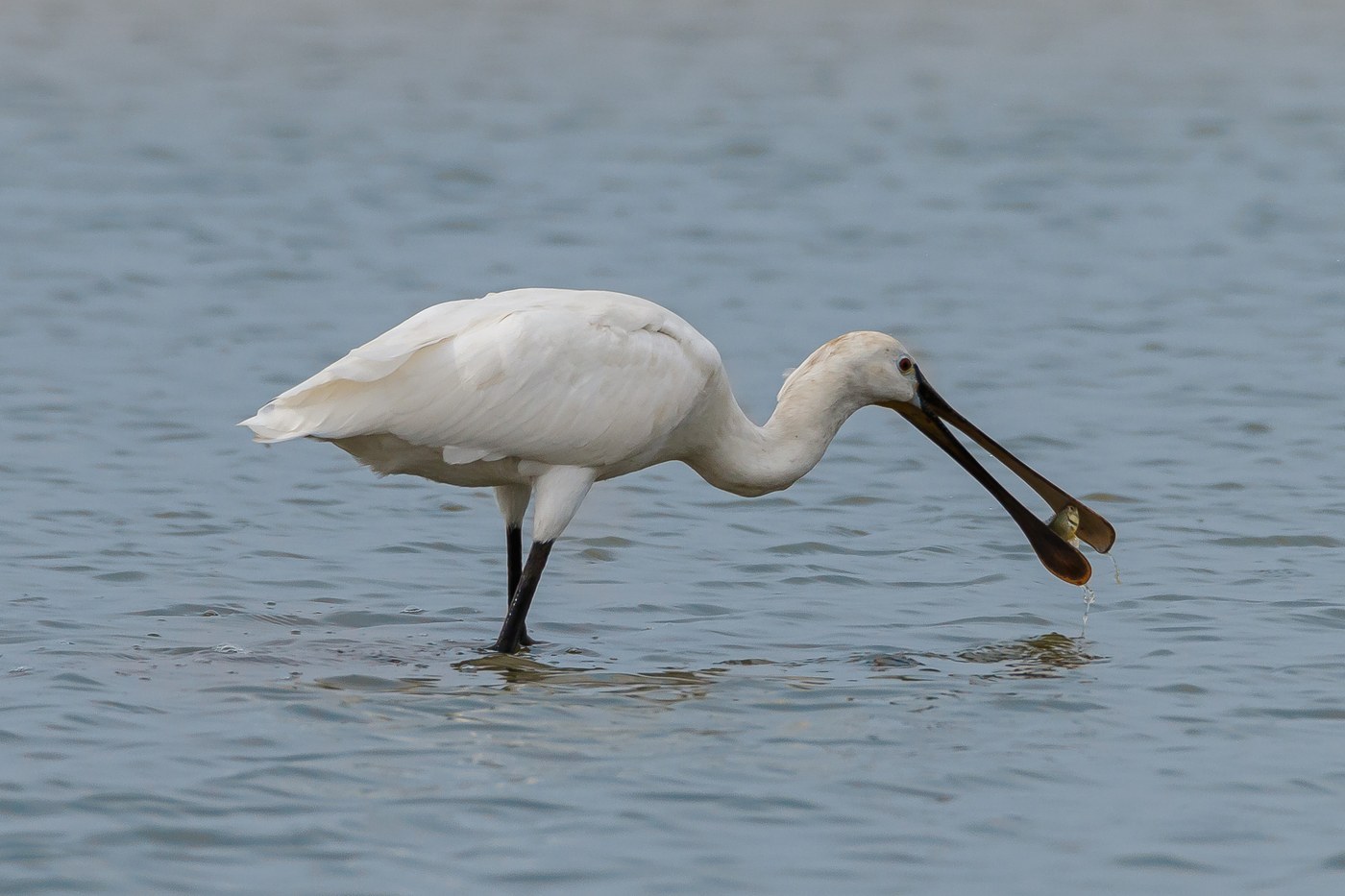
Key Field Marks
- Size & shape: A large wading bird, about 80-93 cm long with a wingspan up to 120-135 cm, standing tall on long legs with a long neck typically held straight (not kinked like a heron's) in flight and at rest.
- Bill: The defining feature — long, black, and flattened with a distinctive spoon- or spatula-shaped tip, often tipped yellow in adults; held slightly open and swept side to side through shallow water while feeding.
- Plumage: Entirely white in adults, with a shaggy, drooping crest at the back of the head during the breeding season and a buffy-yellow wash on the breast ("breast bib") in breeding plumage.
- Legs: Long, black, and trailing well beyond the tail in flight.
- Bare skin: Adults show a patch of bare yellow-and-black skin around the eye and throat, more developed in breeding season.
- Behavior: Feeds by wading through shallow water while sweeping its open bill from side to side to detect prey by touch; often forages in loose groups; flies with neck outstretched (unlike herons) and with slow, steady wingbeats interspersed with glides, sometimes in V-formation or lines.
Separating It From Similar Species
- Great Egret / Little Egret: Both are all-white waders but have straight, pointed (not spoon-shaped) bills and fly with the neck retracted in an S-curve, unlike the straight-necked flight of Spoonbill.
- White Stork: Larger, with a long straight pointed red bill (not spatulate) and red legs, and also flies with the neck extended, but the bill shape alone rules out confusion.
- Juvenile Spoonbill: Shows black wingtips and a pinkish (not black) bill that is less developed in shape, which can suggest an egret at a distance — but the spatulate bill tip, even if pink, is still diagnostic on close view.
- Flight silhouette: The combination of an outstretched neck, trailing legs, and a distinctly flattened, spoon-tipped bill separates Spoonbill from every heron, egret, or stork it might be confused with.
Where & When to See It
- Habitat: Shallow freshwater and brackish wetlands, lagoons, estuaries, and marshes with reed beds or low trees/shrubs for nesting, often in mixed colonies with herons and egrets.
- Range: Breeds locally and patchily across parts of Western Europe (notably the Netherlands, France, Spain), the Mediterranean, and eastward through parts of Asia; European breeders winter mainly in West Africa (particularly Mauritania and Senegal) and around the Mediterranean, while some Asian populations are more sedentary.
- Season: Migratory populations arrive at European breeding sites in spring (March-April) and depart in autumn (September-October); resident and wintering birds can be found in milder coastal wetlands year-round in parts of southern Europe.
Voice & Song Cues
- Generally a quiet bird away from the colony; at breeding colonies gives various low grunting, croaking, and clattering bill-snapping sounds during displays.
- Bill-clattering (rattling the mandibles together) is used in courtship and greeting displays at the nest, similar to storks.
- Away from colonies, Spoonbills are typically silent, so identification relies almost entirely on the distinctive bill shape, feeding behavior, and flight posture rather than voice.
Frequently asked questions
What is the single best field mark for a Eurasian Spoonbill?
The long, black, flattened bill with a spoon- or spatula-shaped tip, which it sweeps side to side through shallow water — no other European wading bird has this bill shape.
How does a Eurasian Spoonbill fly differently from a heron or egret?
It flies with its neck fully outstretched, while herons and egrets retract their necks into an S-shape in flight.
Can juvenile Eurasian Spoonbills be confused with egrets?
At a distance, yes, since juveniles have a pinker, less developed bill and black wingtips, but the spatulate bill tip and straight-neck flight posture still confirm the identification on a closer look.
Where is the best place to see Eurasian Spoonbills in Europe?
Shallow wetlands and lagoons in the Netherlands, France, Spain, and the Mediterranean basin host the main European breeding colonies, often alongside herons and egrets.
Do Eurasian Spoonbills migrate?
Many European breeding populations are migratory, wintering in West Africa or around the Mediterranean, while some southern and Asian populations are more sedentary.