
Eurasian Sparrowhawk Identification Guide
A compact, agile woodland raptor with short rounded wings and a long tail, notable for dramatic size differences between the small male and much larger female.
Read the full Eurasian Sparrowhawk encyclopedia entry →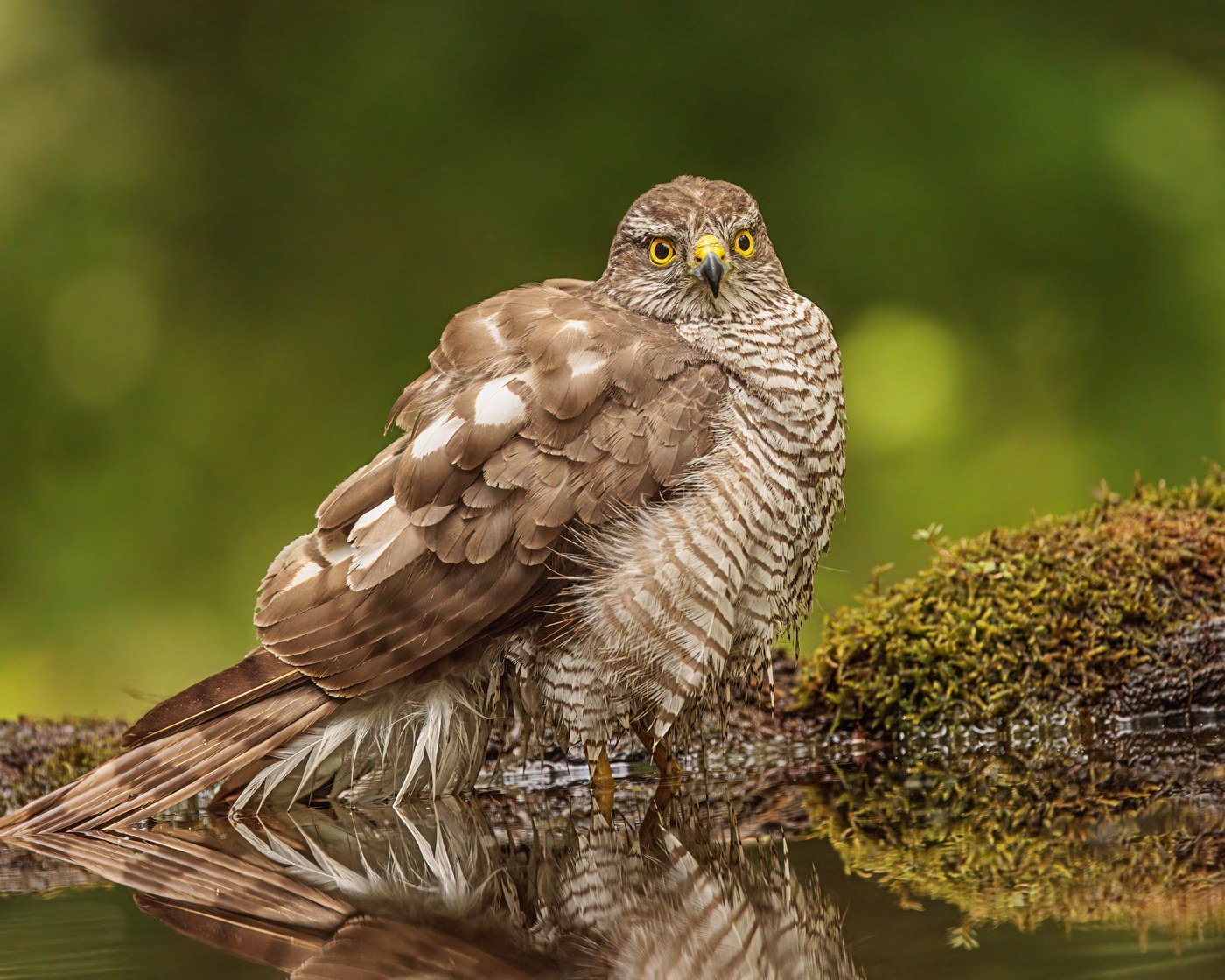
Key Field Marks
- Size & shape: A small to medium accipiter with short, rounded wings and a long, square-tipped tail, built for fast, agile flight through trees. Marked sexual size dimorphism: males are only about 28-32 cm long (jay-sized), while females are notably larger at 35-41 cm (approaching a small buzzard in bulk).
- Male plumage: Slate-blue-gray above with fine orange-rufous barring on the underparts and rufous cheeks.
- Female plumage: Browner-gray above (less blue than the male) with coarser gray-brown barring below and lacking the rufous cheek tone; noticeably bulkier and broader-winged than the male.
- Eyes: Yellow to orange (males often more orange-red with age), giving an intense stare.
- Legs: Long, thin, yellow legs with sharp talons, adapted for snatching small birds.
- Flight: Characteristic "flap-flap-glide" flight low over hedgerows and through woodland, followed by fast, low, surprise attacks on small birds; soars on flat or slightly raised wings with the tail fanned when gaining height.
Separating It From Similar Species
- Northern Goshawk: Considerably larger and bulkier (female Sparrowhawk can approach a small male Goshawk in size, causing confusion), with a more powerful chest, longer-looking head projection, more heavily barred undertail coverts that can bulge past the tail sides, and a bold white supercilium; Goshawk's flight is more powerful with slower, stiffer wingbeats and longer glides.
- Common Kestrel: Longer, more pointed wings and habitual hovering flight immediately separate it from the accipiter shape and flap-glide flight of Sparrowhawk.
- Common Buzzard: Much broader, rounder wings held in a shallow V while soaring, a shorter tail, and a heavier, less agile flight style, contrasting with Sparrowhawk's narrow tail and rapid low flight.
- Male vs Female size confusion: Because male Sparrowhawks are so much smaller than females, an isolated male can suggest a different species entirely — always weigh shape and flight style (short rounded wings, long tail, flap-flap-glide) over size alone.
Where & When to See It
- Habitat: Breeds in woodland (both coniferous and broadleaf) with nearby open ground for hunting; increasingly common in suburban gardens and parks, especially where songbirds gather at feeders.
- Range: Widespread resident across most of Europe and temperate Asia; northern and eastern populations are more migratory, moving south in winter, while western and southern populations are largely sedentary.
- Season: Present year-round through most of its range; garden and feeder sightings often increase in autumn and winter when birds hunt more visibly around concentrations of small birds.
Voice & Song Cues
- Generally silent away from the nest; near the breeding site gives a rapid, chattering "kek-kek-kek-kek" alarm call, sharper and higher-pitched than the similar call of Goshawk.
- Females may give a softer, whining begging call to the male during courtship feeding.
- Vocalizations are rarely the primary identification tool for this species — flight shape and hunting behavior (surprise low-level attacks along hedgerows) are far more diagnostic.
Frequently asked questions
Why do male and female Eurasian Sparrowhawks look so different in size?
The species shows strong reversed sexual size dimorphism: females are considerably larger and bulkier than males, an adaptation that lets the pair hunt different prey sizes and reduce competition.
How do I tell a Eurasian Sparrowhawk from a Northern Goshawk?
Goshawk is notably bulkier with a more powerful chest, bold white supercilium, undertail coverts that can bulge past the tail, and slower, more powerful wingbeats; Sparrowhawk is slimmer with a proportionally longer, narrower tail and quicker flap-flap-glide flight.
What does a hunting Eurasian Sparrowhawk look like in flight?
It flies low and fast along hedgerows and woodland edges with a distinctive 'flap-flap-glide' pattern, using surprise and speed to ambush small birds.
Do Eurasian Sparrowhawks visit gardens?
Yes, they are increasingly common in suburban gardens and parks, often attracted by small birds gathering at feeders, especially in autumn and winter.
What call does a Eurasian Sparrowhawk make?
Near the nest it gives a rapid, chattering 'kek-kek-kek-kek' alarm call; otherwise it is usually silent, so flight shape and hunting style are more useful for identification than voice.