
Eurasian Hobby Identification Guide
A sleek, fast-flying falcon resembling a giant swift, identified by its long swept-back wings, dark mustache marks, and reddish thighs, often seen hawking dragonflies and swallows at high speed.
Read the full Eurasian Hobby encyclopedia entry →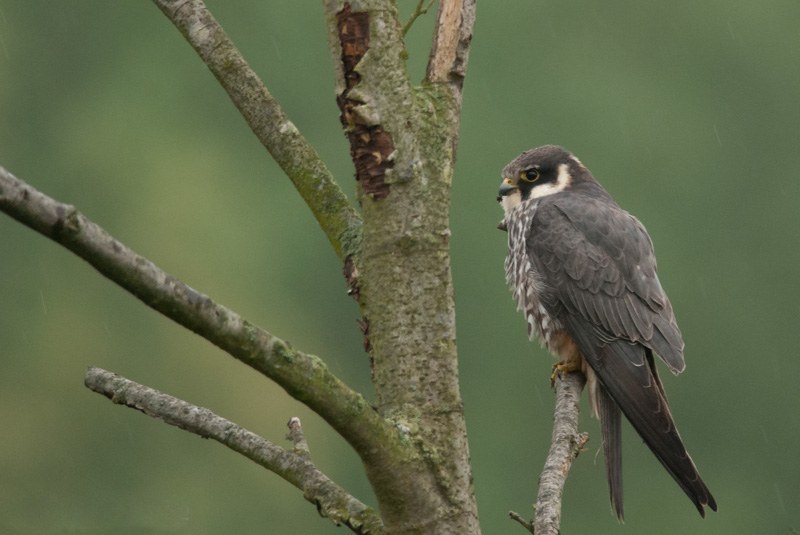
Key Field Marks
- Size & shape: A small, slim falcon (28–36 cm, wingspan 70–84 cm) with long, narrow, pointed, scythe-shaped wings and a relatively short tail — the overall silhouette closely resembles an oversized swift.
- Plumage: Slate-grey upperparts; heavily streaked blackish-on-white underparts; a bold black "mustache" stripe and dark hood contrast with a white throat and cheek patch.
- Distinctive mark: Bright rufous-red thighs and undertail coverts, a key mark visible at moderate range and useful for separating it from other similar falcons.
- Flight: Extremely fast, agile, and acrobatic, with rapid, powerful wingbeats interspersed with glides; frequently hunts on the wing, chasing down dragonflies, swifts, swallows, and other small birds in flight.
- Behavior: Often hunts over water, wetlands, or open country at dusk where flying insects concentrate; highly aerial, rarely seen perched for long compared to other falcons.
Similar Species
- Eurasian Kestrel: Broader-winged and longer-tailed with a more languid flight and frequent hovering; lacks the Hobby's swift-like scythe-winged shape and rufous thighs.
- Peregrine Falcon: Much bulkier and heavier with broader-based wings and a barred (not solid rufous) belly/thigh area; Hobby is noticeably smaller and slimmer with a more buoyant, agile flight.
- Common Swift: Similarly shaped in silhouette (long scythe wings) but entirely dark/blackish with a pale throat patch only, no streaking, mustache, or rufous thighs, and much smaller overall.
Where & When to Look
- Habitat: Open country with scattered trees, heathland, farmland edges, wetlands, and river valleys where flying insects and small birds are abundant; often seen hawking over lakes, gravel pits, or reedbeds at dusk.
- Range: Breeds across most of temperate Europe and Asia; a long-distance migrant wintering mainly in sub-Saharan Africa.
- Season: A summer visitor, typically arriving in late April or May (deliberately timed to coincide with peak insect and young-bird availability) and departing by September or early October.
Voice
- Call: A sharp, high, ringing "kew-kew-kew" or "kik-kik-kik" series, given mainly near the nest site or during territorial disputes; generally quiet away from breeding areas.
Frequently asked questions
How can I tell a Eurasian Hobby from a Common Swift?
Both have long scythe-shaped wings, but Hobby shows a streaked white underside, a dark mustache mark, and rufous thighs, while Swift is uniformly sooty-dark with only a pale throat patch.
What is the best field mark to separate Hobby from Kestrel?
Hobby has longer, narrower, more swept-back wings and a swift-like flight silhouette, plus rufous thighs, whereas Kestrel has broader wings, a longer tail, and habitually hovers, which Hobby rarely does.
What does a Eurasian Hobby eat and how does it hunt?
It catches flying insects like dragonflies and small birds such as swallows and swifts entirely on the wing, using extremely fast, agile aerial pursuit.
When is the best time to see a Eurasian Hobby?
During the breeding season from late spring through summer, especially at dusk over wetlands, lakes, or open country where insects are swarming.
Do Eurasian Hobbies migrate long distances?
Yes, they are long-distance migrants that winter in sub-Saharan Africa and return to Europe and Asia to breed each spring.