
Eurasian Eagle-Owl Identification Guide
One of the world's largest owls, recognized by its huge size, prominent ear tufts, and glowing orange eyes, most often detected at dusk by its deep, far-carrying hooting call.
Read the full Eurasian Eagle-Owl encyclopedia entry →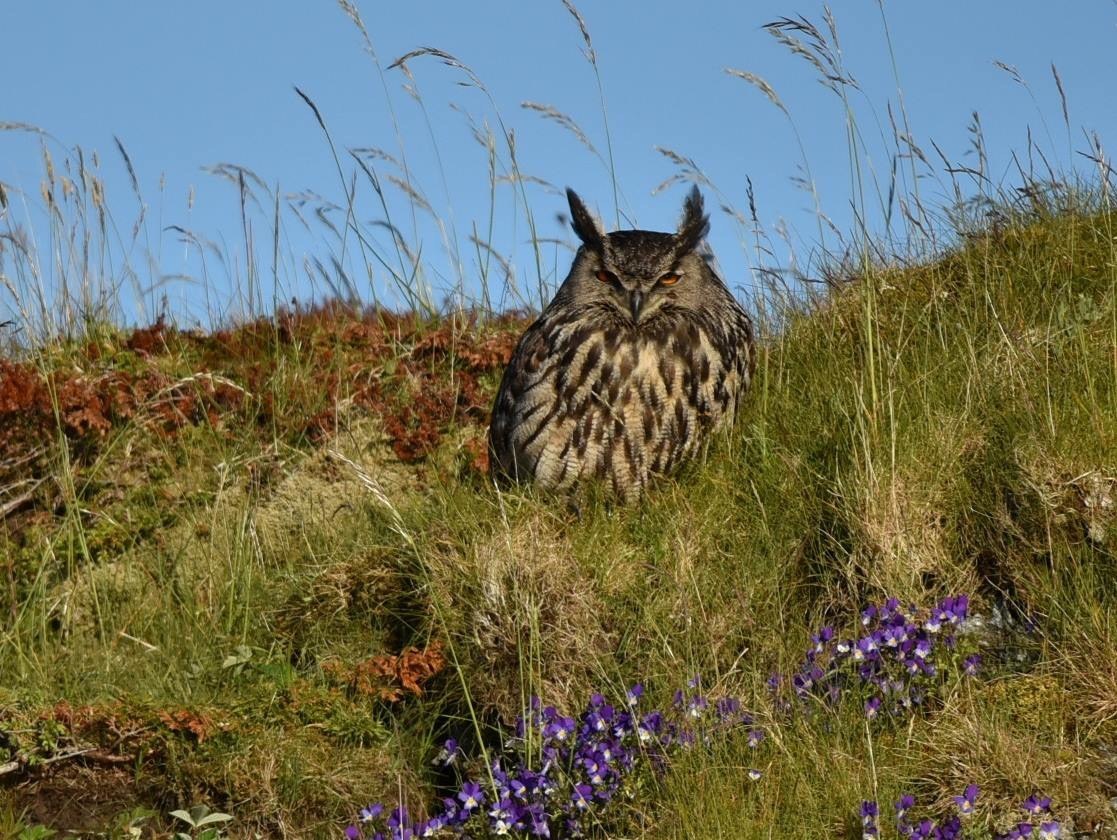
Key Field Marks
- Size & shape: A massive owl (58–75 cm, wingspan up to 1.9 m), among the largest owl species in the world, with a bulky, barrel-chested body and broad, rounded wings.
- Ear tufts: Long, prominent, closely-spaced ear tufts on top of the head, one of the most visible features when perched.
- Eyes: Strikingly large, bright orange eyes that stand out even at a distance or in low light.
- Plumage: Rich tawny-buff to dark brown overall, densely streaked and vermiculated (finely marked) with blackish-brown, giving an intricately patterned, mottled appearance; underparts are paler and streaked rather than barred.
- Behavior: Strictly nocturnal and crepuscular, roosting by day on cliff ledges, in quarries, or dense tree cover; a powerful predator taking prey up to the size of small deer fawns and other raptors; flight is deep, slow, and silent on broad wings.
Similar Species
- Long-eared Owl: Much smaller and slimmer, with closer-set, more vertically oriented ear tufts and orange (not as huge or glowing) eyes; body size difference alone usually separates the two.
- Snowy Owl: Mostly white or heavily white-based plumage with no ear tufts, entirely different coloration from the tawny-brown Eagle-Owl.
- Ural Owl / Great Grey Owl: Both lack ear tufts entirely and have rounded, tuft-less heads, immediately distinguishing them from the tufted Eagle-Owl.
Where & When to Look
- Habitat: Rocky terrain, cliffs, gorges, quarries, and forest edges near open country for hunting; increasingly found in a wide range of habitats including semi-desert, farmland, and even urban quarries in parts of its range.
- Range: Widespread but patchily distributed resident across much of Europe, North Africa, and temperate to central Asia; generally sedentary, with adults holding large territories year-round.
- Season: A year-round resident wherever it occurs; best located at dusk or dawn, or by day at known roost sites (cliff ledges, quarry faces, dense conifers) where it can sometimes be picked out roosting.
Voice
- Call: A deep, resonant, far-carrying two-note hoot, "oohu-hoo," often given at dusk from a prominent perch and audible over long distances, especially during the breeding season.
- Other sounds: Loud, harsh barking or shrieking alarm calls when disturbed near the nest, along with bill-snapping displays of aggression.
Frequently asked questions
How do I identify a Eurasian Eagle-Owl?
Look for its huge size, prominent ear tufts, glowing bright orange eyes, and richly mottled tawny-brown plumage; it is one of the largest owls in the world.
How does Eurasian Eagle-Owl differ from Long-eared Owl?
Eagle-Owl is far larger and bulkier with widely spaced, thicker ear tufts and much bigger orange eyes, while Long-eared Owl is slim, smaller, and has closer-set, narrower tufts.
Where do Eurasian Eagle-Owls nest?
They typically nest on cliff ledges, in quarries, or on the ground under overhangs, and are increasingly recorded nesting in old raptor nests in trees.
What does a Eurasian Eagle-Owl sound like?
Its territorial call is a deep, resonant two-note hoot, 'oohu-hoo', usually delivered at dusk and audible from a great distance.
Is the Eurasian Eagle-Owl active during the day?
No, it is primarily nocturnal and crepuscular, roosting hidden by day and hunting mainly from dusk through night.