
Eurasian Coot Identification Guide
An all-black waterbird with a bright white bill and frontal shield, easily identified swimming on open lakes and ponds with a jerky head-bobbing motion.
Read the full Eurasian Coot encyclopedia entry →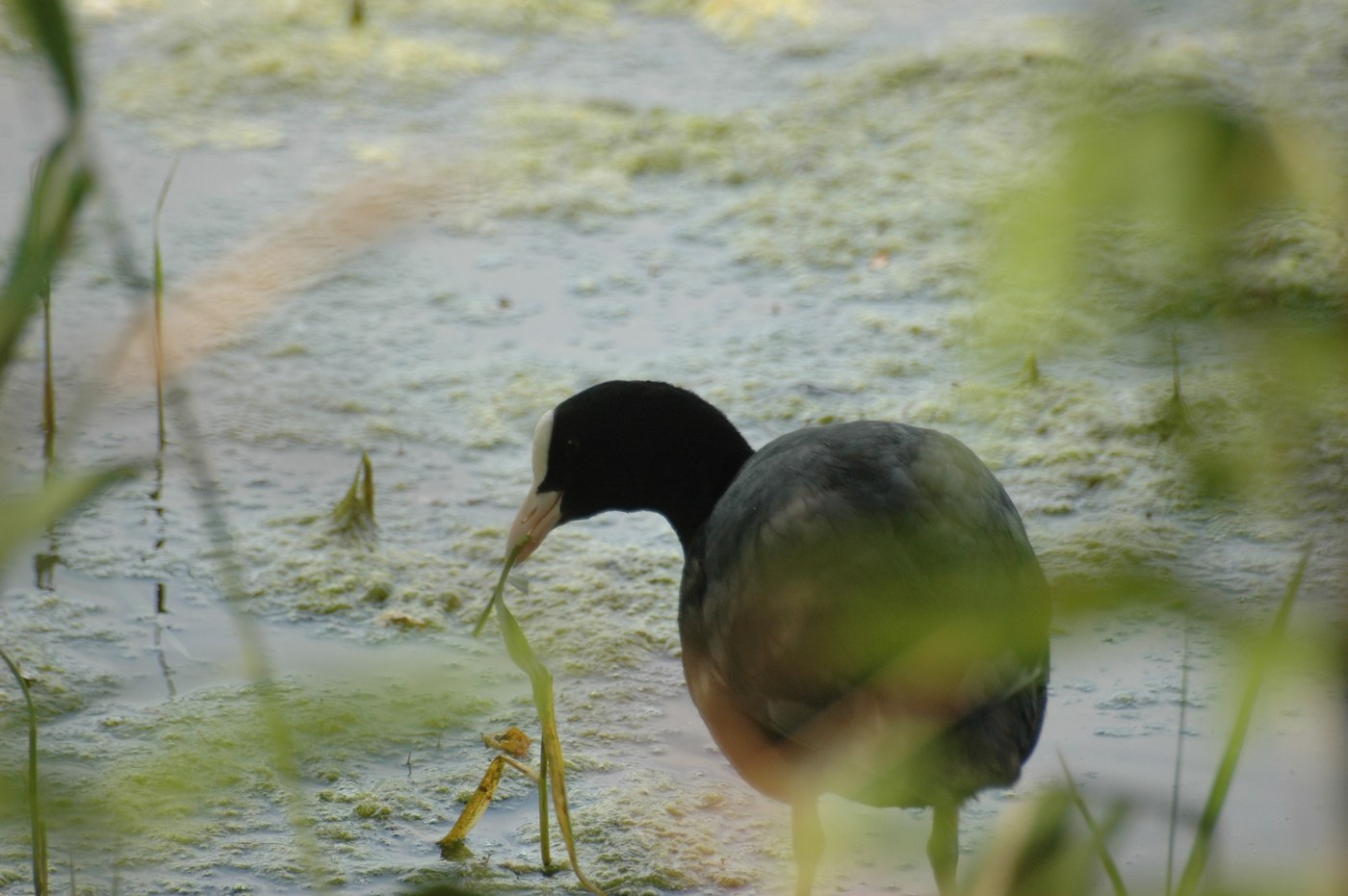
Key Field Marks
- Size & shape: A medium-sized, rounded waterbird (36–42 cm) with a rotund body, small head, and short tail, riding fairly high or low on the water depending on activity.
- Plumage: Uniformly sooty black to slate-grey overall, with no white anywhere on the body plumage itself.
- Bill & shield: The standout field mark is a pure white, conical bill continuing into a broad white frontal shield on the forehead — bright and conspicuous at any distance.
- Legs & feet: Greenish-grey legs with large, lobed (not webbed) toes, visible when the bird is out of the water or in flight.
- Eyes: Deep red iris, visible at close range.
- Behavior: Swims buoyantly with a characteristic forward head-jerking motion; dives frequently for aquatic vegetation, sometimes popping back up like a cork; aggressive and territorial, often chasing other coots or ducks; forms large rafts on open water outside the breeding season.
Similar Species
- Common Moorhen (Gallinule): Smaller and slimmer, with a red (not white) frontal shield and red-and-yellow bill, plus a white line along the flanks and white undertail patches — Coot lacks any white on the flanks or under the tail.
- American Coot (in areas of range overlap or vagrancy): Very similar but typically shows a dark reddish-brown spot near the tip of the frontal shield (often called the "chicken stripe") and sometimes a subtly two-toned bill; Eurasian Coot's shield is more uniformly white without that dark spot.
- Diving ducks (e.g., scaup, pochard): Coots swim with a distinctive bobbing head motion and dive without the wing-opening "jump" typical of many ducks; the white bill/shield is unmistakable once seen.
Where & When to Look
- Habitat: Still or slow-moving freshwater — lakes, reservoirs, ponds, slow rivers, and marshes with open water and fringing vegetation; also brackish lagoons and sheltered coastal waters in winter.
- Range: Breeds widely across Europe, temperate Asia, and parts of North Africa and Australia; northern populations are migratory, wintering further south, while southern populations are largely resident.
- Season: Present year-round in much of its range; numbers on lowland lakes typically swell in autumn and winter as migrants from further north arrive, forming large flocks.
Voice
- Call: A loud, explosive, metallic "kowk" or "kut" note, often repeated, along with a variety of sharp, spitting, and grating calls, especially during territorial disputes.
- Behavior note: Vocal and often heard squabbling loudly with neighboring coots, especially in spring when territories are established.
Frequently asked questions
How do I tell a Eurasian Coot from a Common Moorhen?
Coot has a pure white bill and frontal shield with no white on the body, while Moorhen has a red-and-yellow bill, red shield, and a visible white line along its flanks plus white under the tail.
What is the white patch on a Coot's forehead called?
It's called the frontal shield, an extension of the bill onto the forehead, and in Eurasian Coot it is uniformly white.
Do Eurasian Coots migrate?
Northern breeding populations migrate south for winter, while populations in milder climates are largely resident, so numbers on many lakes increase in winter.
Why do Coots bob their heads while swimming?
The jerky head movement is a normal swimming gait, thought to help them judge distance and remain balanced as they paddle.
How can I distinguish Eurasian Coot from American Coot?
American Coot often shows a small dark red spot near the tip of the white frontal shield, which is typically absent or less obvious on Eurasian Coot.