Eurasian Collared-Dove Identification Guide
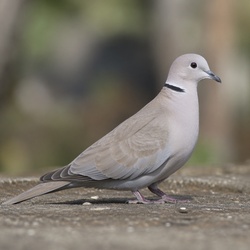
A pale sandy-buff dove with a thin black half-collar on the nape, now common around towns and farms, identified by its three-note cooing call and square white-cornered tail seen in flight.
Read the full Eurasian Collared-Dove encyclopedia entry →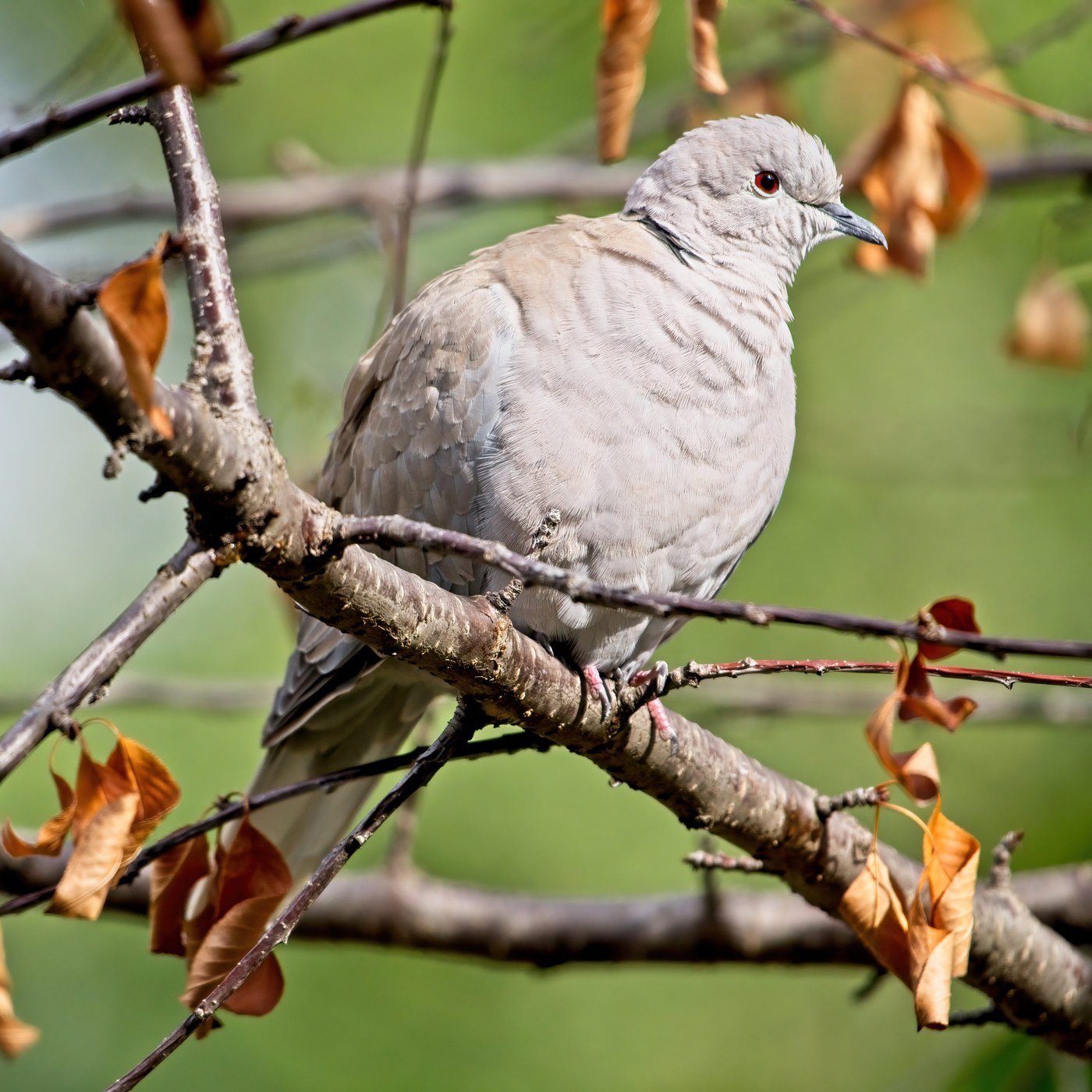
Key Field Marks
- Size & shape: A medium-sized, slender dove (30–33 cm) with a small head, long tail, and overall pale, washed-out sandy-buff to grey-buff plumage.
- Collar: A narrow black half-collar edged with white crosses the back of the neck (absent in juveniles), giving the species its name.
- Underparts & wings: Pale grey-buff body with slightly darker primaries; underwing coverts are pale grey.
- Tail: Long and graduated; from below, shows a broad white terminal band contrasting with a dark base, very obvious as the bird flies away or lands.
- Bare parts: Dark reddish eyes, dark bill, and dull reddish legs.
- Behavior: Often seen perched on wires, rooftops, and aerials in and around towns, villages, and farmyards; flies with quick, shallow wingbeats and glides on down-bowed wings; frequently feeds on the ground on spilled grain near feeders and farms.
Similar Species
- African Collared-Dove / "Ringed Turtle-Dove" (escaped domestic form): Very similar but typically paler and creamier overall, with a different, more nasal call; usually only an issue where domestic stock has been released.
- European Turtle-Dove: Smaller, warmer rufous-brown above with black-and-white scaled patterning on the wing coverts, a black-and-white striped neck patch (not a solid collar), and a dark tail with white edges only at the tip corners, not a full pale band; also a summer migrant, unlike the resident Collared-Dove.
- Rock Pigeon/feral pigeon: Bulkier, more variable in color, lacks the black neck collar and pale sandy tone.
Where & When to Look
- Habitat: Strongly associated with human settlement — towns, villages, farmyards, parks, and gardens with tall trees or wires for perching; less common in extensive natural woodland or open countryside away from buildings.
- Range: Native range historically centered on the Indian subcontinent through the Middle East; underwent a dramatic natural range expansion across Europe in the 20th century and was introduced to the Bahamas in the 1970s, subsequently colonizing much of North America.
- Season: Resident and non-migratory throughout its range; can be seen year-round, often in pairs, and breeds across most months in mild climates.
Voice
- Call: A distinctive, far-carrying three-syllable coo, "coo-COOO-cuk," with stress on the middle note, repeated monotonously, often from a rooftop or wire perch.
- Other sounds: A harsh, nasal, burry "kwurr" or screeching note given in flight or during display, quite different from the soft cooing song.
Frequently asked questions
How do I tell a Eurasian Collared-Dove from a European Turtle-Dove?
Collared-Dove is paler, plain sandy-buff with a solid black half-collar and a broad pale tail band, while Turtle-Dove is smaller, warmer rufous with scaly wing patterning and a striped (not solid) neck patch.
What does the Collared-Dove's call sound like?
A repetitive three-note coo, 'coo-COOO-cuk', with emphasis on the middle syllable, often given from rooftops or wires.
Where is the best place to see a Eurasian Collared-Dove?
Around human habitation — towns, farmyards, gardens, and parks — since the species rarely occurs far from buildings and bird feeders.
Are Eurasian Collared-Doves native to North America?
No, they were introduced in the Bahamas in the 1970s and spread naturally across the continent from there; they are native to Asia and the Middle East, having spread into Europe naturally last century.
How can I tell a juvenile Collared-Dove from an adult?
Juveniles lack the black neck collar entirely and have duller, browner plumage until it develops with age.
Eurasian Collared-Dove identified by the community
Recent Eurasian Collared-Dove sightings identified with Bird Identifier.