
Eurasian Bittern Identification Guide
A secretive, superbly camouflaged heron of dense reedbeds, more often heard through its far-carrying booming call than seen, thanks to intricately patterned buff-and-brown plumage.
Read the full Eurasian Bittern encyclopedia entry →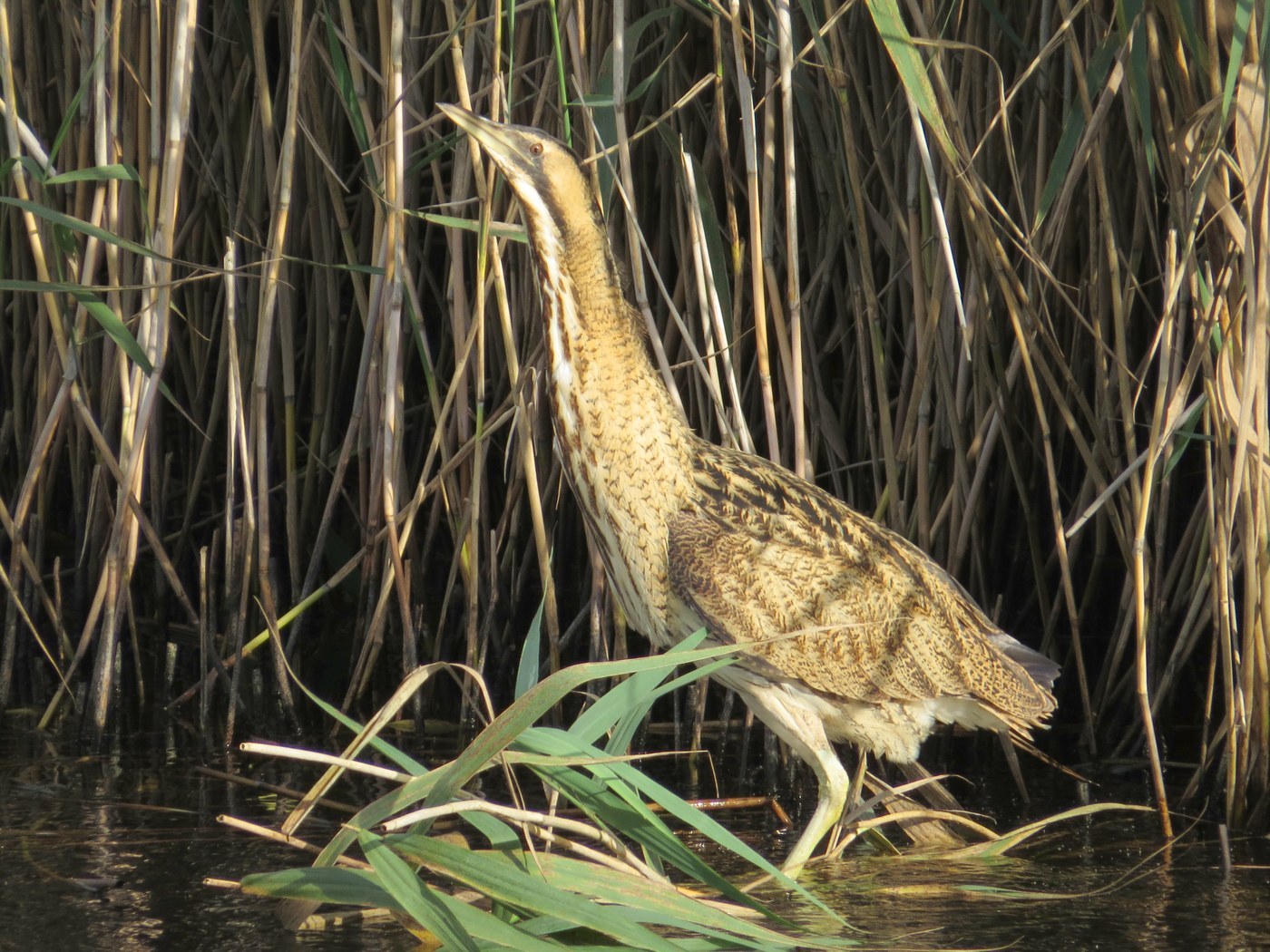
Overview
The Eurasian Bittern (Botaurus stellaris), also called Great Bittern, is a large, thickset heron relative found across much of Europe and Asia, closely tied to extensive reedbeds. It is notoriously secretive and its cryptic plumage, freezing behavior, and reclusive habits make it one of the hardest wetland birds to actually see, even where it is locally common.
Key Field Marks
- Size and shape: A stocky, thick-necked heron, about 69-81 cm (27-32 in) long, shorter-necked and more compact-looking than typical herons, with a hunched posture when at rest.
- Plumage: Intricately patterned buff, golden-brown, and blackish streaking and barring across the body gives outstanding camouflage against dry reed stems — among the best-camouflaged of all herons.
- Bill: Stout, dagger-like, pale yellowish-green bill.
- Behavior when alarmed: Freezes in a distinctive "bittern stance" with bill pointed straight up and neck stretched vertically, swaying gently to mimic wind-blown reeds — a key behavioral identification clue if a bird is spotted.
- In flight: Broad, rounded wings and slow, owl-like flap on take-off, with legs trailing; overall a heavy, browner silhouette compared to other herons.
Separating Eurasian Bittern from Similar Species
Immature night-herons can show some superficial streaking but are smaller, grayer, and lack the bittern's golden-buff tones and bulkier build. American Bittern (a vagrant in parts of the Eurasian Bittern's range) is similar in shape but has a distinct dark malar/neck stripe that Eurasian Bittern lacks, along with darker, more uniformly blackish flight feathers versus the barred flight feathers of Eurasian Bittern. In practice, the biggest identification challenge with this species is simply detecting it at all in dense reeds, where its camouflage and freezing behavior make it nearly invisible.
Where and When to See One
Eurasian Bitterns require large, dense stands of reedbed (particularly common reed, Phragmites) with adjacent shallow water for feeding, found very locally across much of temperate Europe and Asia. Northern and eastern populations are migratory, wintering further south and west (including milder parts of western Europe) while some southern and western European populations are largely resident; the best time to detect breeding birds is spring (roughly March-May) when males give their booming call at dawn and dusk. Reserves with extensive reedbeds are the most reliable places to look, often from a hide overlooking open water-reed edges at first light.
Behavior
Eurasian Bitterns are solitary and highly secretive, moving slowly and deliberately through reeds while hunting fish, amphibians, and invertebrates by stealth, and typically freeze rather than flush when disturbed. They are most active around dawn and dusk, and are far more often detected by their booming call than by sight.
Voice
The male's advertising call is an extraordinary deep, foghorn-like boom — often rendered as "oomph" or "whoomp" — produced by inflating the esophagus, audible up to several kilometers away on a still night, making voice by far the most reliable way to confirm the species' presence in a reedbed.
Quick Reference
- Stocky, thick-necked heron with intricately barred golden-buff and brown plumage
- Freezes in an upright "bittern stance" with bill pointed skyward when alarmed
- Restricted to large reedbeds; migratory in northern/eastern populations
- Extremely far-carrying, foghorn-like booming call from males in spring is the best detection method
Frequently asked questions
Why is the Eurasian Bittern so hard to see?
Its intricately streaked buff-and-brown plumage blends almost perfectly with dry reed stems, and when alarmed it freezes bill-upward and sways like wind-blown reeds rather than flying, making it exceptionally difficult to spot even in reedbeds where it is present.
What does a Eurasian Bittern sound like?
Males produce an extraordinary deep, foghorn-like booming call, audible for several kilometers, given mainly at dawn and dusk during the spring breeding season — the most reliable way to detect the species.
How do you tell Eurasian Bittern from American Bittern?
American Bittern has a bold dark stripe running down the side of the neck and more uniformly dark flight feathers, while Eurasian Bittern lacks the neck stripe and shows barred, patterned flight feathers; American Bittern is a rare vagrant in the Old World.
What habitat do Eurasian Bitterns need?
They depend on large, dense stands of reedbed, typically common reed, with adjacent shallow water for foraging, and are largely absent from wetlands lacking extensive reed cover.