
Emerald Toucanet Identification Guide
A small, bright green toucan of Central and South American cloud forests, identified by its oversized bicolored bill and often a chestnut or blue-tinged throat depending on region.
Read the full Emerald Toucanet encyclopedia entry →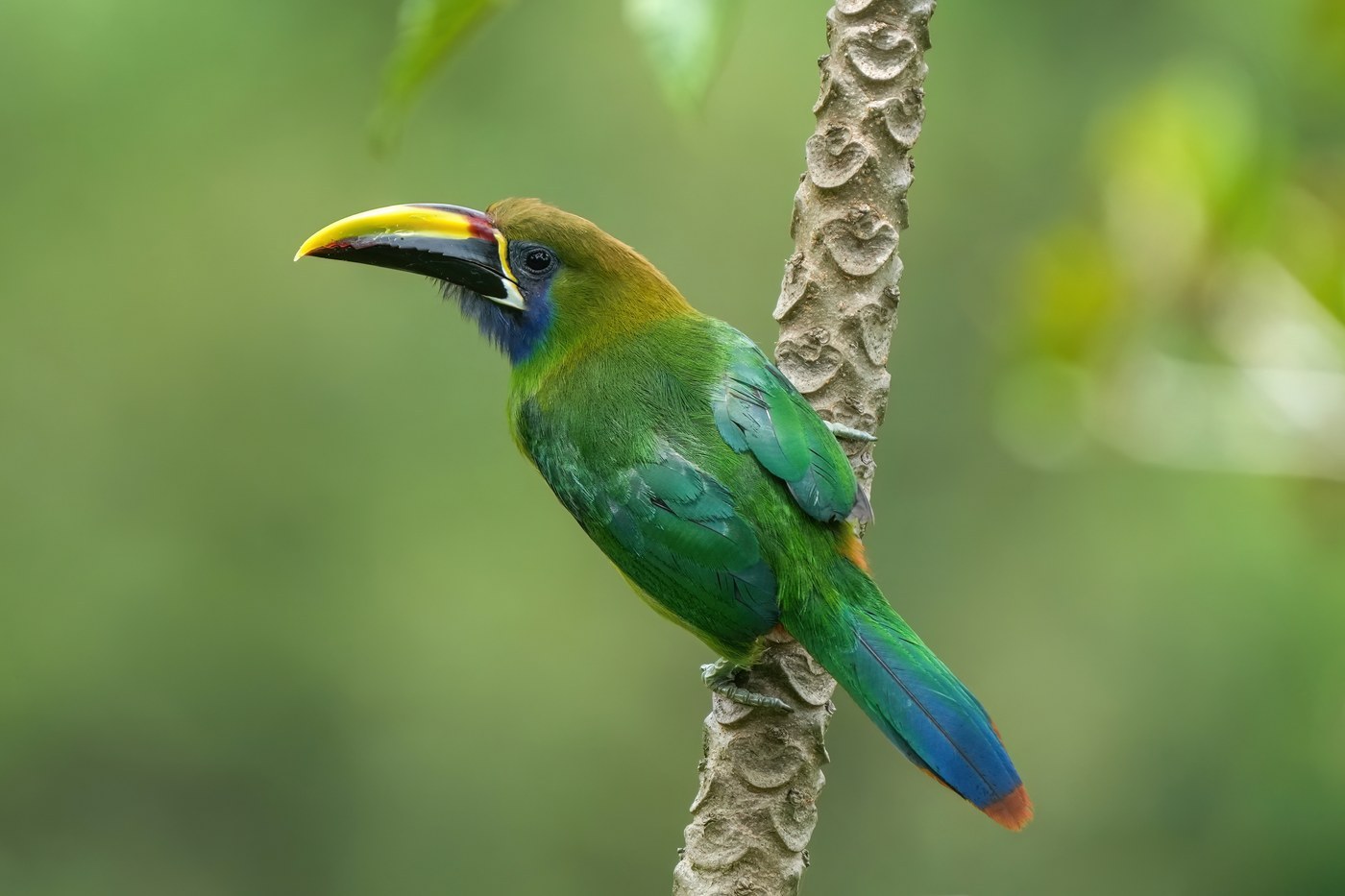
Overview
The Emerald Toucanet (Aulacorhynchus prasinus and related species following recent taxonomic splits) is a small, brilliantly green toucan found in humid montane and cloud forests from Mexico south through Central America into the Andes of South America. Its bright green body and oversized bill make it one of the more approachable toucans to identify, though regional variation is considerable now that the complex has been split into multiple species by many authorities.
Key Field Marks
- Size and shape: A small toucan, about 30-35 cm (12-14 in) long, with the characteristically large, deep bill typical of toucans but proportionally smaller than that of the big lowland toucans.
- Plumage: Overall bright emerald to grass green, blending into the forest canopy remarkably well; some populations show a blue-gray or chestnut throat patch, and a chestnut-tipped tail is present in several forms.
- Bill: Large and laterally flattened like all toucans, typically dark above (blackish or maroon) and yellow, cream, or ivory below, with a thin white or pale line at the base of the bill in many populations — pattern and color vary by subspecies/species across its range and are useful for regional identification.
- Eye: Surrounded by bare skin that is often blue, red, or chestnut depending on the population.
Separating Emerald Toucanet from Similar Species
Within cloud forest habitat, the combination of small size and mostly green plumage with a large bill is essentially unique — larger toucans (e.g., Keel-billed, Toco) are much bigger, boldly patterned in black, white, and bright colors, and typically found at lower elevations. Aracaris are also patterned in black, red, and yellow rather than green. Because the Emerald Toucanet complex has recently been split into several species (such as Northern Emerald-Toucanet, Southern Emerald-Toucanet, Blue-throated Toucanet, and others depending on authority), bill color pattern and throat color are the key marks for distinguishing regional forms from one another.
Where and When to See One
Emerald Toucanets inhabit humid montane forest, cloud forest, and forest edge, generally between about 1,000 and 3,000 m elevation, from central Mexico through Central America and along the Andes into Bolivia. They are non-migratory residents, present year-round, though some local elevational movement occurs in response to fruit availability. Listen and look for them in the mid-to-upper canopy of forest edges, ravines, and clearings, often in small family groups.
Behavior
Like other toucans, Emerald Toucanets are primarily frugivorous, plucking fruit with the tip of the bill and tossing it back to swallow, but they also take insects, small vertebrates, and eggs/nestlings of other birds opportunistically. They move through the canopy in noisy, loose groups of a few birds, hopping along branches with an ungainly, front-heavy gait due to the large bill, and often mob predators together.
Voice
The most frequent call is a loud, dry, croaking or rattling series — "crrick-crrick-crrick" — repeated persistently, along with various croaks and clicks; the voice carries well through cloud forest and is often the first clue to a bird's presence before it is seen.
Quick Reference
- Small toucan, mostly bright green, large bicolored bill
- Regional variation in bill and throat color across a recently split species complex
- Cloud/montane forest resident from Mexico to the Andes, ~1,000-3,000 m elevation
- Loud, dry, repeated croaking call; travels in small canopy groups
Frequently asked questions
Is the Emerald Toucanet one species or several?
Historically treated as one widespread species, the Emerald Toucanet complex has been split by many taxonomic authorities into several separate species (such as Northern and Southern Emerald-Toucanet and Blue-throated Toucanet) based largely on bill pattern and throat color differences across its range.
What elevation should I look for Emerald Toucanets at?
They favor humid montane and cloud forest generally between about 1,000 and 3,000 meters elevation, higher than most large lowland toucan species.
How does an Emerald Toucanet's diet compare to bigger toucans?
It is primarily frugivorous like other toucans, plucking fruit with its bill tip, but also opportunistically eats insects and the eggs or nestlings of small birds.
What is the easiest way to detect an Emerald Toucanet in the forest?
Listen for its loud, dry, repeated croaking call, which often reveals its presence in the canopy well before the bird itself is spotted.