
Egyptian Vulture Identification Guide
The smallest Old World vulture, recognized by its white body, black flight feathers, bare yellow face, and thin, pointed bill well suited to picking at scraps.
Read the full Egyptian Vulture encyclopedia entry →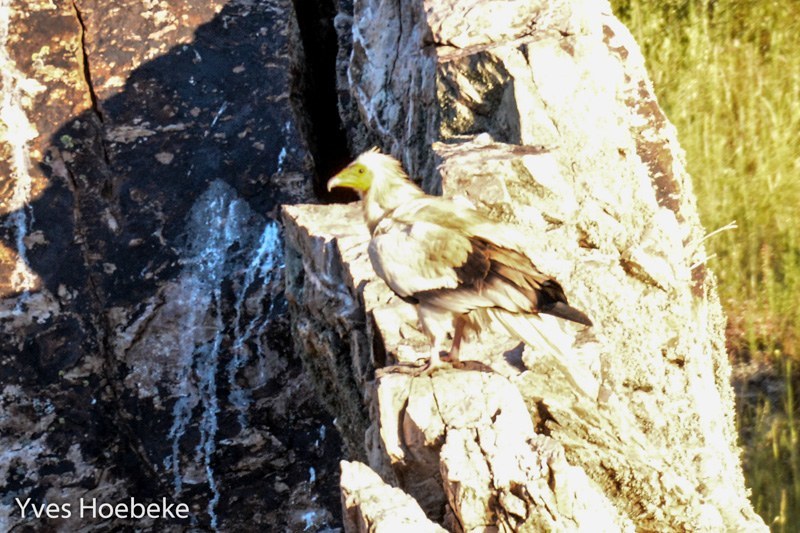
Overview
The Egyptian Vulture (Neophron percnopterus) is a small, distinctive Old World vulture found from southern Europe and North Africa across the Middle East to South Asia. It is well known for its unusual ability to use tools — famously cracking ostrich eggs by throwing rocks at them — and for its scruffy, almost comical appearance compared to larger vultures.
Key Field Marks
- Size and shape: The smallest of the Old World vultures, about 58-70 cm (23-28 in) long with a wingspan of roughly 155-170 cm, notably smaller and more buoyant in flight than Griffon or other large vultures.
- Adult plumage: Predominantly white or creamy-white body and wing coverts contrasting sharply with black flight feathers (primaries and secondaries) — a bold black-and-white pattern visible from a great distance in flight.
- Head: Bare yellow to orange facial skin and a shaggy, unkempt-looking ruff of thin feathers around the neck, along with a thin, slightly hooked, pointed black bill quite different from the heavier bills of larger vultures.
- Juveniles: Dark brown overall, gradually acquiring white feathering over 4-5 years to reach adult plumage — juvenile and immature birds can be confused with other dark raptors until the diagnostic wedge-shaped tail is seen.
- Tail shape: Distinctly wedge-shaped or pointed tail, unlike the fanned or rounded tails of most other vultures — visible in silhouette even at a distance.
Separating Egyptian Vulture from Similar Species
Adults are essentially unmistakable due to the white body/black flight feather pattern and small size. Immature birds are more challenging and can suggest a young eagle or other vulture, but the combination of small size, buoyant flapping and gliding flight (rather than the heavy soaring of larger vultures), and pointed tail helps separate it. Griffon Vultures are far larger, uniformly brown, and lack the wedge tail; White-backed Vultures lack the white head and body of adult Egyptian Vultures.
Where and When to See One
Egyptian Vultures breed on cliffs and rocky outcrops in mountainous or semi-arid terrain across southern Europe, the Middle East, and parts of Africa and South Asia, often near towns and villages where they scavenge at rubbish dumps and carcasses. European and Central Asian populations are migratory, wintering in sub-Saharan Africa or the Indian subcontinent and returning to breeding grounds in spring; African and South Asian resident populations remain in place year-round. Look for them soaring over open country, near dumps, or around livestock carcasses.
Behavior
Unlike larger vultures that dominate carcasses, Egyptian Vultures are subordinate scavengers, often waiting at the edges to pick up scraps once bigger species have fed, or specializing in smaller food items, eggs, and even feces at some ungulate colonies. Their tool use — dropping stones on ostrich eggs to break the thick shell — is one of few documented cases of tool use among birds.
Voice
Generally silent away from the nest; occasional weak hissing, growling, or squealing notes are given at the nest or during interactions with other vultures at carcasses.
Quick Reference
- Small vulture, white body with black flight feathers, bare yellow face
- Wedge-shaped pointed tail distinguishes it from all other vultures
- Migratory in Europe/Central Asia, resident in Africa/South Asia
- Subordinate scavenger, feeds at carcass edges and rubbish dumps
Frequently asked questions
What is the easiest field mark for an adult Egyptian Vulture?
The sharp contrast between the white body and black flight feathers, combined with a bare yellow face and a distinctly wedge-shaped tail, is diagnostic and visible even at long range.
How long does it take for a young Egyptian Vulture to gain adult plumage?
Juveniles are dark brown and take about 4 to 5 years, molting through several intermediate plumages, before acquiring the full white-and-black adult pattern.
Do Egyptian Vultures migrate?
European and Central Asian breeding populations are long-distance migrants that winter in sub-Saharan Africa or South Asia, while many African and South Asian populations are largely resident.
Is it true Egyptian Vultures use tools?
Yes, they are one of the few bird species documented to use tools, picking up and throwing stones to break open thick-shelled ostrich eggs.