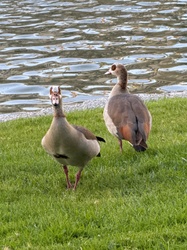
Egyptian Goose Identification Guide
A boldly patterned, long-legged waterfowl native to Africa that is easily told apart by its dark eye patches and pink legs, and is now established as a feral species in parts of Europe and the US.
Read the full Egyptian Goose encyclopedia entry →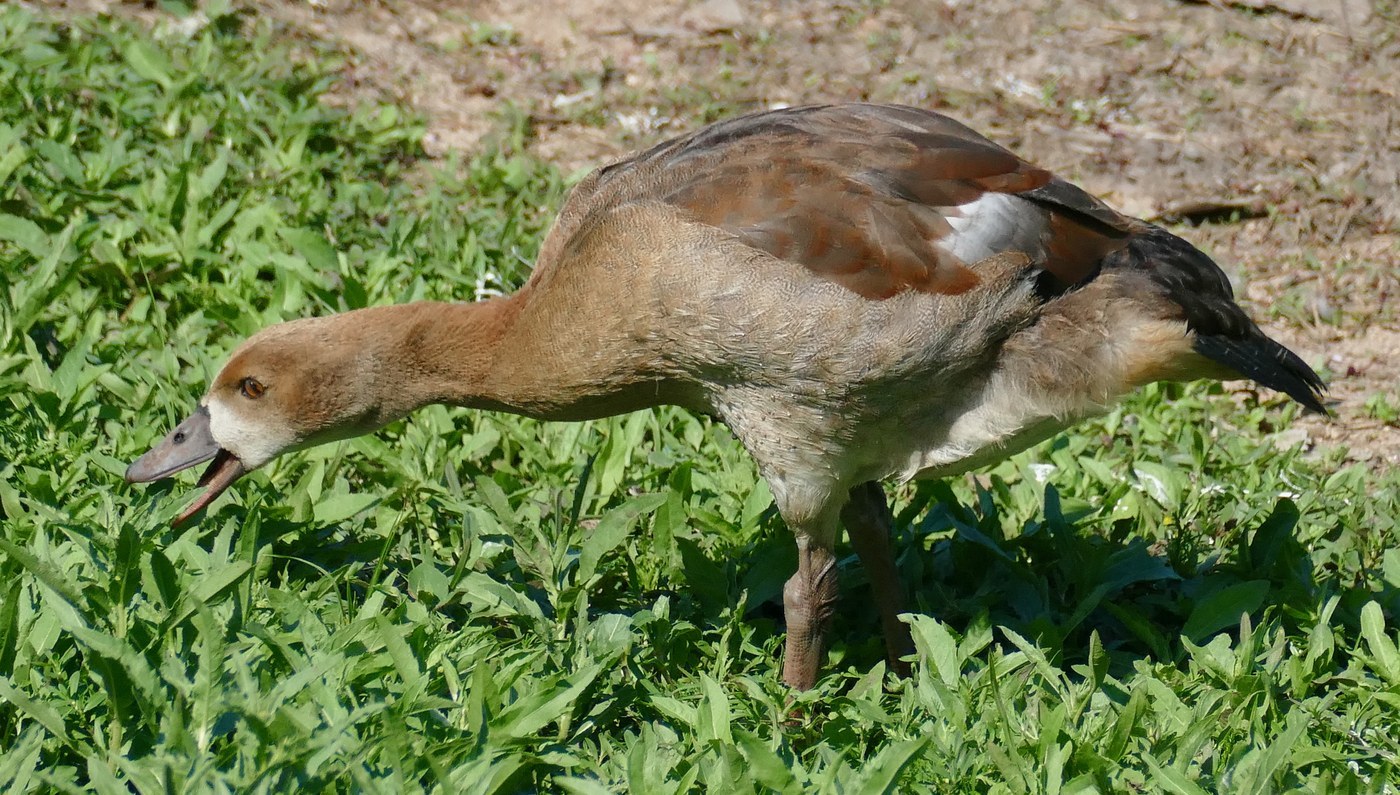
Overview
The Egyptian Goose (Alopochen aegyptiaca) is a large, distinctive waterfowl native to sub-Saharan Africa and the Nile Valley, more closely related to shelducks than to true geese. Popular in waterfowl collections, it has established sizable feral, self-sustaining populations in parts of Europe (notably the UK, Netherlands, and Belgium) and in Florida and Texas in the United States.
Key Field Marks
- Size and shape: A large, long-legged, long-necked duck-like bird, about 63-73 cm (25-29 in) long, with an upright stance reminiscent of a goose despite being a shelduck relative.
- Plumage: Pale buffy-brown to grayish body with a chestnut-brown patch around the eye and a similar patch in the center of the breast.
- Head: Pale grayish-white face and crown with the diagnostic dark brown eye patch — the single best field mark.
- Legs and bill: Bright pink to reddish-pink legs and a pink bill, both standing out against the muted body plumage.
- In flight: Shows large white wing patches bordered by black and iridescent green speculum, very conspicuous and diagnostic in flight.
Separating Egyptian Goose from Similar Species
No other common waterfowl combines the pink legs and bill, brown eye patch, and bold white wing patches. Ruddy Shelduck (a vagrant in some overlapping areas) lacks the dark eye patch and has an overall warmer orange-cinnamon body without the pale face. Domestic or feral goose hybrids can cause confusion but lack the sharply defined chocolate eye mask and pink legs together.
Where and When to See One
In its native range, Egyptian Geese are found year-round near almost any water body — rivers, lakes, reservoirs, wetlands, and even golf courses and parks — across sub-Saharan Africa and the Nile Valley. Introduced populations in the UK and continental Europe, as well as Florida, are resident and increasingly common in urban parks, retention ponds, and farmland with open water. They are non-migratory and can be seen at any time of year, often in pairs that mate for life and aggressively defend territory during the breeding season.
Behavior
Egyptian Geese graze on grass and low vegetation on land as readily as they feed on aquatic plants in the water, often seen walking well away from water on lawns and fields. Pairs are highly territorial and vocal, chasing off other waterfowl, and both sexes participate in aggressive displays with wings raised and loud calling.
Voice
Males give a hoarse, wheezy, breathy call, while females produce a loud, harsh, repeated honking or cackling — the sexes are often distinguishable by voice alone, with the female notably louder and more raucous.
Quick Reference
- Pale brown-gray body, chocolate eye patch, pink legs and bill
- Large white wing patches obvious in flight
- Common on lawns, parks, and water edges, native to Africa, feral in Europe/US
- Loud, aggressive, territorial pairs
Frequently asked questions
Is the Egyptian Goose actually a true goose?
No — despite its name and goose-like stance, it is classified with the shelducks (genus Alopochen) rather than true geese (Anser or Branta).
Are Egyptian Geese invasive outside Africa?
In parts of Europe (UK, Netherlands) and Florida, feral populations descended from escaped ornamental birds are now self-sustaining and considered naturalized or invasive in some areas due to competition with native waterfowl.
What is the easiest way to identify an Egyptian Goose at a glance?
Look for the combination of pink legs, a pink bill, and a distinctive dark brown patch around the eye on an otherwise pale, sandy-brown body.
Do Egyptian Geese migrate?
They are largely sedentary and non-migratory, though local movements occur in response to water availability and drought conditions in parts of Africa.
Egyptian Goose identified by the community
Recent Egyptian Goose sightings identified with Bird Identifier.