
Eastern Wood-Pewee Identification Guide
A quiet, olive-gray flycatcher of forest canopies and edges, told from similar Empidonax flycatchers by its longer wings, lack of an eye-ring, and its lazy, slurred pee-a-wee song.
Read the full Eastern Wood-Pewee encyclopedia entry →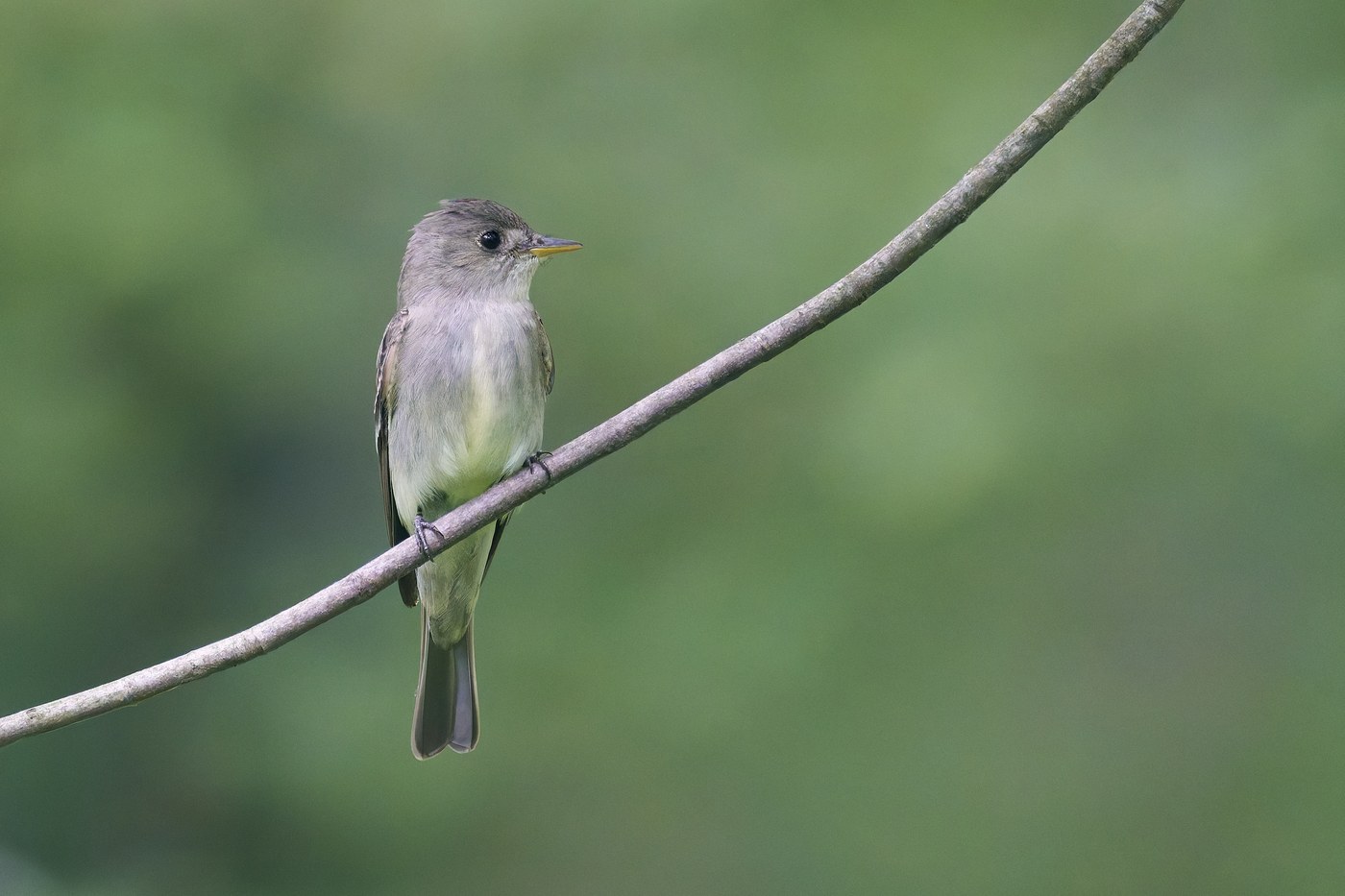
Key Field Marks
- Size & shape: A medium-small flycatcher (6-6.5 in / 15-16 cm) with notably long wings that extend well down the tail when perched, a fairly large head, and an upright flycatcher posture.
- Plumage: Olive-gray to grayish-brown upperparts, darker on the head, with dingy whitish-to-pale-yellow underparts and a diffuse, incomplete gray breast band or "vest" rather than a sharply defined pattern.
- Wings: Two crisp whitish wingbars stand out against the darker wing (more distinct than on the similar Eastern Phoebe).
- Face: No obvious eye-ring (unlike most Empidonax flycatchers), giving a plain, somewhat big-headed and long-winged look.
- Bill: Lower mandible pale orange/yellowish at the base, contrasting with the dark upper mandible — a helpful mark against the all-dark bill of Eastern Phoebe.
- Behavior: Perches quietly and often motionlessly on an open, dead branch in the mid-to-upper canopy, sallying out to catch flying insects and typically returning to the same or a nearby perch; does not pump its tail.
Separating from Similar Species
- Empidonax flycatchers (Least, Acadian, Willow, etc.): Eastern Wood-Pewee is larger with proportionally longer wings and lacks the bold white eye-ring most Empids show; Empids also tend to be more compact with shorter primary projection.
- Eastern Phoebe: Phoebe has an all-dark bill, weaker/indistinct wingbars, and habitually pumps its tail — pewees do not pump the tail and show crisper wingbars.
- Olive-sided Flycatcher: Notably bulkier, with a distinct dark "vest" contrasting sharply with a white central throat/breast stripe (a more defined pattern than the pewee's diffuse wash), and often perches at the very top of a dead snag.
Habitat & Range
Breeds across most of eastern North America, from southern Canada south to the Gulf Coast and central Texas, in deciduous and mixed forests, especially favoring forest edges, clearings, and open woodland with tall trees offering exposed perches in the mid-to-upper canopy. Winters in South America, primarily in the Amazon basin and northern Andes foothills.
Seasonal Notes
Arrives on breeding grounds relatively late in spring (often mid-to-late May) compared to many other migrants, and departs relatively early in fall. Often detected first by voice since it can perch motionless and inconspicuously high in the canopy for long periods between sallies.
Voice
A slow, plaintive, whistled "pee-a-wee," slurring down then up, often followed by a lower, descending "pee-oh" phrase — a distinctive, unhurried, and slightly mournful song frequently repeated from the same perch through the day, including in the heat of midday when many other birds go quiet.
Frequently asked questions
How do you tell Eastern Wood-Pewee from Empidonax flycatchers?
Eastern Wood-Pewee is larger with longer wings (long primary projection) and lacks the bold white eye-ring shown by most Empidonax flycatchers, giving it a plainer-faced, more elongated look.
What does the Eastern Wood-Pewee's song sound like?
A slow, slurred, whistled 'pee-a-wee' that dips down and rises again, often followed by a lower 'pee-oh' phrase — frequently repeated from an exposed perch, even during midday heat.
Does Eastern Wood-Pewee pump its tail like Eastern Phoebe?
No — that habitual tail-pumping is characteristic of Eastern Phoebe, not the wood-pewee, which instead tends to sit still with a more horizontal posture between sallies.
Where does the Eastern Wood-Pewee like to perch?
On open, often dead branches in the mid-to-upper forest canopy, especially near edges and clearings, from which it sallies out to catch flying insects and typically returns to the same perch.