Eastern Towhee Identification Guide
A large, striking sparrow relative with black (male) or brown (female) upperparts, rich rufous flanks, a white belly, and red eyes, usually detected first by its loud rustling in leaf litter.
Read the full Eastern Towhee encyclopedia entry →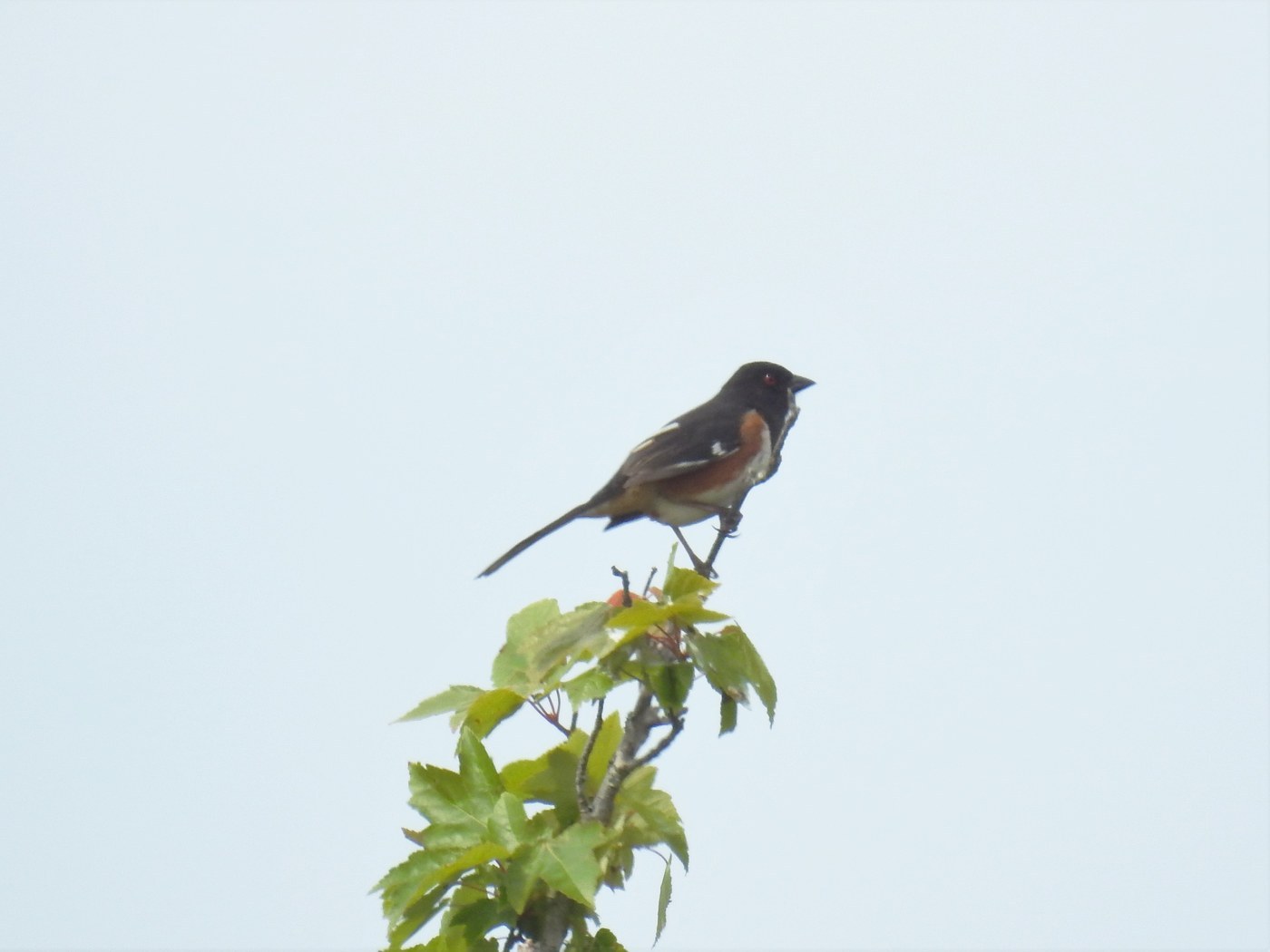
Key Field Marks
- Size & shape: A large, long-tailed member of the sparrow family (7-8.5 in / 18-21 cm), noticeably bigger and chunkier than typical sparrows, with a thick, conical seed-eating bill.
- Male: Bold black hood, back, wings, and tail contrasting sharply with rufous-orange flanks and a clean white belly; white patches in the wings and white corners on the tail flash in flight.
- Female: Same bold pattern but with warm brown replacing the male's black — brown hood/back/wings/tail, rufous flanks, white belly.
- Eyes: Red in most of the range (northern/eastern birds), though far southern Florida populations ("white-eyed towhees") have pale whitish eyes.
- Behavior: Forages on the ground in dense understory, using a distinctive noisy double-scratch/hop kick with both feet to flip leaf litter in search of insects and seeds — often heard before seen.
Separating from Similar Species
- Spotted Towhee (western counterpart): Shows bold white spotting on the back and wing coverts (Eastern Towhee's back and wings are plain black/brown without spots); ranges meet on the Great Plains with occasional hybrids.
- American Robin: Superficially similar rufous-and-dark color scheme but robins are larger, lack the towhee's white belly/black hood contrast, and have a different overall shape and thin bill.
- Dark-eyed Junco: Smaller, lacks rufous flanks, and has an all gray/dark hood without the towhee's rufous sides.
Habitat & Range
Common in dense shrubby understory, brushy woodland edges, overgrown fields, and thickets across the eastern United States, from southern New England and the Great Lakes south through Florida and west to the Great Plains. Prefers habitat with a thick leaf-litter layer and dense low cover for both foraging and nesting on or near the ground.
Seasonal Notes
Northern populations are migratory, moving south for winter, while birds in the mid-Atlantic and southeastern U.S. are largely resident year-round. Most easily detected in spring and summer when males sing persistently from low perches at territory edges; in winter, often joins mixed flocks with sparrows in brushy cover.
Voice
A classic, well-known mnemonic song: "drink-your-TEEEA," a clear introductory note or two followed by a long trill. Call is a distinctive, rising "chewink" or "tow-HEE" (the source of the bird's name), a sharp, whistled two-note exclamation.
Frequently asked questions
What does the Eastern Towhee's song sound like?
It's often rendered as 'drink-your-TEEEA' — one or two clear introductory notes followed by a rolling trill — and its call gives the bird its name, a sharp, rising 'tow-HEE' or 'chewink.'
How do you tell Eastern Towhee from Spotted Towhee?
Eastern Towhee has a plain, unspotted black or brown back and wings, while Spotted Towhee (found farther west) shows bold white spots and streaks across the back and wing coverts.
Why do Eastern Towhees make so much noise in leaf litter?
They forage by vigorously kicking both feet backward at once to flip and scatter leaves, exposing hidden insects and seeds — a noisy, distinctive foraging technique often heard before the bird is seen.
Do all Eastern Towhees have red eyes?
Most do, but the subspecies resident in peninsular Florida has pale, whitish eyes instead, sometimes called the 'white-eyed towhee.'
Eastern Towhee identified by the community
Recent Eastern Towhee sightings identified with Bird Identifier.