
Eastern Spinebill Identification Guide
A slender Australian honeyeater with a long, strongly downcurved bill, a rufous throat crossed by a dark band, and a habit of hovering at tubular flowers like a hummingbird.
Read the full Eastern Spinebill encyclopedia entry →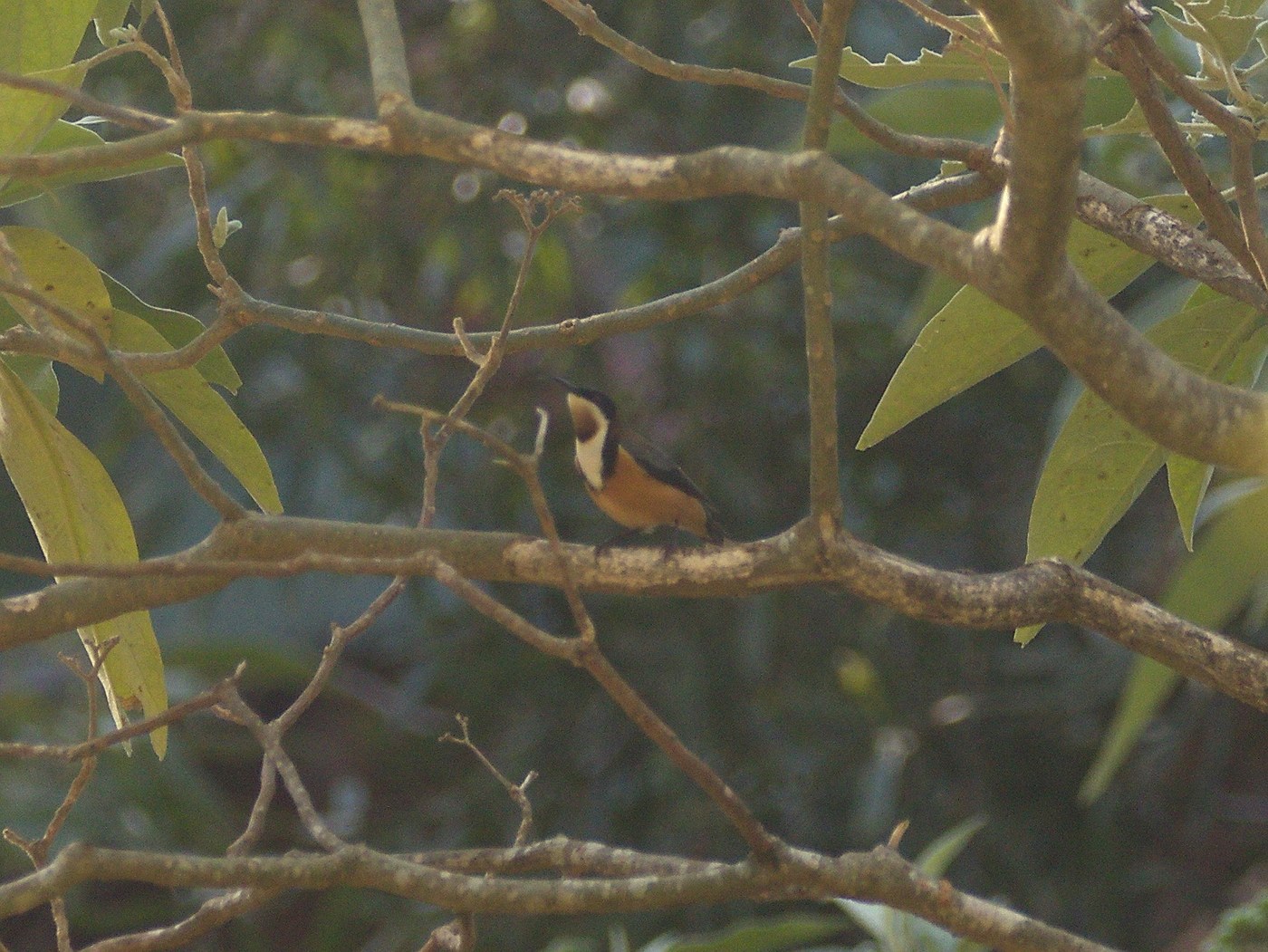
Key Field Marks
- Size & shape: A small, slim honeyeater (6-7.5 in / 15-19 cm including a longish tail) with a notably long, thin, strongly downcurved bill adapted for probing tubular flowers.
- Head & throat: Gray-brown crown, black face mask through the eye, and a rich rufous-orange throat patch bordered below by a distinct dark/blackish breast band or "collar."
- Body: Gray-brown upperparts, whitish belly with buff/rufous wash on the flanks, and a long, dark tail with white outer tail-tip patches visible in flight.
- Behavior: Frequently hovers in front of flowers to feed on nectar (hummingbird-like), though it also perches to probe blooms; fast, darting flight between flowering shrubs.
- Sexes: Similar pattern, but females are duller and somewhat smaller-billed than males.
Separating from Similar Species
- Western Spinebill: Very similar shape but has a rufous crown/nape (not gray-brown) and different range (southwestern Australia vs. Eastern Spinebill's southeastern range) — essentially an east/west replacement species pair.
- Other honeyeaters (e.g., New Holland Honeyeater): Have straighter, shorter bills and different, more streaked plumage patterns; lack the spinebill's long decurved bill and rufous throat/collar combination.
- Silvereye: Much smaller, short-billed, with a white eye-ring — easily separated by bill shape alone.
Habitat & Range
Found in forests, woodlands, heathland, and well-vegetated gardens with flowering native shrubs across southeastern Australia — from southern Queensland through New South Wales and Victoria to South Australia, and in Tasmania. Favors areas rich in tubular native flowers such as grevilleas, banksias, correas, and epacrids, on which it depends heavily for nectar, supplemented by small insects taken in flight or gleaned from foliage.
Seasonal Notes
Largely sedentary, though some populations undertake local altitudinal movements, descending from higher elevations in winter to lower, more sheltered gardens and woodlands where flowering shrubs persist. Breeds in spring through summer (roughly August-January in the Southern Hemisphere), building a small cup nest low in dense shrubbery.
Voice
A high, thin, rapid piping — often a fast series of sharp "pip-pip-pip" or "chip" notes, along with a more complex, chattering warble during display; calls are notably sharp and penetrating for such a small bird.
Frequently asked questions
What makes the Eastern Spinebill's bill so distinctive?
It is unusually long, thin, and strongly downcurved — a specialized adaptation for probing deep into tubular native flowers like grevilleas and correas for nectar.
Does the Eastern Spinebill really hover like a hummingbird?
Yes, it frequently hovers briefly in front of flowers while feeding, a distinctive behavior among Australian honeyeaters that often draws comparisons to hummingbirds, though it also perches to feed.
How is Eastern Spinebill different from Western Spinebill?
Eastern Spinebill has a gray-brown crown, while Western Spinebill has a rufous crown and nape; the two species occupy separate, non-overlapping ranges in southeastern versus southwestern Australia.
What plants attract Eastern Spinebills to gardens?
Tubular native flowers such as grevilleas, banksias, correas, and epacrids are especially attractive, providing the nectar this species relies on heavily.