
Eastern Rosella Identification Guide
A strikingly multicolored Australian parrot with a scarlet head and breast, bright yellow-green back, blue cheeks and wings, and a long blue-green tail.
Read the full Eastern Rosella encyclopedia entry →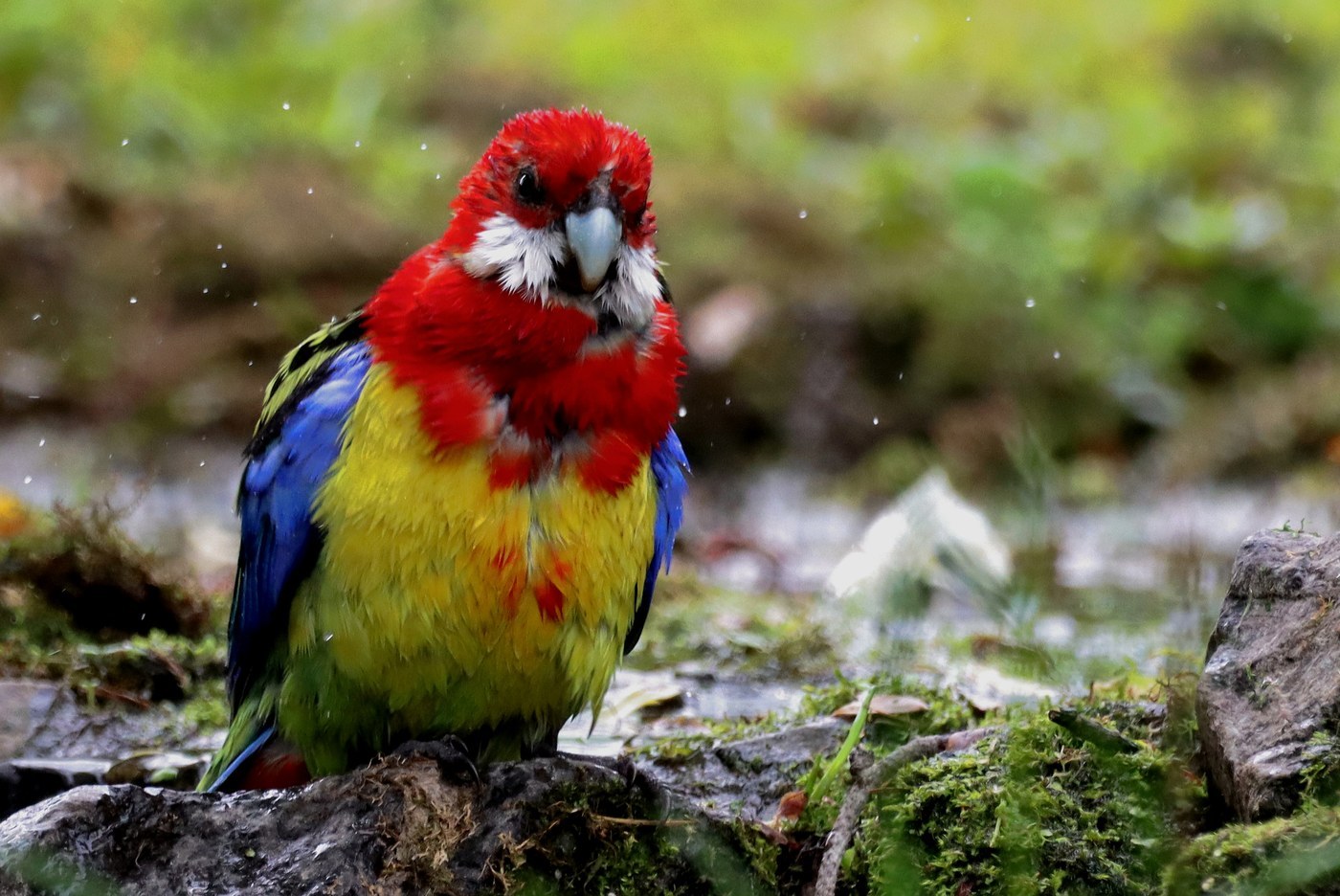
Key Field Marks
- Size & shape: A medium-sized, slender parrot (about 12 in / 30 cm including a long, graduated tail) with a fairly small hooked bill typical of broad-tailed parrots (rosellas/Platycercus).
- Head & underparts: Vivid scarlet-red head, throat, and upper breast contrasting with bright white to pale blue-white cheek patches.
- Body: Back and wing coverts show a striking scalloped pattern of black feathers broadly edged in bright yellow-green to golden-green; rump is yellow-green; belly is pale yellow.
- Wings & tail: Blue shoulder patch and blue in the flight feathers; long tail is blue-green above with blue outer feathers, graduated and pointed at the tip.
- Sexes: Similar, though females and immatures are often slightly duller with a somewhat smaller red hood and duller cheek patches.
Separating from Similar Species
- Crimson Rosella: All-crimson body (no yellow-green back) with blue cheeks — lacks the Eastern Rosella's contrasting scalloped yellow-green back.
- Pale-headed Rosella: Head is pale yellow-white rather than red, with a similar scalloped back pattern; ranges adjoin/overlap in parts of Queensland and hybrids occur.
- Golden-shouldered/other rosellas: Different color combinations and more restricted ranges; Eastern Rosella's red head plus yellow-green scalloped back is a unique combination within its range.
Habitat & Range
Native to open woodlands, farmland, parks, gardens, and forest edges of southeastern Australia — from southeastern Queensland through New South Wales, Victoria, and into South Australia — plus Tasmania. Adapts well to human-modified landscapes, including suburban gardens, orchards, and golf courses, where it feeds on seeds, fruit, blossoms, and some insects, often foraging on the ground as well as in trees. Introduced and established feral populations exist in New Zealand (North Island) and around Perth, Western Australia, well outside its native range.
Seasonal Notes
Largely sedentary/resident year-round within its range, though some local movement occurs in response to food availability. Breeds in tree hollows, typically spring through early summer in the Southern Hemisphere (roughly September-January), often nesting in loose neighborhood associations near suitable hollow-bearing trees.
Voice
A range of calls including a distinctive ringing, bell-like "kwink kwink" or repeated metallic "cussik-cussik" contact call given in flight, and softer chattering and warbling notes while perched and interacting with mates.
Frequently asked questions
How do you tell Eastern Rosella from Crimson Rosella?
Eastern Rosella has a scarlet head and breast but a contrasting yellow-green, black-scalloped back, while Crimson Rosella is essentially all crimson-red over the body with no yellow-green back patterning.
Where is the Eastern Rosella naturally found?
Southeastern Australia — Queensland, New South Wales, Victoria, South Australia, and Tasmania — in open woodland, farmland, and parkland habitats; it has also been introduced to New Zealand and parts of Western Australia.
What does an Eastern Rosella eat?
Mainly seeds (including grass and weed seeds), fruit, blossoms, and nectar, along with occasional insects and larvae; it often forages on the ground as well as in trees and shrubs.
Where do Eastern Rosellas nest?
In natural hollows of large, mature trees (especially eucalypts), typically laying eggs in spring to early summer in the Southern Hemisphere.