
Eastern Kingbird Identification Guide
A bold, blackish-and-white flycatcher with a crisp white-tipped tail that perches upright on wires and aggressively chases off crows and hawks.
Read the full Eastern Kingbird encyclopedia entry →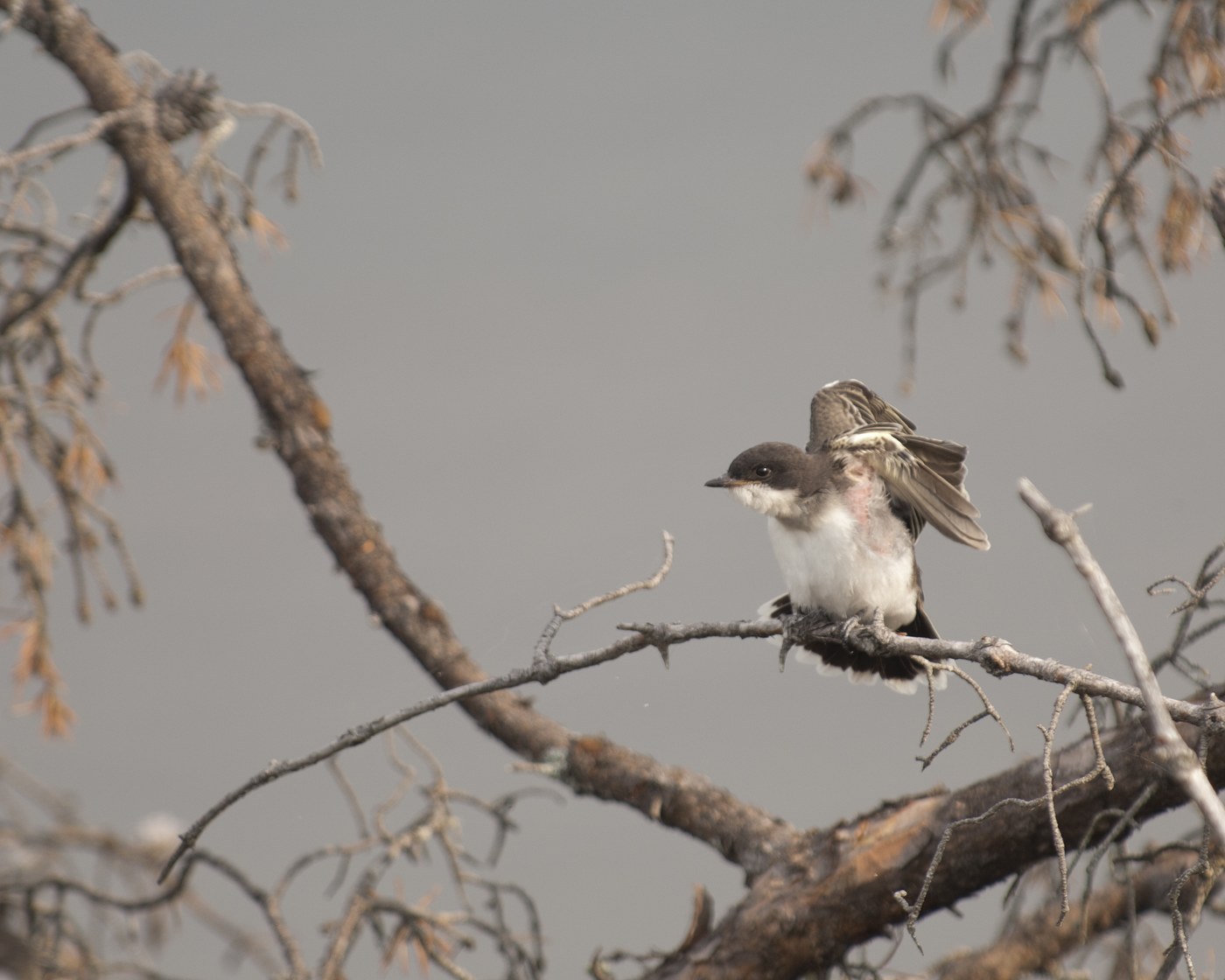
Key Field Marks
- Size & shape: A medium-sized flycatcher (8-9 in / 20-23 cm) with a large head, broad shoulders, and a fairly long, squared-off tail; sits upright on exposed perches.
- Plumage: Blackish-slate upperparts (darkest on the head, forming a subtle "capped" look), clean white underparts, and — the signature mark — a crisp white terminal band across the tip of the black tail.
- Bill: Broad, flat, black flycatcher bill typical of the genus.
- Crown patch: A concealed reddish-orange crown patch is rarely visible except during aggressive displays.
- Behavior: Highly conspicuous and pugnacious — sallies out from wires, fences, and treetops to catch flying insects, and famously mobs and chases crows, hawks, and other birds that stray near its territory, sometimes landing on their backs.
Separating from Similar Species
- Eastern Phoebe: Smaller, lacks the white tail band, has a dark head that blends more into an olive-gray back, and characteristically pumps its tail.
- Gray Kingbird: Paler gray above, larger bill, lacks the white tail band, and is a Southeast coastal specialty.
- Loggerhead Shrike: Superficially blackish/white/gray but has a hooked bill, black mask, and gray back rather than the kingbird's slate-black back and white tail tip.
Habitat & Range
Breeds across nearly all of temperate North America (southern Canada through most of the U.S., scarcer in the arid Southwest) in open country with scattered trees — farmland, orchards, hedgerows, riparian edges, and pond/lake margins — almost always near some water or open ground for aerial insect foraging. Highly migratory, wintering in South America, chiefly in the Amazon basin, where its behavior shifts dramatically: it becomes quiet, flocking, and largely frugivorous (fruit-eating) rather than the solitary, aggressive insect-hawker of summer.
Seasonal Notes
Arrives on breeding grounds in late spring and departs early, among the earlier fall migrants to head south (often by August-September). On the breeding grounds pairs are strongly territorial and vocal, readily seen perched on roadside wires; in winter in South America it forms large, quiet flocks in fruiting trees, a striking behavioral contrast from its summer persona.
Voice
A sharp, electric, sputtering chatter — a rapid series of buzzy "dzee-dzee-dzee" or "kit-kit-kitter-kitter" notes, often given while chasing intruders; call is a harsh, single "kit" or "dzeet."
Frequently asked questions
What is the best field mark for Eastern Kingbird?
A clean white band across the very tip of an otherwise blackish tail, combined with slate-black upperparts and white underparts.
Why do Eastern Kingbirds attack crows and hawks?
They are fiercely territorial flycatchers that will chase, dive-bomb, and even land on the backs of much larger birds like crows, hawks, and herons that intrude near their nest.
Do Eastern Kingbirds have any hidden colorful features?
Yes — both sexes have a small reddish-orange crown patch that is normally concealed and only flashed during aggressive or courtship displays.
Where do Eastern Kingbirds go in winter?
They migrate to South America, mainly the Amazon basin, where they switch from solitary insect-hawking to flocking and feeding heavily on fruit.