
Eared Grebe Identification Guide
A small, slender-necked grebe with a peaked black head and golden fan of feathers behind the eye in breeding plumage, best told from Horned Grebe by shape and bill.
Read the full Eared Grebe encyclopedia entry →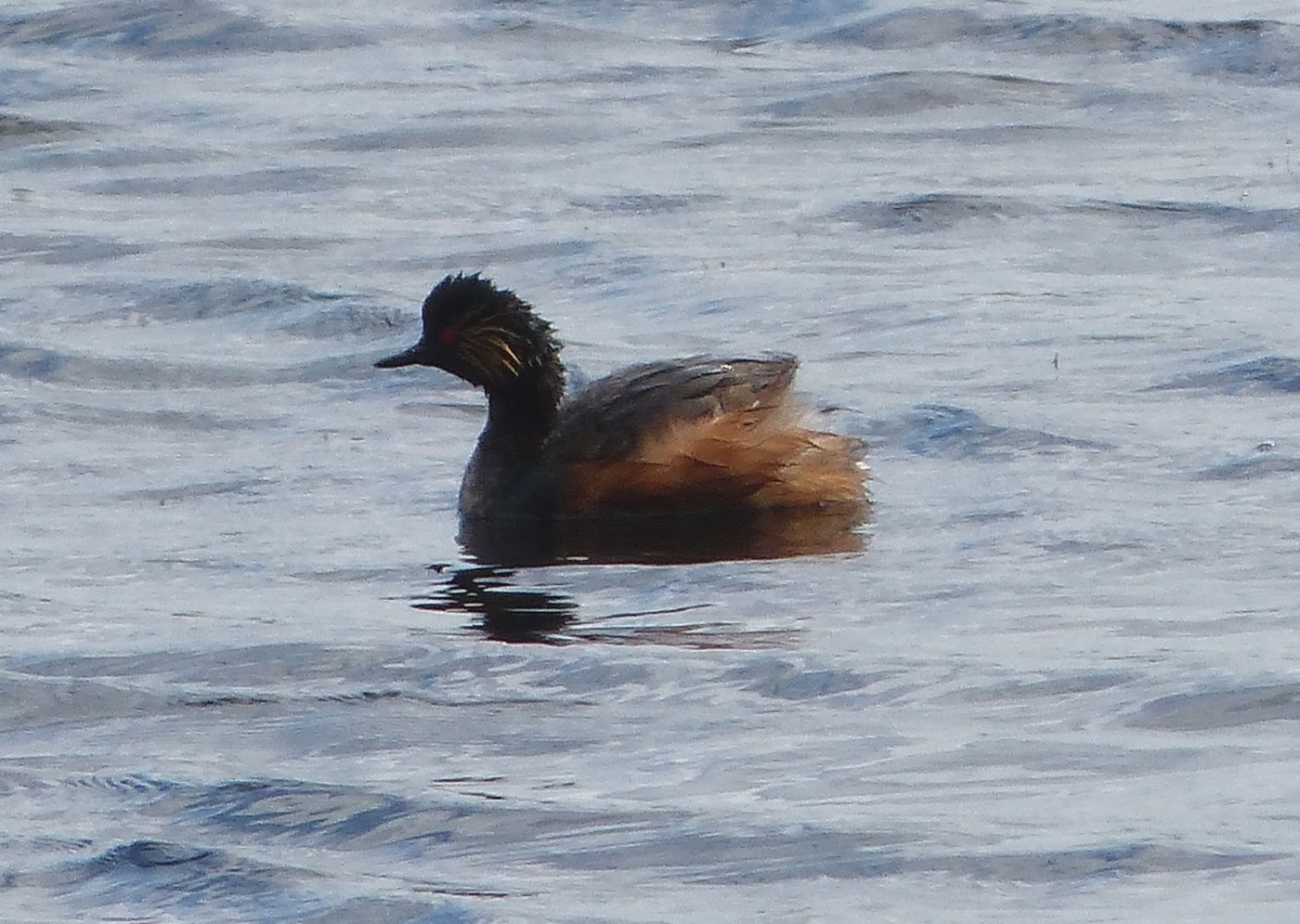
Key Field Marks
- Size & shape: A small waterbird (12-14 in / 30-35 cm) with a slim neck, a peaked, almost triangular crown, and a steep forehead that gives the head a distinctive "puffy-headed" look.
- Bill: Thin, slightly upturned (concave) black bill — a useful mark distinguishing it from the straighter-billed Horned Grebe.
- Breeding plumage: Black head and neck with a striking fan of thin, golden-yellow "ear" plumes sweeping back from behind the red eye; chestnut flanks; blackish back.
- Nonbreeding plumage: Dusky gray-black above, whitish below, with a smudgy dark cheek/neck patch (never crisply demarcated white cheek like Horned Grebe) and a dark cap that dips below the eye.
- Eye: Bright red in all plumages, though duller in juveniles.
- Posture: Rides low in the water; neck often held in a subtle "kinked" S-curve rather than straight.
Separating from Similar Species
- Horned Grebe: Has a straighter bill, a rounder/flatter crown, and in nonbreeding plumage shows a cleanly defined white cheek and foreneck contrasting with a dark cap that stops above the eye (Eared Grebe's dark cap extends through/below the eye, giving a "dirtier" face). In breeding plumage, Horned Grebe has a rusty-red neck and stubby golden head plumes rather than the Eared Grebe's black neck and thin, fanned golden plumes.
- Pied-billed Grebe: Stockier, brown overall, with a thick chicken-like bill lacking any red eye emphasis.
- Western/Clark's Grebe: Much larger with a long, straight neck and dagger-like bill.
Habitat & Range
Breeds colonially on shallow, alkaline or saline lakes and marshes across the interior West and Great Plains of North America, often in huge numbers at staging lakes (e.g., Mono Lake, Great Salt Lake) during migration, where hundreds of thousands gather to molt and fatten on brine shrimp and alkali flies before an extended flightless period. Winters mainly on saline lakes, estuaries, and coastal bays in the southwestern U.S. and Mexico, and locally the Gulf Coast. Also breeds across Eurasia and Africa (called Black-necked Grebe there).
Seasonal Notes
- Spring/Summer: On breeding lakes in full black-and-gold finery, often in loose colonies with elaborate courtship displays.
- Fall staging: Enormous flocks build up at a handful of hypersaline lakes in the western interior, where birds become temporarily flightless while fueling for migration.
- Winter: Found on saline coastal lagoons and inland alkaline lakes in the Southwest and Mexico, typically in nonbreeding plumage.
Voice
A short, rising, whistled "poo-EEP" or "krik," higher-pitched and less far-carrying than the trilling calls of some other grebes; largely quiet outside the breeding season.
Frequently asked questions
What is the easiest way to tell Eared Grebe from Horned Grebe in winter?
Look at the face pattern: Eared Grebe shows a dusky, poorly defined cheek with the dark cap dipping below the eye, while Horned Grebe has a crisp white cheek and foreneck with the dark cap stopping above the eye. Bill shape also helps — Eared Grebe's bill looks thinner and slightly upturned.
Why do Eared Grebes gather in such huge flocks?
They stage by the hundreds of thousands at a few hypersaline lakes (like Mono Lake and Great Salt Lake) to gorge on brine shrimp and alkali flies, building up fat reserves during a molt period when they are briefly flightless.
Do Eared Grebes fly much?
Rarely, and only at night during migration. They are reluctant fliers and, after molting their flight feathers at staging lakes, are flightless for several weeks.
What color are Eared Grebe eyes?
Bright red in adults year-round, which helps pick them out even in drab nonbreeding plumage.