
Dusky Grouse Identification Guide
A large, dark grouse of interior western mountain forests, formerly grouped with Sooty Grouse as "Blue Grouse," known for the male's low hooting display and inflatable neck sac.
Read the full Dusky Grouse encyclopedia entry →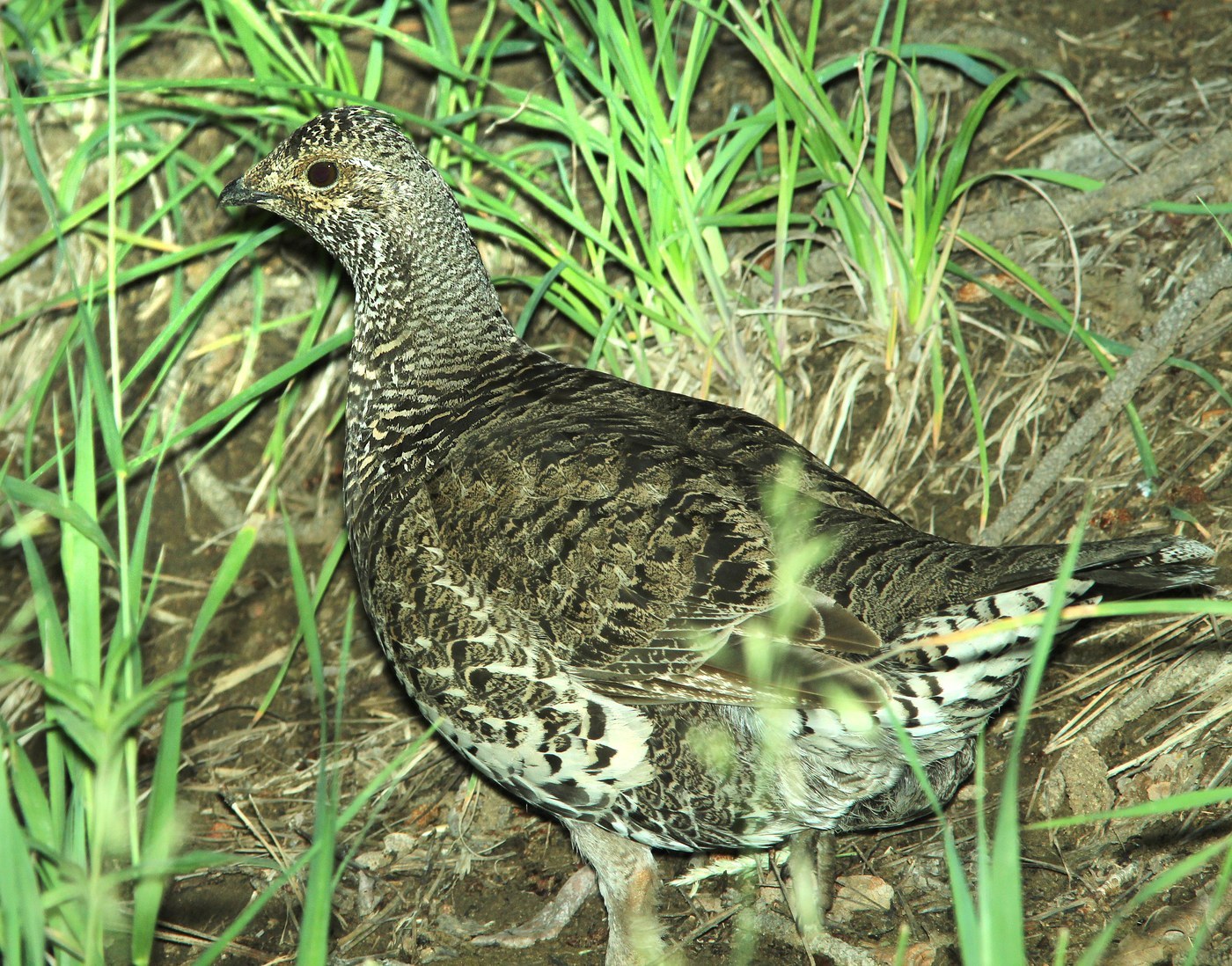
Key Field Marks
- Size & shape: A large, chicken-like grouse with a plump body, small head, and a broad, fan-shaped tail typically held closed when walking and spread during display.
- Male: Overall dark sooty-gray to blackish body plumage, a yellow-orange to reddish fleshy comb over the eye, and a bare neck patch (air sac) used in display that is dull purplish-red edged with white feathering; the tail shows little or no pale terminal band, or only a very narrow gray band.
- Female: Mottled brown, gray, and buff overall, providing excellent camouflage against forest litter; larger and bulkier than a female Ruffed Grouse, with a plain grayish tail lacking the bold dark subterminal band shown by Ruffed Grouse.
- Behavior: Males perform a striking ground display — tail fanned, body feathers fluffed, neck sac inflated and exposed — accompanied by a series of low hooting calls, often given from a low perch or the ground.
Separating It From Similar Species
- Sooty Grouse: Very similar and formerly considered the same species ("Blue Grouse"); Sooty Grouse occurs along the Pacific coastal mountain ranges and shows a yellow (not purplish-red) neck sac and typically a more distinct pale gray terminal tail band. Range is the most practical separator, since the two species have limited overlap.
- Ruffed Grouse: Smaller, with a distinctly banded tail showing a bold dark subterminal band, a ruff of feathers on the neck used in display, and a drumming (wing-beating) display rather than vocal hooting; found across a broader range of forest types at generally lower elevations.
- Spruce Grouse: Smaller and darker still, with a shorter tail often tipped rufous, and found in denser boreal/subalpine conifer stands, mainly farther north.
Habitat, Range & Season
Resident across coniferous and mixed montane forests of the interior western United States and Canada, from the Rocky Mountains west to the interior ranges (but not the immediate Pacific coastal belt, where Sooty Grouse replaces it). The species is an altitudinal migrant, typically moving to higher, more open slopes and forest edges in summer and dropping into denser, sheltered conifer stands at lower elevations for winter, where it feeds heavily on conifer needles.
Voice
Males give a series of low-pitched, resonant hooting notes during courtship display, often surprisingly hard to pinpoint due to their low frequency; females give soft clucking notes, especially near young.
Frequently asked questions
What is the difference between Dusky Grouse and Sooty Grouse?
These two species were once combined as "Blue Grouse." Dusky Grouse occurs in interior western mountain ranges and males show a purplish-red neck sac, while Sooty Grouse is found along the Pacific coastal ranges and males show a yellow neck sac; range is usually the easiest way to tell them apart.
How do I tell a female Dusky Grouse from a Ruffed Grouse?
Dusky Grouse is larger and bulkier with a plain grayish tail lacking a bold dark band, while Ruffed Grouse is smaller with a tail showing a prominent dark subterminal band and a neck ruff.
Where should I look for Dusky Grouse and at what time of year?
In coniferous and mixed forests of interior western mountains; males display and hoot in spring, while in winter birds move to denser, lower-elevation conifer stands, making spring the easiest season to detect them by voice.
What does the male Dusky Grouse's courtship display look like?
He fans his tail, fluffs his body feathers, and inflates a bare neck sac while giving a series of low hooting calls, typically performed on the ground or from a low perch.