Double-crested Cormorant Identification Guide
North America's most widespread cormorant, a large blackish waterbird with an orange throat pouch, hooked bill, and a habit of perching upright with wings spread to dry.
Read the full Double-crested Cormorant encyclopedia entry →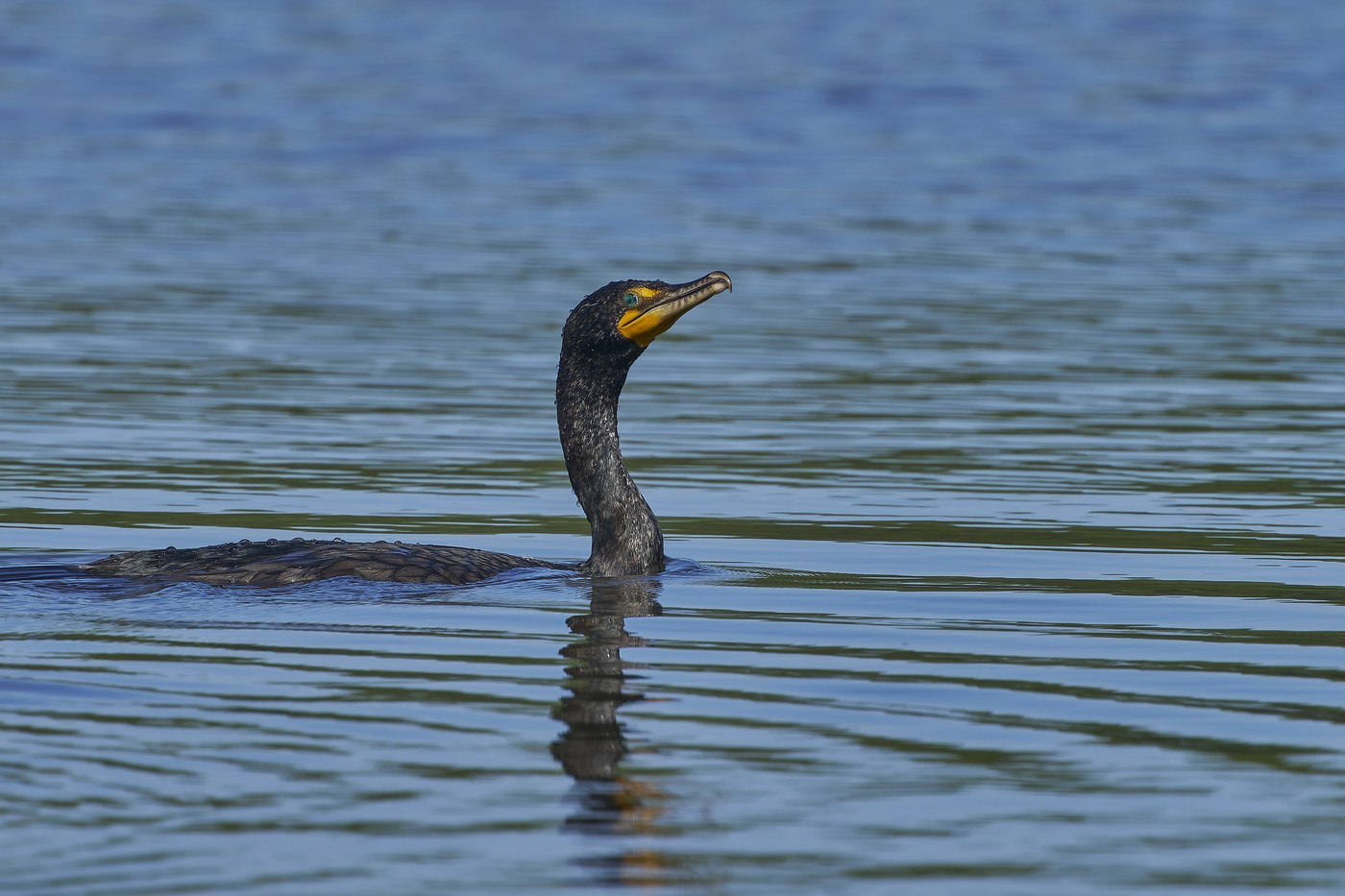
Key Field Marks
- Size & shape: Large, long-necked waterbird, roughly 28-35 in (70-90 cm), with a slim body, long tail, and a long bill hooked sharply at the tip.
- Plumage: Mostly blackish overall with a subtle bronze-green sheen visible in good light; bare orange-yellow skin on the face and throat pouch is diagnostic at close range.
- Breeding adults: Grow small tufts of feathers ("double crests") above the eyes — black in western/interior birds, whitish in some eastern/coastal birds — visible only briefly during the breeding season and often hard to see in the field.
- Juveniles: Browner overall with a pale, dingy buff-to-whitish breast and neck contrasting with a darker belly, gradually molting to adult plumage over two to three years.
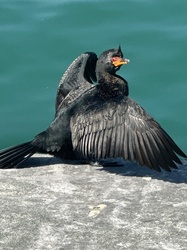
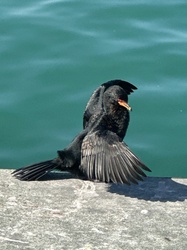
- Behavior: Swims low in the water with the bill angled upward; dives from the surface to pursue fish; frequently perches on posts, snags, or rocks with wings held open in a spread-eagle posture to dry its feathers, which are less waterproof than most waterbirds'.
Separating It From Similar Species
- Neotropic Cormorant: Smaller and slimmer with a proportionally longer tail, a pointed (not rounded) throat pouch often bordered with a thin white line, and a range concentrated in Texas, the Gulf Coast, and the Southwest, with more overlap now farther north.
- Great Cormorant: Larger and bulkier, with a whitish patch on the flank in breeding plumage and a more extensive pale yellow chin patch bordered by white feathering; mainly a coastal bird in the Northeast.
- Anhinga: Has a much thinner, straight (not hooked) dagger-like bill, a longer fan-shaped tail, and swims with only the head and neck above water ("snakebird" posture); found in freshwater swamps in the Southeast.
Habitat, Range & Season
Double-crested Cormorants breed in colonies across a huge swath of North America — on inland lakes and rivers as well as coastal bays and estuaries — nesting in trees, on cliffs, or on the ground on islands. They are present year-round in much of the southern and coastal US, while northern/interior breeders migrate south for winter to the Gulf Coast, Florida, Mexico, and the Caribbean.
Voice
Generally silent away from breeding colonies; at nesting sites, gives low, guttural, pig-like grunts and croaking calls.
Frequently asked questions
How do I tell a Double-crested Cormorant from a Neotropic Cormorant?
Double-crested Cormorants are larger with a rounded orange throat pouch, while Neotropic Cormorants are smaller and slimmer with a pointed throat pouch often edged in a thin white line and a longer tail.
Why do cormorants stand with their wings spread out?
Their feathers are less waterproof than most waterbirds', so after diving they perch with wings open to air-dry them and restore insulation and flight efficiency.
When can I see the 'double crest' that gives the species its name?
Only briefly during the breeding season, when adults grow small tufts of feathers above each eye; the crests are subtle and often hard to see even then, and absent the rest of the year.
Are Double-crested Cormorants found on freshwater or saltwater?
Both — they breed and forage on inland lakes and rivers as well as coastal bays, estuaries, and the open ocean nearshore.
Double-crested Cormorant identified by the community
Recent Double-crested Cormorant sightings identified with Bird Identifier.