
Double-barred Finch Identification Guide
A small Australian estrildid finch with an owl-like white face and two neat black bars across a white breast, often seen in tight flocks near grassy waterholes.
Read the full Double-barred Finch encyclopedia entry →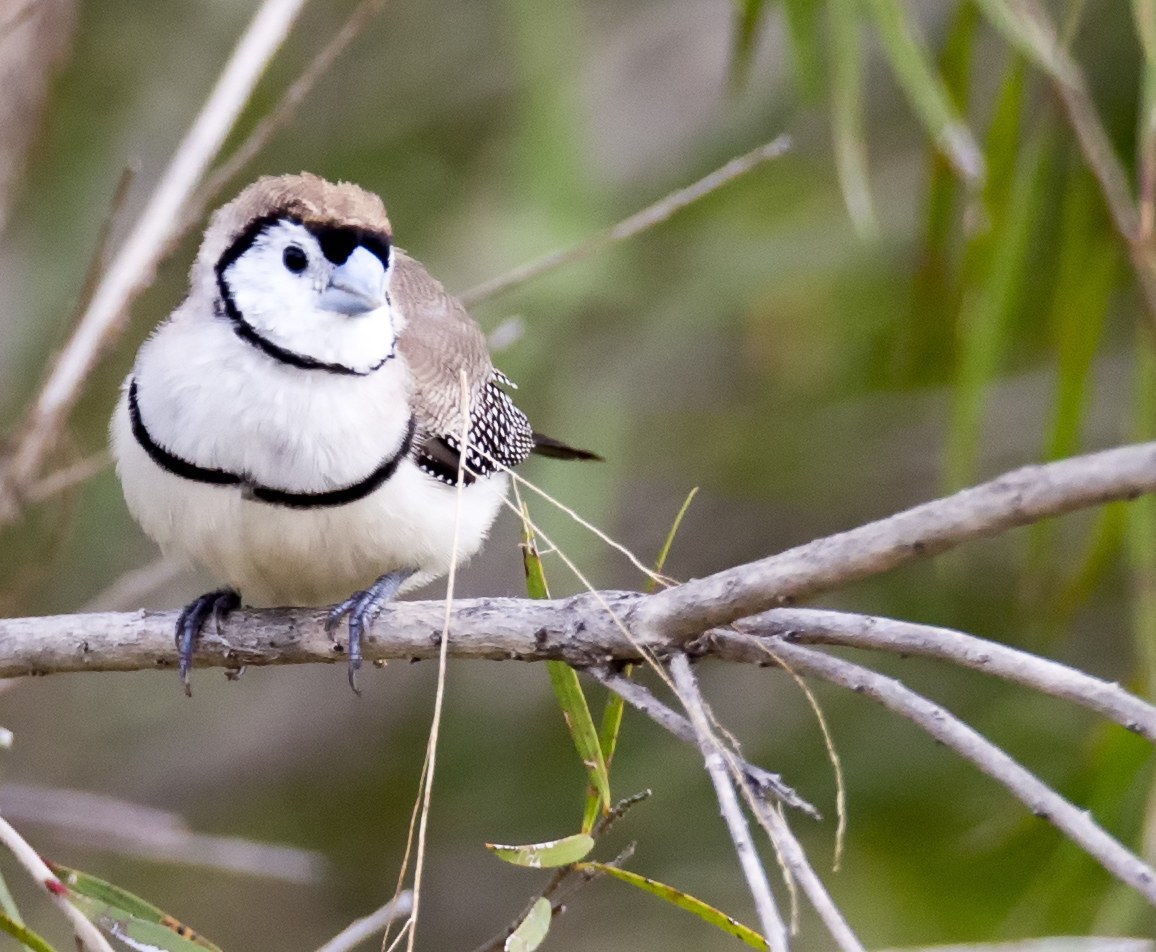
Key Field Marks
- Size & shape: Tiny and compact, about 10-11 cm (4 in), with a short black bill, short tail, and rounded body typical of estrildid finches.
- Face: A distinctive white face outlined by a black ring around the eye and crown, giving an "owl-faced" look that is the quickest way to recognize the species.
- Underparts: White breast and belly crossed by two narrow black bars — one across the upper breast, one lower across the flanks — which give the bird its common name.
- Upperparts: Grayish-brown back and wings finely spotted with white; two subspecies groups differ in rump color — black-rumped birds in the east, white-rumped birds in the north and west of the range.
Separating It From Similar Species
- Zebra Finch: Shares a similar size and habitat but has an orange cheek patch, a red-orange bill, and (in males) chestnut flanks with white spots — all absent in the Double-barred Finch, which instead shows the plain white owl-face and black double bars.
- Other estrildid finches (e.g., Plum-headed or Masked Finch): Show extensive red, chestnut, or black masking on the face rather than the clean white face-and-eye-ring pattern of the Double-barred Finch.
Habitat, Range & Season
Found year-round across northern and eastern Australia in grassy open woodland, savanna, farmland edges, and scrub near creeks and waterholes. It is a resident, non-migratory species that forms small, tight-knit flocks and forages on the ground for grass seeds, rarely straying far from cover and water.
Voice
A soft, nasal "beep" or "tang" contact call, frequently given in flight and while flocking, along with quiet chattering when perched in groups.
Frequently asked questions
What is the easiest way to identify a Double-barred Finch?
Look for the white, owl-like face outlined in black plus two black bars crossing the white breast and flanks — no other small Australian finch shows this exact combination.
How does the Double-barred Finch differ from the Zebra Finch?
Zebra Finches have an orange cheek patch and red bill; Double-barred Finches lack any orange on the face and instead show a plain white face and two black chest bars.
Where in Australia is the Double-barred Finch found?
Across northern and eastern Australia in grassy woodland and scrub near water, with black-rumped birds in the east and white-rumped birds in the north and west.
Does the Double-barred Finch migrate?
No, it is a sedentary, resident species that stays within its home range year-round, though it may wander locally in search of water and seed.