Domestic Canary Identification Guide
A small, tame cage-bred finch descended from the wild Atlantic Canary, recognized by its bright uniform coloring, stubby bill, and rich warbling song.
Read the full Domestic Canary encyclopedia entry →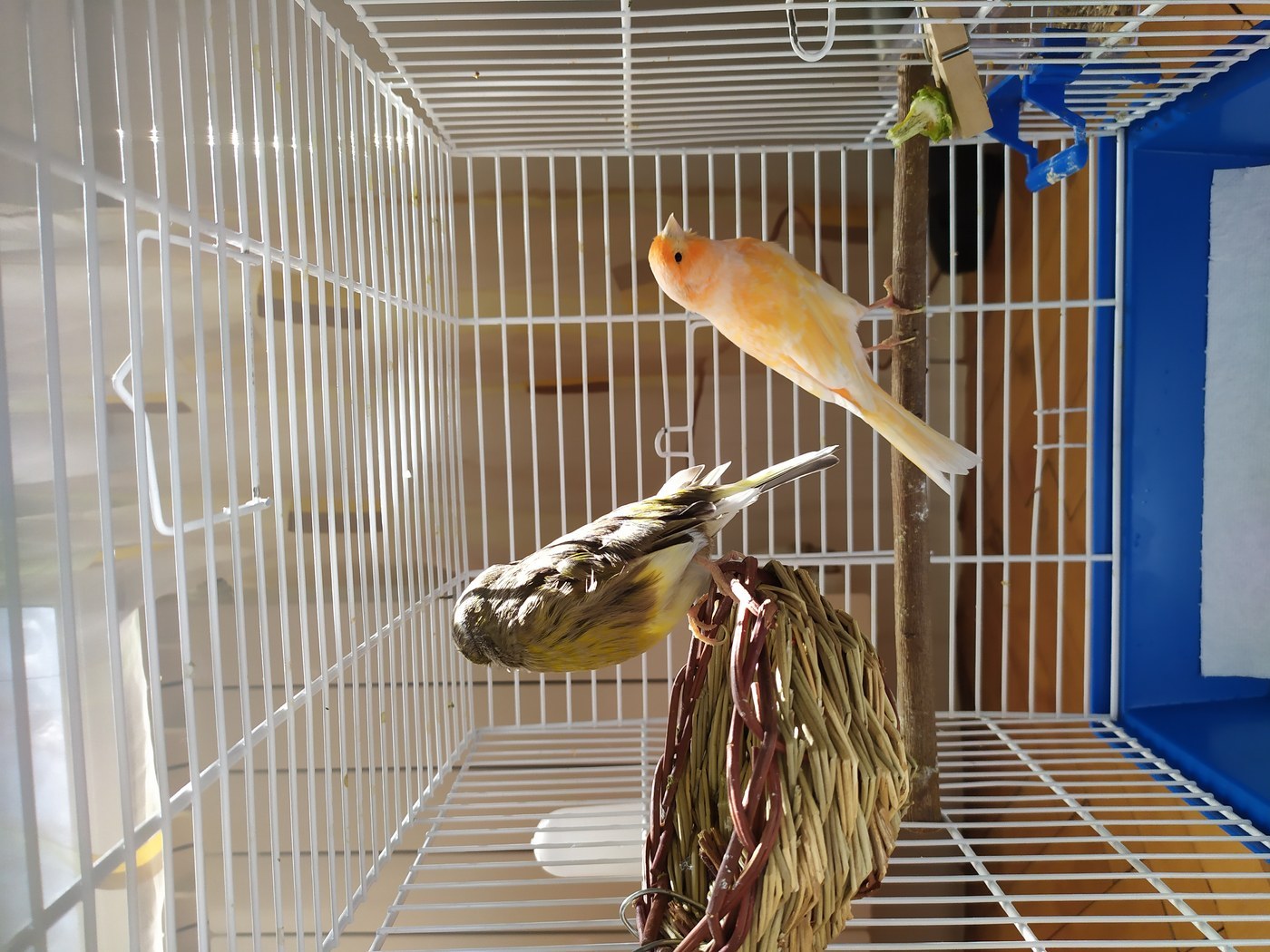
Key Field Marks
- Size & shape: A small finch about 5 in (12-13 cm) long with a short, stubby, conical seed-eating bill and a short, notched tail; exact proportions vary by breed (Yorkshire canaries are tall and slim, Gloster canaries can show a rounded crest called a "corona").
- Color: Selective breeding has produced many color forms — bright canary-yellow is most familiar, but birds can also be orange, white, cinnamon/brown, or variegated (patched) with darker feathering.
- Bare parts: Pale pinkish legs and a pale, stubby bill lacking any bold pattern.
- Behavior: Notably tame and confiding compared to wild finches, often seen near feeders, gardens, or buildings if it is an escapee, and generally reluctant to flee at close range.
Separating It From Similar Species
- Wild Atlantic Canary (the ancestral species): Streaky olive-green and yellow overall, resembling an oversized siskin — domestic canaries lack this dense streaking and instead show cleaner, more uniform color blocks.
- American Goldfinch / Lesser Goldfinch: Wild goldfinches show black wings and cap (breeding male) or black-edged wings with white wingbars; domestic canaries have plain wings without bold black-and-white patterning and a stubbier bill.
- General rule: Any small, all-yellow, orange, or white finch-like bird that is unusually tame and seen outside its expected native range is almost always an escaped or released domestic canary rather than a wild finch.
Habitat, Range & Season
Domestic Canaries are cage birds worldwide and are not established as a self-sustaining wild population in most regions; sightings "in the field" are almost always escapees near towns, gardens, or bird feeders and tend to be short-lived once released, since domestic stock is poorly equipped to survive predation and weather. The wild ancestor, the Atlantic Canary, is a resident of the Canary Islands, Azores, and Madeira and is not found in mainland North America.
Voice
Domestic Canaries are prized for their song — a rich, varied, continuous warbling with trills and rolls. Breeds selected specifically for vocal quality, such as the Roller canary, produce especially soft, melodious, closed-bill warbling, while "type" breeds selected for shape/color sing a more typical open, cheerful finch song.
Frequently asked questions
Is a Domestic Canary the same species as the wild canary?
Yes — it is a domesticated form of the Atlantic Canary (Serinus canaria), selectively bred for centuries for color, shape, and song, but genetically the same species.
If I see a bright yellow finch-like bird in my yard, is it a Domestic Canary?
Possibly, especially if it is unusually tame and lacks black wing markings — but first rule out a wild American or Lesser Goldfinch, which show black in the wings and a different bill shape.
Can escaped Domestic Canaries survive and breed in the wild?
Rarely for long; domestic canaries are poorly adapted to predators, weather, and finding wild food, so escaped birds seldom establish breeding populations outside their native Macaronesian island range.
What makes Roller canaries different from other canary breeds?
Rollers are bred specifically for soft, continuous, closed-bill warbling song quality rather than for a particular color or body shape, which is the focus of "type" and "color" breeds.
Domestic Canary identified by the community
Recent Domestic Canary sightings identified with Bird Identifier.