
Diamond Dove Identification Guide
Australia's smallest dove, pale blue-gray with a scattering of white-spotted wing coverts resembling diamonds, a red eye-ring, and a soft cooing call heard across the arid outback.
Read the full Diamond Dove encyclopedia entry →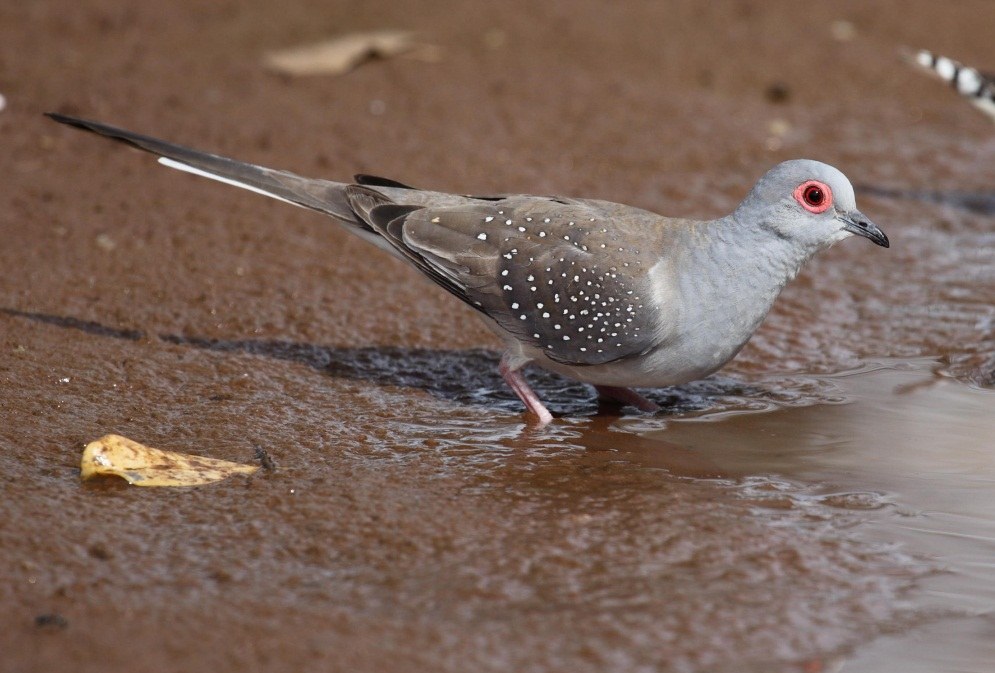
Overview
The Diamond Dove (Geopelia cuneata) is a tiny, delicate dove native to the drier interior of Australia, named for the rows of small white spots on its wing coverts that resemble scattered diamonds. It is also widely kept in aviculture, but wild birds are common across arid and semi-arid habitats.
Key Field Marks
- Size & shape: About 19–21 cm (7.5–8.25 in) including tail — Australia's smallest dove species, with a small head, slim body, and long, graduated tail.
- Plumage: Soft blue-gray head, neck, and underparts; brownish-gray back and wings.
- Wing spots: Rows of small, crisp white spots ringed with black on the wing coverts — the "diamonds" that give the species its name, visible at rest and especially obvious in good light.
- Eye-ring: Bright red-orange bare skin around the eye, conspicuous and colorful against the muted body plumage.
- Bill: Small, dark grayish bill.
- Tail: Long and graduated, blackish with white outer tips visible in flight and when fanned.
- Sexes: Similar, though males average slightly more richly colored with a more vivid eye-ring; juveniles are duller and browner with less defined spotting.
Similar Species
- Peaceful Dove: Larger, with fine black barring on the neck and upper breast rather than white wing spots, and lacks the bold red eye-ring.
- Bar-shouldered Dove: Larger still, with a coppery-scaled nape patch and barred underparts, quite different in pattern.
- The combination of tiny size, white-spotted wings, and red eye-ring is unique to Diamond Dove among Australian doves.
Habitat & Range
Widespread across arid and semi-arid interior Australia, favoring open woodland, scrub, and grassland near permanent or semi-permanent water sources, including around stock tanks and waterholes. Largely sedentary but can be locally nomadic, moving in response to rainfall and food availability.
Behavior
Forages on the ground for seeds of grasses and low plants, often in small flocks, particularly near water where large numbers may gather to drink. Flight is fast and direct with quick wingbeats. Generally tame and approachable.
Voice
Song is a soft, low, repeated "coo-COO-coo" or similar mellow cooing, softer and higher-pitched than many larger doves, often given from a perch in the heat of the day.
Best Viewing Tips
Visit waterholes or stock tanks in Australia's arid interior in the morning or late afternoon, when flocks of Diamond Doves often come to drink; look for the tiny size and check for the telltale white-spotted wings and red eye-ring at close range.
Frequently asked questions
Why is it called the Diamond Dove?
It's named for the rows of small white spots ringed with black on its wing coverts, which resemble scattered diamonds.
Is the Diamond Dove the smallest dove in Australia?
Yes, it is Australia's smallest native dove species.
Where does the Diamond Dove live?
It inhabits arid and semi-arid interior Australia, typically near water sources in open woodland, scrub, and grassland.
How can I tell a Diamond Dove from a Peaceful Dove?
Diamond Dove is smaller, shows white spots on the wing coverts and a bright red eye-ring, while Peaceful Dove is larger with fine black barring on the neck and breast instead of wing spots.