
Dartford Warbler Identification Guide
A small, dark, long-tailed warbler of European heathland and scrub, with a wine-red breast, gray upperparts, red eye-ring, and a habit of cocking its tail while perched atop gorse.
Read the full Dartford Warbler encyclopedia entry →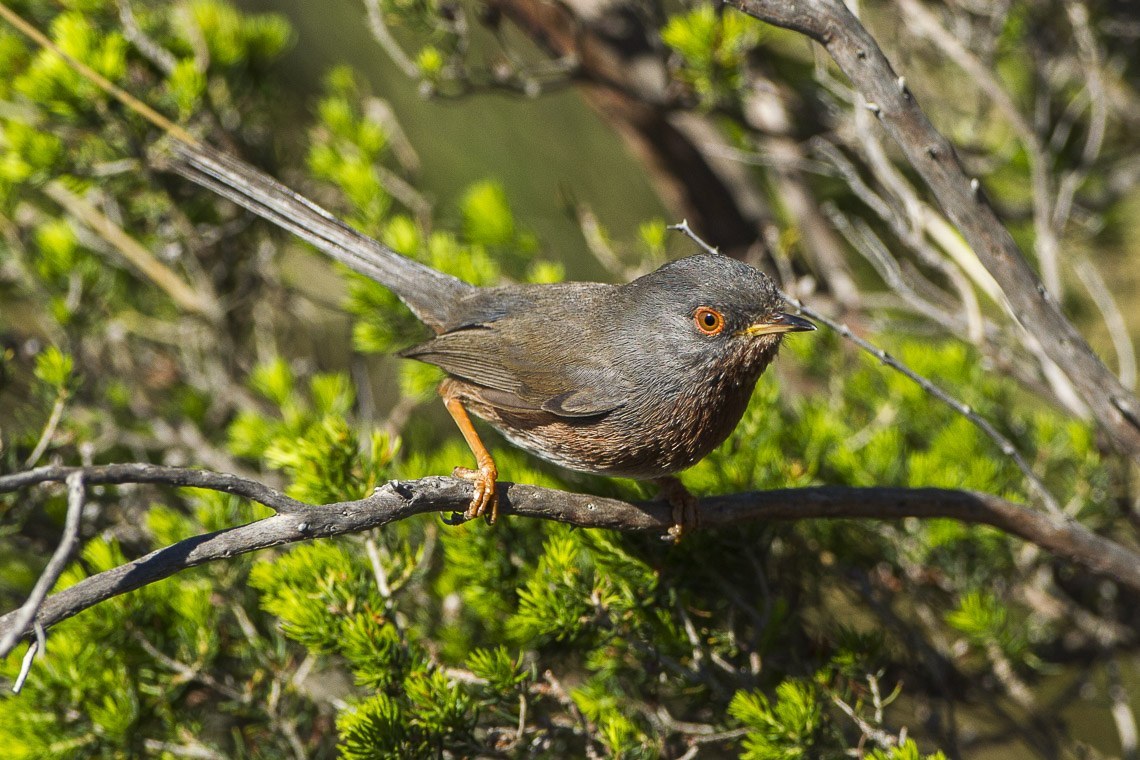
Overview
The Dartford Warbler (Curruca undata, formerly Sylvia undata) is a small, skulking warbler tied closely to heathland and gorse scrub in western Europe, notably in southern England, France, Spain, Portugal, and the Mediterranean region. It is a non-migratory (or only short-distance dispersive) species, unusual among Sylvia-type warblers.
Key Field Marks
- Size & shape: About 12–13.5 cm (4.75–5.25 in), small and slim with a notably long, often cocked tail relative to body size, giving a distinctive silhouette.
- Upperparts: Dark slate-gray to blackish-gray on the head and back.
- Underparts: Deep wine-red to maroon on the throat and breast (males brighter and more extensively colored than females), fading to paler, more grayish tones on the belly and undertail.
- Eye: Bright orange-red eye-ring and reddish-orange eye, conspicuous at close range against the dark head.
- Bill: Small, fine, and dark, typical of a warbler.
- Tail: Long, dark, and frequently flicked or cocked upward, often held at an angle while perched.
- Juveniles/females: Duller and browner overall, with less vivid underparts than adult males.
Similar Species
- Subalpine Warbler / Spectacled Warbler (partial range overlap in Mediterranean scrub): Both show pinkish underparts too, but have a pale mustachial stripe and different structure; Dartford Warbler is darker overall with a longer, more obviously cocked tail and lacks a pale supercilium.
- Marmora's/Balearic Warbler: Very similar overall shape but grayer underparts lacking the deep wine-red tone, and largely allopatric (western Mediterranean islands).
- Habitat (gorse/heath) combined with the long cocked tail and red eye-ring is usually enough to clinch Dartford Warbler.
Habitat & Range
Resident in lowland heathland, gorse, and Mediterranean maquis/scrub, particularly where gorse and heather dominate. Found from southern England (its historic English stronghold) through France, Iberia, and around the Mediterranean basin. Sedentary or only locally dispersive, and vulnerable to severe winters, which can cause sharp population crashes.
Behavior
Skulking and often hard to see well, staying low in dense gorse or heather, though males sing from an exposed perch, sometimes performing a brief song-flight above the scrub. Feeds low down on insects and spiders gleaned from vegetation.
Voice
Song is a scratchy, rapid, chattering warble, somewhat harsh and unmusical, delivered from a perch or in a short display flight. Call is a distinctive harsh, buzzy "tchirr" or grating "churr," often the first clue to its presence in dense cover.
Best Viewing Tips
Scan the tops of gorse bushes on heathland in southern England or Mediterranean scrub for a small dark bird with a long cocked tail; listen for the scratchy call from within the bushes, and wait for a male to pop up to sing from an exposed twig.
Frequently asked questions
What is the best field mark for a Dartford Warbler?
A small, dark warbler with a long, often cocked tail, wine-red underparts, and a bright red-orange eye-ring, usually seen low in gorse or heather.
Where does the Dartford Warbler live?
It is a resident of heathland and Mediterranean scrub in western Europe, including southern England, France, Iberia, and around the Mediterranean basin.
Is the Dartford Warbler migratory?
No, it is largely sedentary, though populations can crash after severe winters and slowly recolonize suitable habitat afterward.
How do I distinguish a Dartford Warbler from a Subalpine Warbler?
Dartford Warbler is darker overall, lacks a pale mustachial stripe, and has a proportionately longer, frequently cocked tail compared to the Subalpine Warbler.