
D'Arnaud's Barbet Identification Guide
A chunky, ground-loving East African barbet with bold yellow-and-black spotted plumage and a habit of performing duetting display dances at nest burrows.
Read the full D'Arnaud's Barbet encyclopedia entry →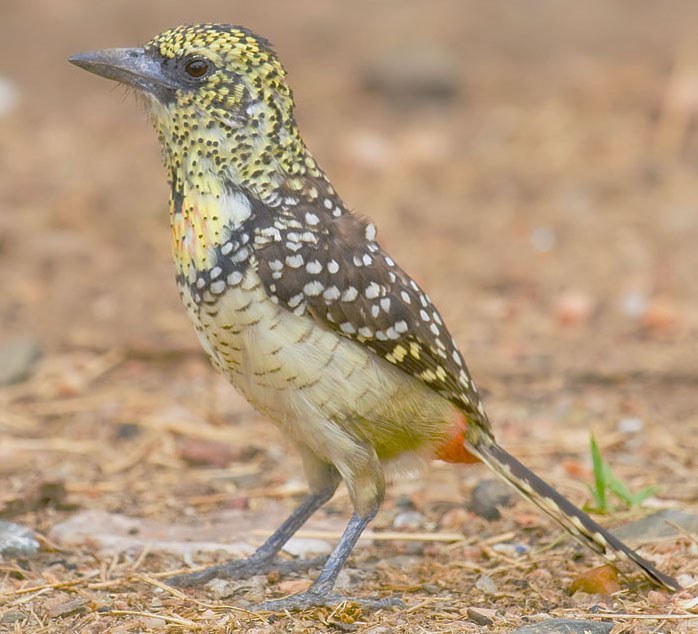
Overview
D'Arnaud's Barbet (Trachyphonus darnaudii) is a stocky, terrestrial barbet of East African savanna and bushland, notable for its heavily spotted plumage and its energetic duet displays performed with a mate at the nest entrance.
Key Field Marks
- Size & shape: About 18–20 cm (7–8 in), a plump, short-tailed, big-headed barbet often seen hopping on the ground.
- Head: Black crown finely spotted with yellow or white (variable by subspecies), yellow face and throat, sometimes with a small area of bare orange-red skin around the eye.
- Upperparts: Blackish-brown boldly spotted with yellow, giving a strongly speckled look on the back and wings.
- Underparts: Yellow, with a band of black spotting across the breast and a variable orange-red to yellow patch on the belly (subspecies-dependent, e.g., "Usambiro Barbet" form has a more orange belly).
- Bill: Stout, blackish, typical thick barbet bill.
- Tail: Blackish tail with paler tips visible from below.
Similar Species
- Red-and-yellow Barbet: Much more extensively red on the face and underparts with a broader black breast band and different overall color balance — bolder red rather than mostly yellow-spotted black.
- Yellow-breasted Barbet: Paler, plainer face without the dense black-and-yellow spangled back pattern.
- Range and the dense, evenly spotted upperparts pattern are the best clues to separate D'Arnaud's from its more red-faced relatives.
Habitat & Range
Resident in dry bushland, acacia savanna, and semi-arid scrub of East Africa, including Kenya, Tanzania, Uganda, and parts of Ethiopia and Somalia. Favors open country with scattered bushes and termite mounds used for nesting.
Behavior
Forages mostly on the ground, hopping between bushes to pick up insects, seeds, and fruit, and often excavates nest burrows in earth banks or termite mounds rather than tree cavities like most barbets. Pairs perform loud, synchronized duet displays with bowing, wing-flicking, and calling at the nest entrance to reinforce the pair bond and defend territory.
Voice
Duet call is a fast, repetitive, bubbling "pudi-pudi-pudi" or similar chattering series, delivered antiphonally by the pair so quickly it can sound like one bird. This vocal duetting display is one of the best ways to detect the species.
Best Viewing Tips
Listen for the fast duetting chatter near termite mounds or earthen banks in acacia savanna; watch for a pair hopping on open ground near a burrow entrance, bowing and calling together.
Frequently asked questions
What is distinctive about D'Arnaud's Barbet's behavior?
Pairs perform synchronized duet displays at their nest burrow, bowing and calling together in a fast, bubbling chatter that helps maintain their pair bond.
Where does D'Arnaud's Barbet nest?
Unlike most barbets that nest in tree cavities, it excavates a burrow in an earth bank or termite mound.
How is D'Arnaud's Barbet different from the Red-and-yellow Barbet?
D'Arnaud's is more heavily yellow-spotted black overall with less red, while the Red-and-yellow Barbet shows much more extensive red on the face and underparts.
Where is D'Arnaud's Barbet found?
It lives in dry bushland and acacia savanna across East Africa, including Kenya, Tanzania, and Uganda.