
Curl-crested Aracari Identification Guide
An unmistakable Amazonian toucan relative with glossy, curled, patent-leather-like feathers on its crown and a large bicolored bill.
Read the full Curl-crested Aracari encyclopedia entry →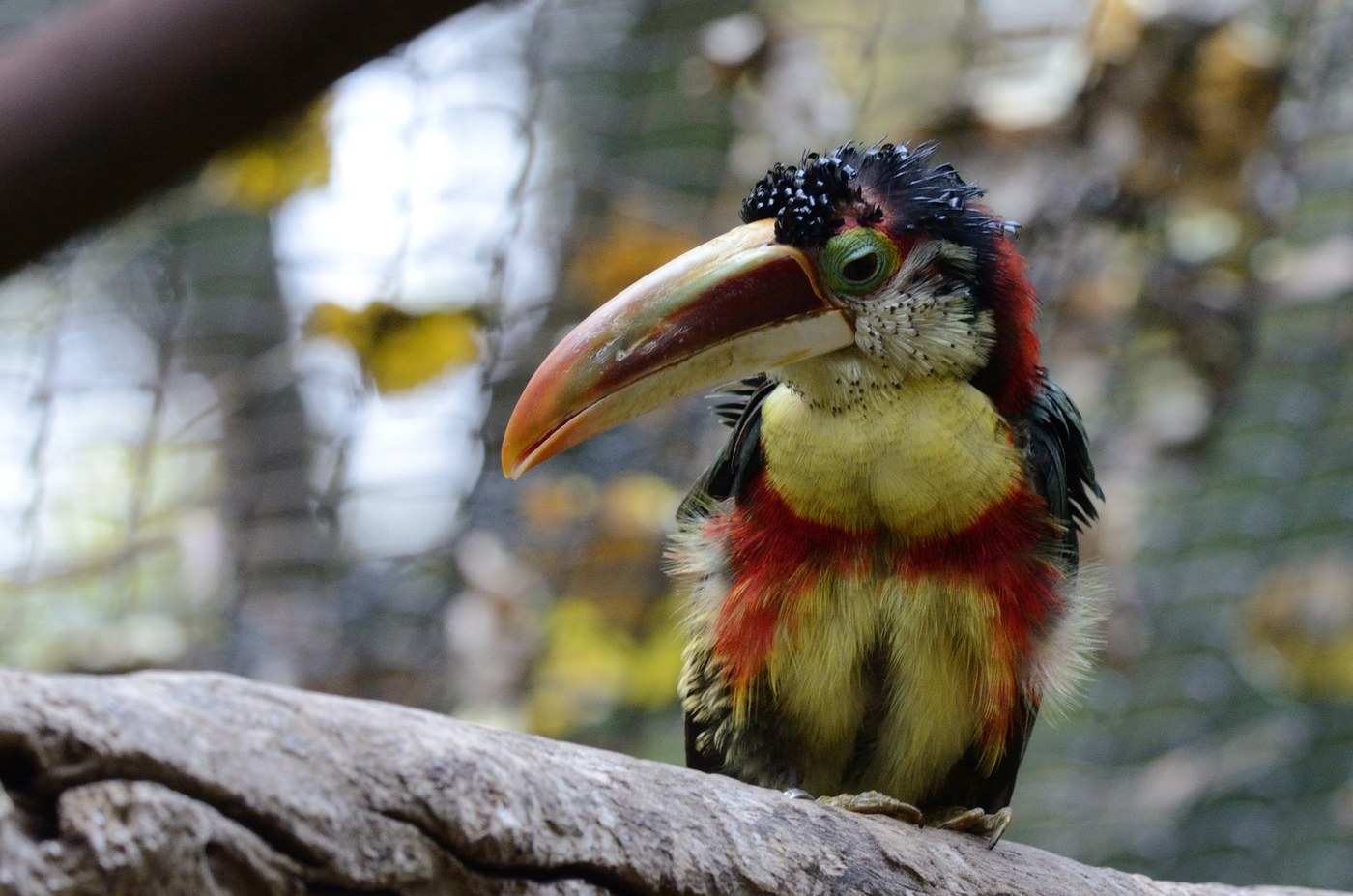
Overview
The Curl-crested Aracari (Pteroglossus beauharnaesii) is a small toucan (a member of the aracari group) found in the western Amazon basin. Its bizarre, glossy curled crown feathers make it one of the most distinctive birds in the toucan family and essentially unmistakable where it occurs.
Key Field Marks
- Size & shape: About 41–46 cm (16–18 in) long including a long, slim, arched bill; slender toucan body shape with a long graduated tail.
- Crown: Unique glossy, curly black feathers on the crown that look like shiny plastic or lacquered wood shavings — diagnostic and unlike any other bird.
- Bill: Large, laterally flattened bill, pale yellowish on the upper mandible with a dark culmen ridge, blackish lower mandible, and a fine pale line along the base.
- Body: Mostly dark, glossy blackish-green upperparts; underparts yellow with a broad red band across the belly, scalloped with black spots — a classic aracari underpart pattern.
- Bare skin: Pale bluish to greenish skin around the eye contrasting with the dark head.
- Tail: Long, dark, and graduated, often held loosely.
Similar Species
- Other Amazonian aracaris (e.g., Chestnut-eared Aracari, Many-banded Aracari): All lack the curled, glossy crown feathers — no other aracari shares this crown texture, making the Curl-crested unmistakable when the crown is seen well.
- In poor light or brief glimpses, focus on the odd "wet-look" curled crown rather than bill color, which can appear similar to other Pteroglossus species.
Habitat & Range
Resident in humid lowland and foothill terra firme and várzea forest of the western Amazon basin, mainly in eastern Peru, western/central Brazil (south of the Amazon River, Madeira-Tapajós interfluve region), and adjacent Bolivia. Stays in forest canopy and subcanopy, rarely at edges.
Behavior
Travels in small noisy family groups of 4–10 birds through the canopy, hopping along branches and making short flap-and-glide flights between trees. Feeds on fruit, supplemented with insects, small vertebrates, and nestlings/eggs of other birds. Roosts communally in tree cavities, several birds packed in together with tails folded over their backs.
Voice
Gives sharp, squeaky, high-pitched "tsick" or "pseek" calls, often repeated in a chattering series as the flock moves through the canopy — higher-pitched and less throaty than the croaking calls of true toucans.
Best Viewing Tips
Scan the mid-to-upper canopy of terra firme forest in the western Amazon (e.g., Manu or Tambopata in Peru) for small mixed groups moving through fruiting trees; the curled crown is visible even at a distance in good light.
Frequently asked questions
What makes the Curl-crested Aracari so easy to identify?
Its glossy, curled black crown feathers, which look like shiny plastic curls, are unique among toucans and aracaris and instantly separate it from every other species.
Where does the Curl-crested Aracari live?
It is restricted to humid lowland forest in the western Amazon basin, chiefly in eastern Peru and adjacent Brazil and Bolivia.
Does the Curl-crested Aracari have red on its underparts like other aracaris?
Yes, it shares the typical aracari pattern of yellow underparts crossed by a red band with black spotting, but the curled crown remains the key distinguishing feature.
Are Curl-crested Aracaris social?
Yes, they travel and roost in small family groups, often seen moving noisily together through the forest canopy.