
Cuban Amazon Identification Guide
A medium-sized Caribbean parrot with a green body, white forehead, rosy-pink throat patch, and blue-tinged cheeks, found in Cuba, the Bahamas, and the Cayman Islands.
Read the full Cuban Amazon encyclopedia entry →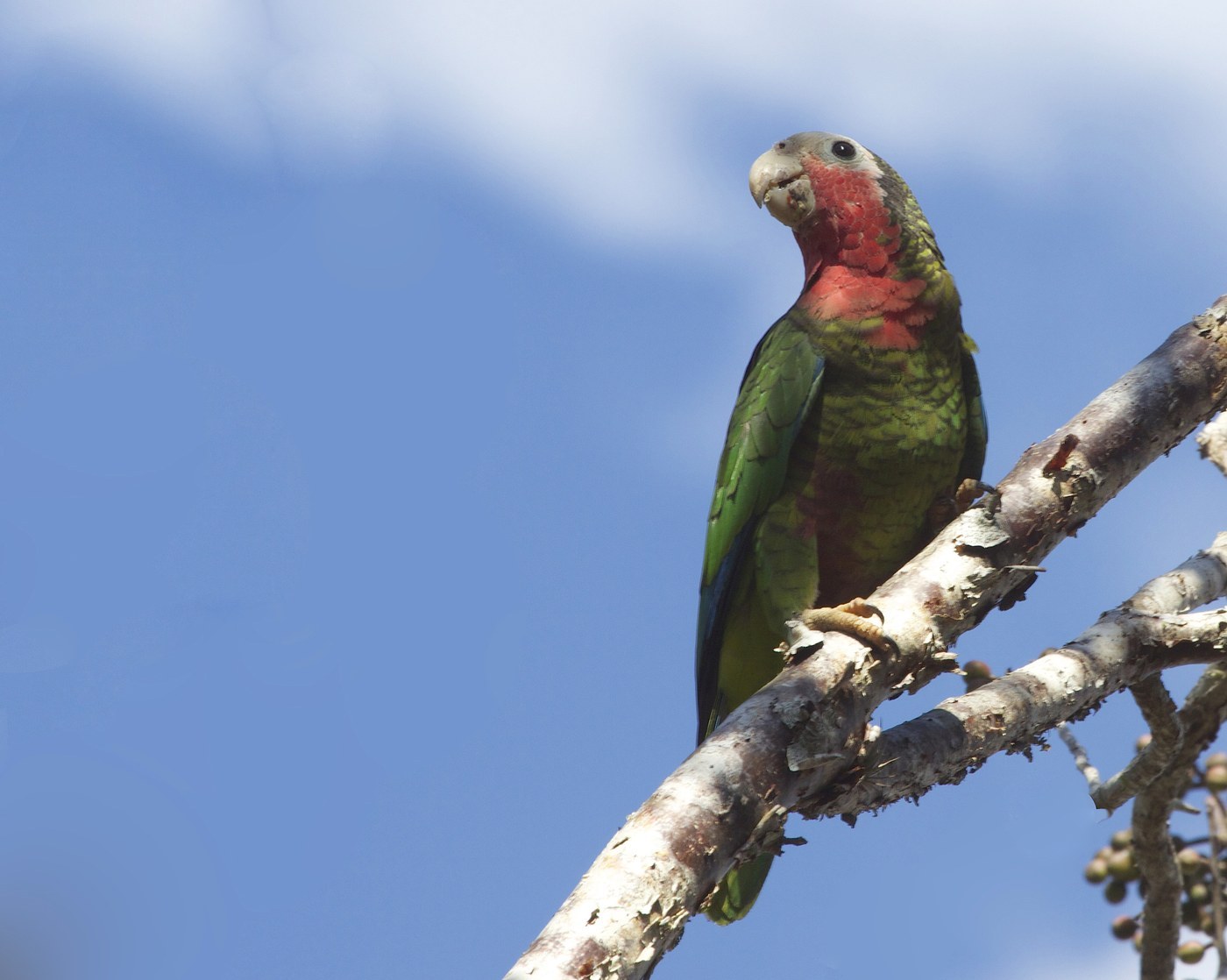
Overview
The Cuban Amazon (Amazona leucocephala) is a stocky, medium-sized parrot endemic to the Caribbean, occurring in Cuba, the Bahamas, and the Cayman Islands. It is one of the more colorful Amazon parrots, with a patchwork of green, white, pink, and blue on the head and chest that varies by island population.
Key Field Marks
- Size & shape: About 28–33 cm (11–13 in) long; stocky Amazon-parrot build with a short, squared tail and a large, strongly hooked pale bill.
- Head pattern: White forehead and forecrown; blue-gray wash across the cheeks and ear coverts.
- Throat and breast: Rosy-pink to reddish patch on the throat and upper breast, edged below by green.
- Body: Bright green overall, each body feather often narrowly edged in black, giving a faintly scaled look on the nape, belly, and flanks.
- Belly patch: Variable maroon patch on the lower belly, more pronounced in Bahamian and Cayman birds than in most Cuban birds.
- Wings/tail: Green wings with a small red speculum near the bend of the wing, visible in flight; green tail sometimes shows a thin yellowish tip.
- Bare parts: Pale horn-colored bill, dark eyes with a narrow pale eye-ring, gray legs and feet.
Similar Species
- Hispaniolan Amazon: Lacks the pink throat patch; has a more solidly white forehead without the blue cheek wash, and red confined mainly to the wing.
- Cuban Parakeet (range overlap in Cuba): Much smaller, slimmer, long-tailed, and lacks the white face and pink throat.
- Other Caribbean Amazons (Hispaniolan, Puerto Rican) are allopatric (non-overlapping in range), so location alone is often diagnostic.
Habitat & Range
Resident in forests, pine woodlands, and wooded scrub of Cuba, the Isla de la Juventud, Great Inagua and Abaco in the Bahamas, and Cayman Brac. Prefers areas with large trees for cavity nesting, including limestone forest and palm savanna. Non-migratory; pairs and small flocks move locally in search of fruiting and flowering trees.
Behavior
Forages in the canopy on fruits, seeds, flowers, and buds, often in pairs or small noisy flocks. Flight is direct and fairly fast on shallow wingbeats, with the red wing patch flashing. Roosts communally in some areas.
Voice
Gives loud, harsh, screeching and squawking calls typical of Amazon parrots, along with softer chattering notes between paired birds. Flight calls are sharp, repeated screeches audible well before the birds come into view.
Best Viewing Tips
Look and listen for flocks moving between fruiting trees at dawn and dusk in Cuban forest reserves (e.g., Zapata Swamp) or on Abaco and Great Inagua in the Bahamas; scan tall snags for nesting or roosting birds.
Frequently asked questions
What is the easiest field mark for a Cuban Amazon?
The combination of a white forehead, blue-gray cheeks, and a rosy-pink throat patch on an otherwise green Amazon parrot is diagnostic within its range.
Where is the Cuban Amazon found?
It is endemic to Cuba, the Isla de la Juventud, parts of the Bahamas (notably Abaco and Great Inagua), and Cayman Brac.
How can I tell a Cuban Amazon from other Amazon parrots?
Range is usually decisive since Caribbean Amazons rarely overlap; plumage-wise, the pink throat combined with a white forehead and blue cheek patch separates it from relatives like the Hispaniolan Amazon.
Is the Cuban Amazon endangered?
It is considered Near Threatened, with populations reduced by habitat loss and historically by capture for the pet trade, though some island populations remain locally common.