
Crowned Lapwing Identification Guide
A common African grassland plover instantly recognized by the striking white ring encircling its black cap and its loud, persistent alarm calls.
Read the full Crowned Lapwing encyclopedia entry →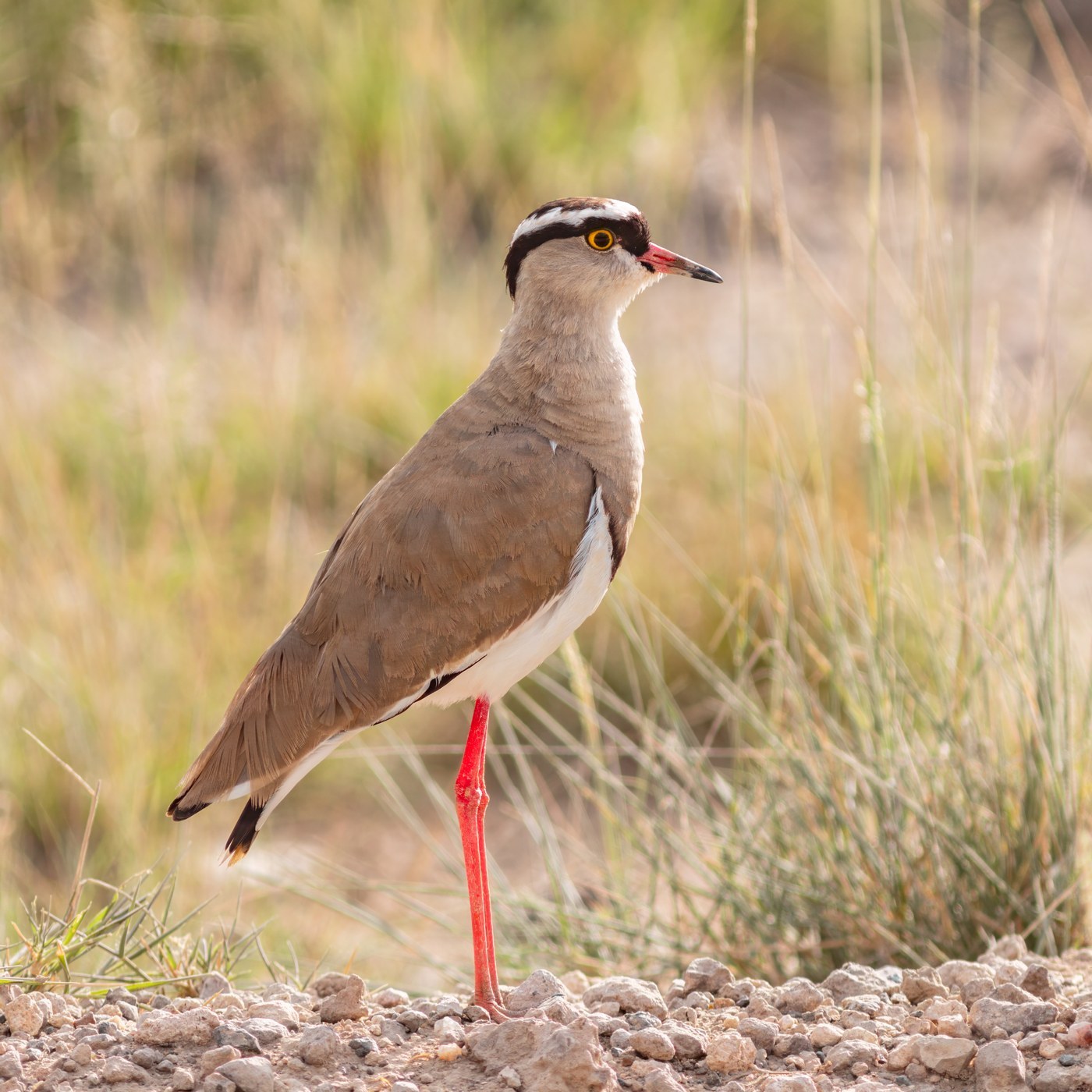
Key Field Marks
- Size & shape: A medium-sized plover/lapwing with long legs and an upright stance typical of the family.
- Head pattern: A black cap encircled by a distinct white ring — the "crown" that gives the species its name — is the single most diagnostic feature.
- Body: Sandy-brown upperparts, white underparts, and a black breast band separating the two.
- Bare parts: A bright red eye-ring and a black bill with a red base, along with long pinkish-red legs.
Separating It From Similar Species
- Black-winged Lapwing / Senegal Lapwing: Both lack the complete white ring around the black cap and differ in wing pattern and range/season.
- Wattled Lapwing: Shows fleshy yellow wattles in front of the eyes and lacks the white crown ring entirely.
- The complete white ring circling the black cap is unique among African lapwings and makes this species straightforward to identify with a clear head view.
Where & When to See It
- Range: Widespread across eastern and southern Africa, common in countries such as Kenya, Tanzania, and South Africa.
- Habitat: Open short grassland, savanna, farmland, golf courses, and airfields — favors dry, open, closely cropped terrain.
- Season: Largely resident, though some local movements occur in response to rainfall and grazing conditions.
Voice & Behavior
- Voice: A loud, strident, repeated "kreep-kreep" or "kar-r-r-eet" alarm call, given persistently, including at night, especially near a nest.
- Habits: Highly vocal and vigilant, often the first to raise an alarm at approaching predators or people; frequently seen in small groups on short grass.
- Nesting: Lays eggs in a simple scrape on bare or short grassy ground, relying on aggressive mobbing and alarm calls to defend the nest.
Frequently asked questions
What is the most distinctive feature of a Crowned Lapwing?
The complete white ring encircling its black cap, which gives the species its common name and is unique among African lapwings.
Why is the Crowned Lapwing so noisy?
It is highly vigilant and gives loud, repeated alarm calls, especially near its nest or when disturbed, often continuing after dark.
What habitat does the Crowned Lapwing prefer?
Open, short grassland and dry savanna, including farmland, golf courses, and airfields.
How do you tell a Crowned Lapwing from a Wattled Lapwing?
Crowned Lapwing has a white ring around its black cap and no facial wattles, while Wattled Lapwing has fleshy yellow facial wattles and lacks the white crown ring.