
Crissal Thrasher Identification Guide
A skulking, long-tailed desert thrasher identified by its strongly curved black bill, plain gray body, and rich chestnut undertail coverts.
Read the full Crissal Thrasher encyclopedia entry →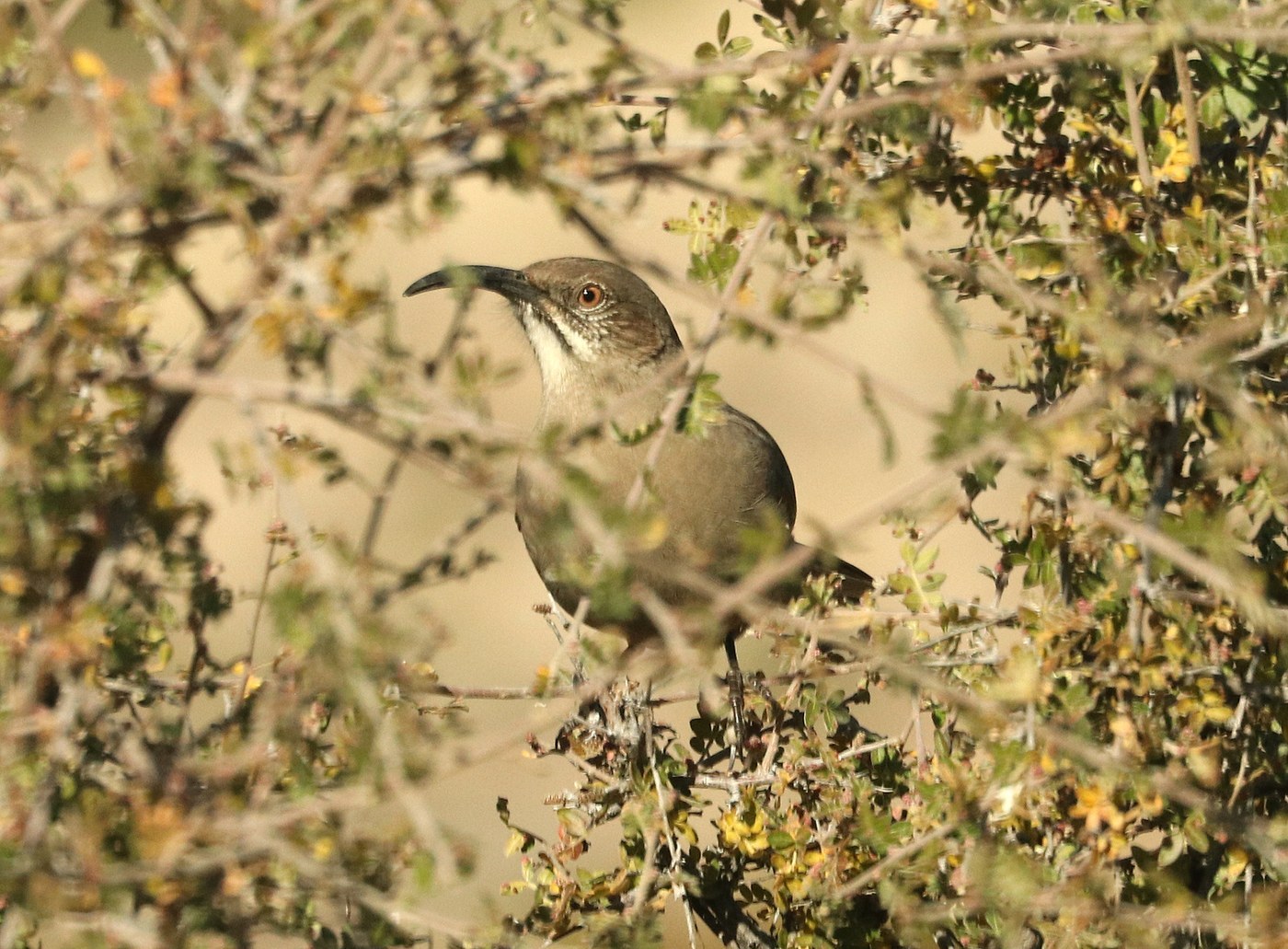
Key Field Marks
- Size & shape: A large, slender thrasher with a long tail, often held slightly cocked, and an overall drab appearance.
- Bill: Long and strongly downcurved, more sharply curved than most other thrasher species in its range.
- Plumage: Plain grayish-brown overall with unstreaked underparts (unlike some other thrashers), and a diagnostic rich chestnut-rufous patch under the tail (the "crissum," for which it is named).
- Eye: Dark eye without the pale iris found in some related species.
Separating It From Similar Species
- Le Conte's Thrasher: Paler and sandier overall, with a shorter-looking tail relative to body, and found in more open, sparsely vegetated desert flats.
- Bendire's Thrasher: Shorter, straighter bill, streaked/spotted breast, and a pale eye — quite different from Crissal's plain underparts and dark eye.
- California Thrasher: Overlaps only marginally in range, is larger and darker overall, and lacks the rufous crissum as a standout contrast feature.
- The combination of a strongly curved bill, unstreaked gray underparts, and chestnut undertail coverts is the most reliable ID combination.
Where & When to See It
- Range: Southwestern United States (Arizona, New Mexico, southern Nevada, southern Utah, west Texas, southeastern California) and northern Mexico.
- Habitat: Dense desert scrub, mesquite thickets, and riparian washes in arid lowlands — favors thick brush rather than open ground.
- Season: Largely resident year-round within its range.
Voice & Behavior
- Voice: A rich, melodious song with repeated phrases in the mimid tradition, along with a sharp, distinctive "chidurr" or whistled call note.
- Habits: Notoriously skulking, spending most of its time hidden in dense brush and rarely venturing into the open; more often heard than seen.
- Diet: Forages on the ground, using its curved bill to probe leaf litter and soil for insects.
Frequently asked questions
What does 'crissal' refer to in this bird's name?
It refers to the crissum, the area of feathers under the tail, which is a distinctive rich chestnut color in this species.
How do you tell a Crissal Thrasher from a Bendire's Thrasher?
Crissal Thrasher has a longer, more strongly curved bill, a dark eye, and plain unstreaked underparts, while Bendire's has a shorter, straighter bill, a pale eye, and a spotted breast.
Why is the Crissal Thrasher hard to see?
It is a notoriously skulking species that spends most of its time hidden deep within dense desert scrub and mesquite thickets.
What habitat does the Crissal Thrasher prefer?
Dense desert scrub, mesquite thickets, and riparian washes in arid lowland regions of the southwestern US and northern Mexico.