
Crimson-backed Tanager Identification Guide
A striking South American tanager with velvety black wings and tail set against a brilliant crimson-red back, throat, and breast.
Read the full Crimson-backed Tanager encyclopedia entry →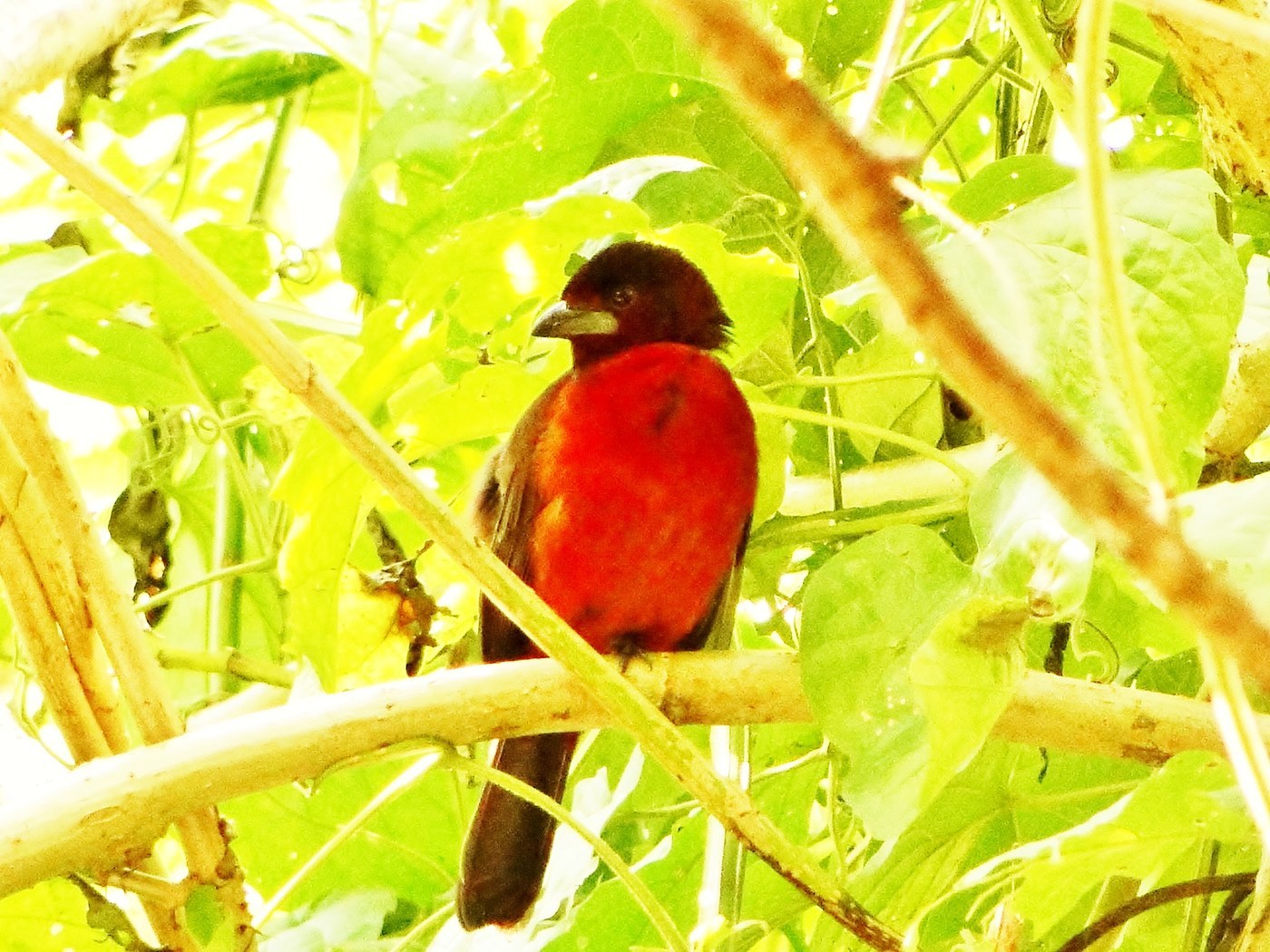
Key Field Marks
- Size & shape: A medium-sized tanager with a fairly stout, conical bill typical of the tanager family.
- Male plumage: Velvety black head, wings, and tail contrasting with a bright crimson-red back, rump, throat, and breast that extends down the mantle.
- Bill: Bicolored — pale silvery-blue on the lower mandible, contrasting with a darker upper mandible.
- Female plumage: Much duller, with orange-red to brownish tones replacing the male's crimson, and a duskier overall appearance.
Separating It From Similar Species
- Crimson-collared Tanager (Central America): Shows red confined to a collar around the neck and rump rather than covering the full back — ranges barely overlap.
- Passerini's Tanager / Cherrie's Tanager / Flame-rumped Tanager: All show a red or scarlet rump but retain a black back and mantle, unlike Crimson-backed Tanager's fully red back.
- The key distinguishing feature is the extent of red covering the entire back down to the rump, not just a collar or rump patch.
Where & When to See It
- Range: Colombia and Venezuela, with a more localized presence in Panama.
- Habitat: Forest edge, scrubby second growth, gardens, and semi-open lowland habitats.
- Season: Resident year-round; not migratory.
Voice & Behavior
- Voice: A thin, high-pitched call note and a simple, unremarkable warbling song typical of many tanagers.
- Habits: Often forages in pairs or small groups, frequently visiting fruiting trees and garden feeders in its range.
- Diet: Primarily fruit, supplemented with insects.
Frequently asked questions
How do you tell a Crimson-backed Tanager from a Crimson-collared Tanager?
Crimson-backed Tanager has red covering the entire back and mantle, while Crimson-collared Tanager shows red restricted to a narrow collar around the neck and rump, with a black back.
Are male and female Crimson-backed Tanagers similarly colored?
No, males are brilliant crimson and black, while females are duller with orange-red to brownish tones.
Where is the Crimson-backed Tanager found?
It occurs in Colombia and Venezuela, with a smaller range extending into Panama.
What habitat does the Crimson-backed Tanager prefer?
Forest edges, gardens, and scrubby second-growth vegetation in lowland areas.