
Crested Oropendola Identification Guide
A large glossy-black South American icterid known for its chestnut-and-yellow tail, pale eyes, and colonial nests of long woven hanging pouches.
Read the full Crested Oropendola encyclopedia entry →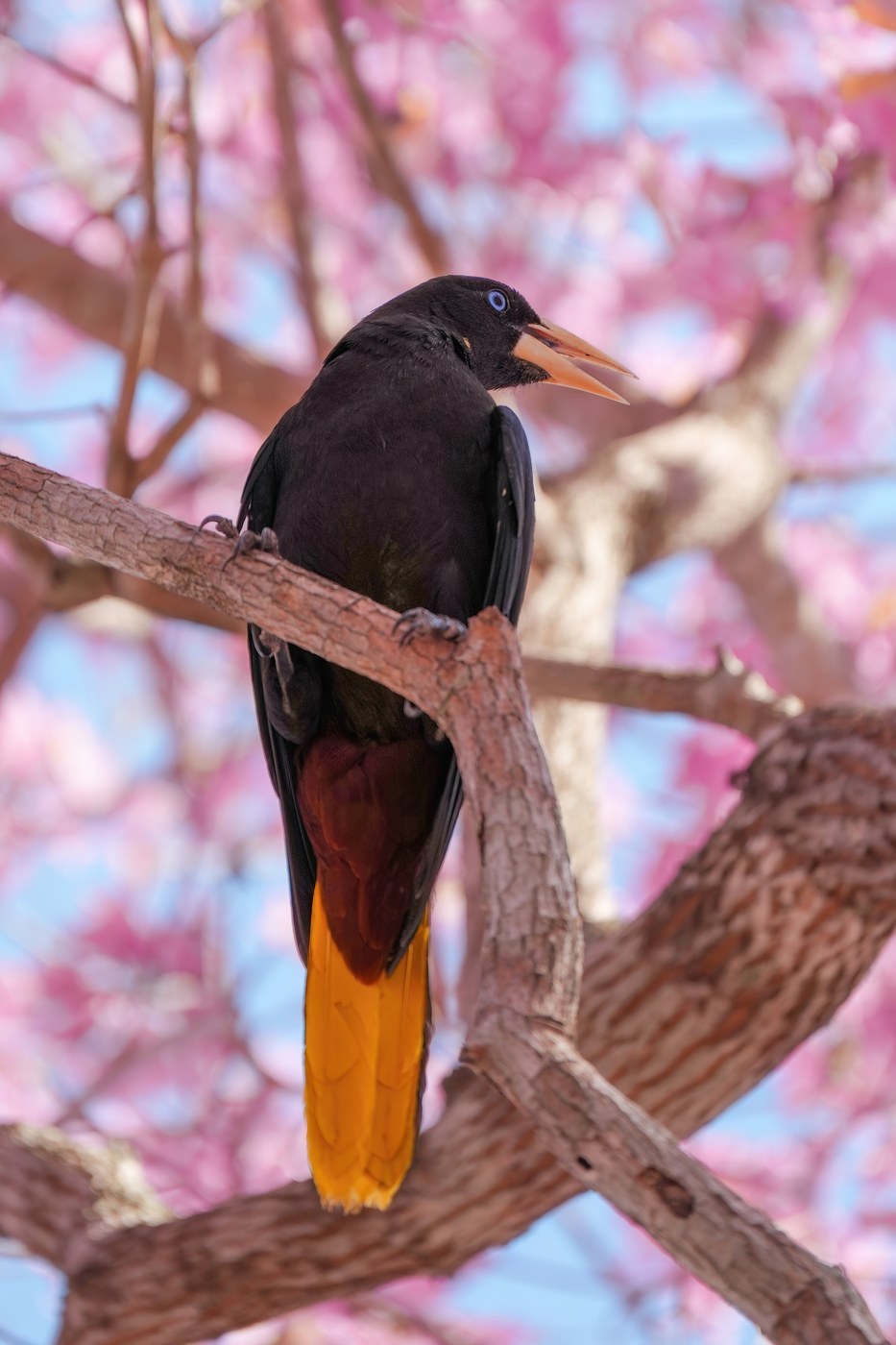
Key Field Marks
- Size & shape: A large, long-tailed member of the blackbird family (Icteridae), noticeably bigger than a grackle, with a heavy, pointed bill.
- Plumage: Overall glossy black body with a contrasting chestnut/maroon rump and central tail feathers, while the outer tail feathers are bright yellow — very obvious in flight or when the tail is fanned.
- Bare parts: Pale blue eyes and a mostly black bill with a reddish-orange tip.
- Crest: Thin, wispy black feathers on the crown form a subtle crest that is easy to overlook in the field.
- Sexes: Males are considerably larger than females, though plumage is similar in both.
Separating It From Similar Species
- Other oropendolas (e.g., Russet-backed, Chestnut-headed): Differ in the extent of chestnut coloring, bill color, and bare facial skin — check overall body color pattern and bill pattern.
- Yellow-rumped Cacique: Smaller, with yellow confined to the rump and wing patches rather than the tail, and lacks the oropendola's long wedge-shaped tail.
- Great-tailed Grackle: All-black with a much longer, keel-shaped tail and no yellow tail patches.
Where & When to See It
- Range: Panama through Colombia, Venezuela, the Guianas, Trinidad, and Amazonian South America south to Bolivia, Paraguay, and northern Argentina.
- Habitat: Forest edges, clearings, riverine woodland, and plantations, often near colonial nest trees.
- Season: Resident throughout its range; not migratory.
Voice & Behavior
- Song: A loud, liquid, gurgling series of notes, delivered while the male performs a bowing display with wings raised and tail fanned.
- Nesting: Highly colonial, building long, pendulous woven nests — often over a meter long — that hang in clusters from tall trees.
- Diet: Fruit, nectar, and insects, often foraged in the forest canopy.
Frequently asked questions
Why is it called an oropendola?
The name refers to the long, pendulous, woven hanging nests the colony builds, which sway from tree branches like pendulums.
How can you tell a Crested Oropendola from other oropendolas?
Look at the tail pattern (chestnut center with yellow outer feathers), pale blue eyes, and the black bill with a reddish-orange tip in combination with overall size.
Is the crest on a Crested Oropendola obvious?
No, it is a subtle tuft of thin feathers on the crown and is often hard to see in the field.
Do Crested Oropendolas nest in colonies?
Yes, they are highly colonial, with dozens of pendulous nests often clustered in a single tall tree.