
Crested Caracara Identification Guide
A long-legged, ground-walking falcon relative with a black cap, pale face, and bold black-and-white body pattern, often seen scavenging in open country.
Read the full Crested Caracara encyclopedia entry →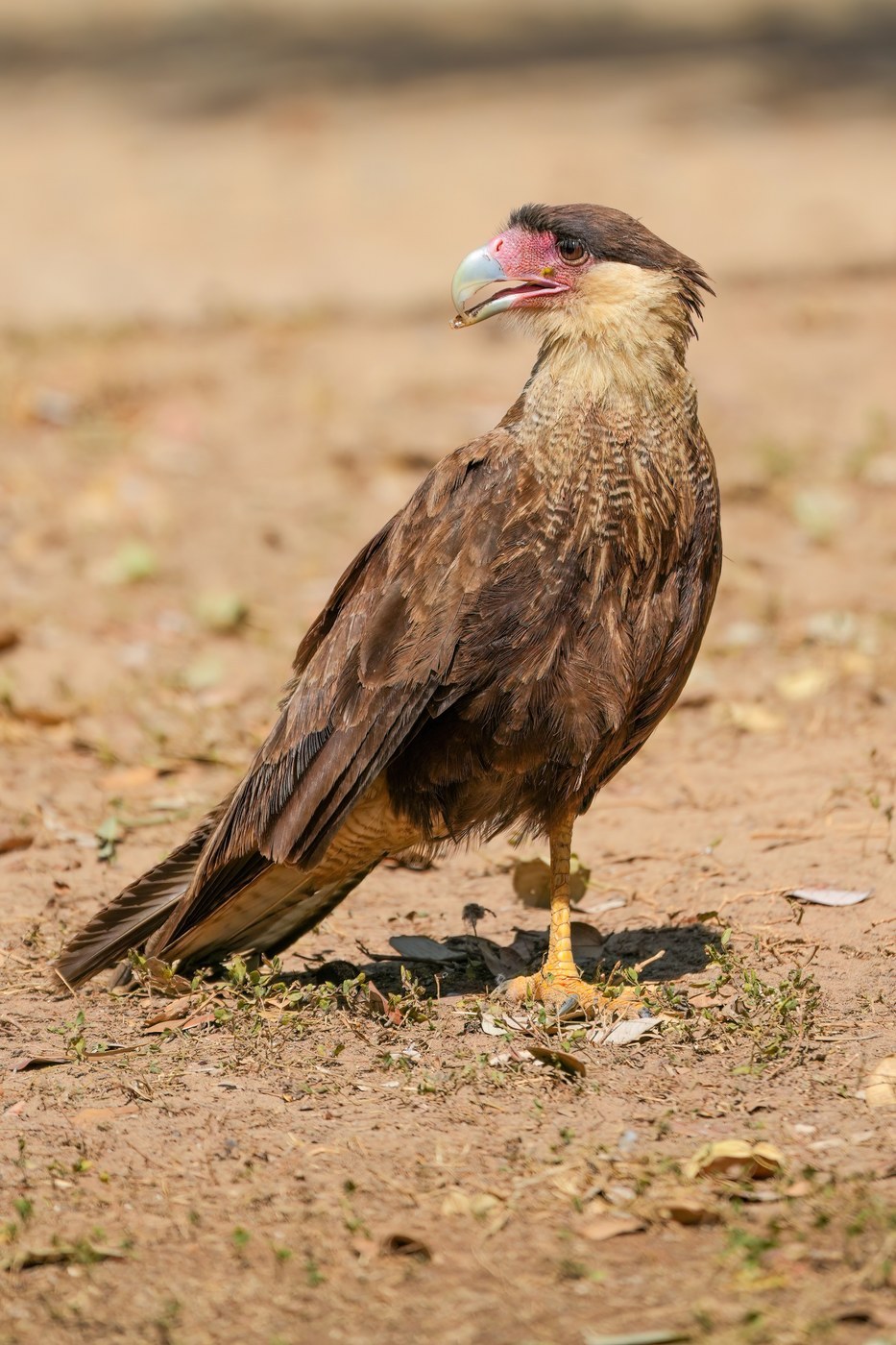
Key Field Marks
- Size & shape: A large raptor (about 50–58 cm) with a long neck, long legs, and a flat-headed profile unlike typical falcons.
- Head: Black cap with a short bushy crest, contrasting pale yellowish-white face and throat, and a heavy blue-gray hooked bill.
- Body: Blackish body and wings with a white neck and upper breast that is finely barred black.
- In flight: Pale patches at the base of the primaries ('windows'), a whitish tail with a broad black terminal band, and slow, steady, somewhat labored wingbeats interspersed with glides.
- Legs: Long, bare, yellow-orange legs adapted for walking and running on the ground.
Separating It From Similar Species
- Turkey Vulture / Black Vulture: Both lack the caracara's white neck and long yellow-orange legs; caracaras also fly with flatter, steadier wingbeats rather than vultures' teetering or heavy flapping.
- Chimango Caracara / Yellow-headed Caracara (South America): Both are noticeably smaller and lack the strong black-white-black head/breast/cap contrast of Crested Caracara.
- Ground behavior is a strong clue: Crested Caracaras habitually walk and run on the ground, something few other raptors do regularly.
Where & When to See It
- Range: Southern United States (Texas, Arizona, Florida), Mexico, Central America, and much of South America.
- Habitat: Open country — grassland, ranchland, agricultural fields, and roadsides.
- Season: Largely resident (non-migratory) throughout its range.
Voice & Behavior
- Voice: A harsh, rattling cackle, most often given during displays or interactions at carcasses.
- Feeding: An opportunistic scavenger frequently seen at roadkill and carrion alongside vultures, but also actively hunts small mammals, reptiles, and insects.
- Habits: Bold and often approachable; commonly perches on fence posts, poles, or the ground.
Frequently asked questions
Is the Crested Caracara a falcon?
Yes, taxonomically it belongs to the falcon family (Falconidae), though its long legs, ground-walking habit, and scavenging behavior make it look and act quite differently from typical falcons.
How do you tell a Crested Caracara from a vulture at a distance?
Look for steadier, flatter wingbeats, a white neck and tail, and long legs — vultures teeter in flight and lack the caracara's crisp black-and-white pattern.
Where in the US can you see a Crested Caracara?
Resident populations occur in southern Texas, southern Arizona, and central Florida, especially in open ranchland.
What does a Crested Caracara eat?
It is an opportunistic feeder, eating carrion as well as live prey such as insects, small mammals, reptiles, and eggs.