
Crested Barbet Identification Guide
A chunky, garden-friendly African barbet told at a glance by its yellow-and-black spotted plumage, red face patch, and constant rattling call.
Read the full Crested Barbet encyclopedia entry →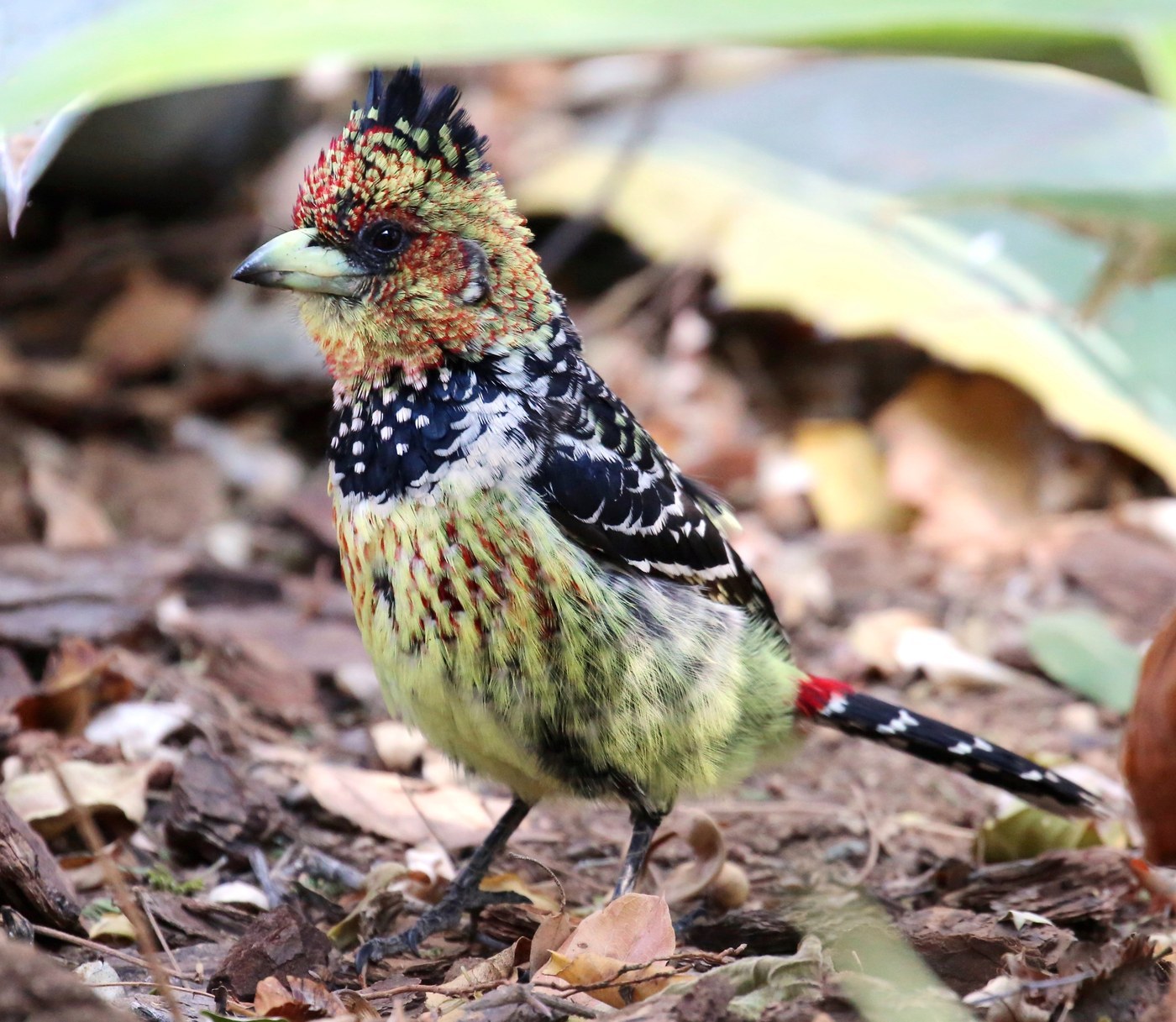
Key Field Marks
- Size & shape: A stocky, big-headed bird around 23 cm long with a heavy, pale, chisel-shaped bill built for excavating dead wood.
- Plumage: Bold black-and-yellow spotted body, a black bib flecked with white, and a bright red patch of bare skin around the face and throat.
- Crest: A short, ragged black crest on the crown that gives the species its name, though it is often held flat and can be hard to see.
- Bare parts: Pale horn-colored bill and dark legs.
- Sexes: Males and females look alike, making this an easy species to sex-neutral ID.
Separating It From Similar Species
- Black-collared Barbet: Also has a red face, but shows a solid black collar and lacks the Crested Barbet's dense yellow spotting and shaggy crest.
- Woodpeckers: Crested Barbets are chunkier and shorter-tailed than any sympatric woodpecker, with a stubbier bill and no stiff tail props.
- Overall, the combination of red face, dense yellow-and-black spangled body, and loud sustained rattle is diagnostic.
Where & When to See It
- Range: Southern Africa, including South Africa, Zimbabwe, Botswana, Namibia, Mozambique, and Zambia.
- Habitat: Woodland, savanna, riverine thicket, and — notably — suburban gardens, where it readily visits fruit feeders.
- Season: Resident year-round; not migratory.
Voice & Behavior
- Song: An extraordinarily long, mechanical trilling rattle, often likened to an old-fashioned alarm clock, sometimes sustained for a minute or more.
- Nesting: Excavates its own cavity in dead or soft wood, sometimes reusing old woodpecker holes.
- Feeding: Omnivorous, eating fruit, insects, and occasionally small vertebrates or eggs.
Frequently asked questions
What does a Crested Barbet sound like?
It gives an extremely long, buzzy, mechanical rattle or trill that can run on continuously for many seconds, often compared to a ringing alarm clock.
Is the Crested Barbet's crest easy to see?
Not always — the shaggy black crest is often held flat against the crown and only becomes obvious when the bird is agitated or displaying.
Where is the best place to find a Crested Barbet?
They are common and confiding in southern African gardens, parks, and woodland edges, often visiting fruit feeders.
How can I tell a Crested Barbet from a Black-collared Barbet?
Crested Barbet is densely spotted yellow and black all over with a ragged crest, while Black-collared Barbet has a clean black collar and lacks spotting.