
Costa's Hummingbird Identification Guide
A tiny desert hummingbird whose male sports a brilliant violet-purple gorget flared into elongated points, easily separated from Black-chinned and Anna's Hummingbirds by shape, color, and habitat.
Read the full Costa's Hummingbird encyclopedia entry →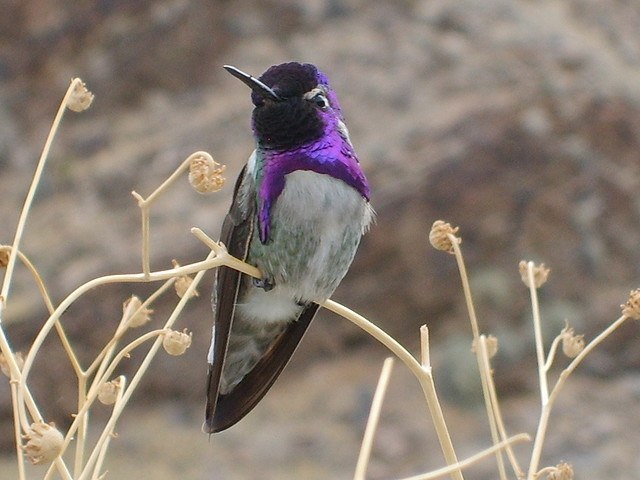
Key Field Marks
- Size & shape: A very small hummingbird, about 7.5–9 cm, among the smallest hummingbirds in North America.
- Male plumage: A brilliant, iridescent violet-purple crown and gorget, with the gorget feathers extended into elongated points that flare out to the sides of the neck like a mustache; greenish back and whitish underparts with greenish flanks.
- Female plumage: Green above and pale below, with a faint dusky eye stripe; may show a few scattered purple throat spots but lacks the male's full colored crown and gorget.
- Behavior: Favors arid desert scrub and chaparral; males perform a spectacular high-speed diving display accompanied by a distinctive high-pitched whistling sound produced by the tail and wing feathers, and often perch conspicuously on exposed twigs.
Separating It From Similar Species
- Black-chinned Hummingbird: Male shows a black chin with only a narrow band of purple at the base of the gorget (not a full flared purple gorget), and habitually pumps its tail while hovering, unlike Costa's.
- Anna's Hummingbird: Larger overall, with the male's rose-red to magenta gorget and crown covering the entire head and throat in a rounded shape rather than Costa's flared, pointed mustache-like extensions.
- Female Costa's vs. other female hummingbirds: Best separated by range, small size, and habitat (arid desert scrub) combined with the faint eye stripe and lack of strong facial markings.
Where & When to See It
- Habitat: Desert washes, arid scrub, chaparral, and increasingly gardens in desert cities that offer nectar sources.
- Range: Southwestern United States (California, Arizona, Nevada) and northwestern Mexico, including Baja California.
- Season: Some populations show altitudinal and seasonal movement; the species is noted for breeding very early in the year, often January through March, timed to track the desert spring bloom.
Voice
- Males produce a thin, high-pitched whistling sound during their dramatic diving display flights; the call note is a sharp, dry "tik."
Frequently asked questions
What makes a male Costa's Hummingbird's gorget distinctive?
The violet-purple gorget feathers extend outward into elongated, pointed flares on either side of the neck, giving a mustache-like appearance unlike the rounder gorgets of related species.
How do you tell Costa's Hummingbird from Black-chinned Hummingbird?
Male Costa's has a full violet-purple gorget flared into points, while male Black-chinned shows mostly a black chin with only a narrow purple band at the base and habitually pumps its tail in flight.
How is Costa's Hummingbird different from Anna's Hummingbird?
Costa's is smaller, and its male's gorget color is violet-purple with pointed lateral extensions, whereas Anna's male shows a rose-red to magenta gorget and crown that cover the head and throat in a more rounded shape.
What habitat does Costa's Hummingbird prefer?
It favors hot, arid desert scrub, washes, and chaparral, and increasingly visits desert gardens with nectar-bearing flowers or feeders.
When does Costa's Hummingbird breed?
It often breeds unusually early, from January through March, timed to coincide with the desert spring wildflower bloom.