
Corn Crake Identification Guide
An elusive, rarely seen rail of hay meadows, far more often heard than observed thanks to its rasping, mechanical "crex-crex" call given at night.
Read the full Corn Crake encyclopedia entry →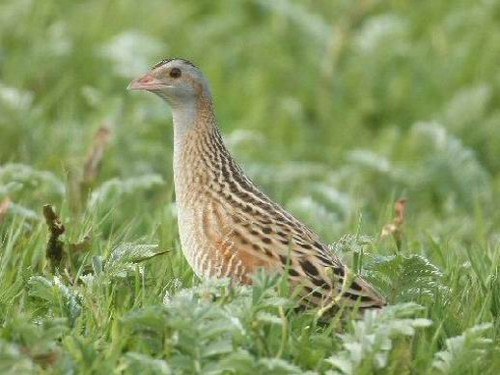
Key Field Marks
- Size & shape: A medium-sized rail, about 27–30 cm, with a chicken-like but noticeably slimmer, more elongated body than typical rails, and a short, stout, pinkish-buff bill.
- Plumage: Buff-brown, streaked and mottled with chestnut and black above; a grayish face and breast (more pronounced in males); chestnut wing patches that are especially conspicuous in flight.
- Legs: Pale pinkish legs suited to walking through dense grass.
- Behavior: Extremely secretive, spending nearly all its time hidden within tall grass or hay, rarely venturing into the open; when flushed it flies reluctantly, low and briefly, with legs dangling.
Separating It From Similar Species
- Water Rail: Found in wetlands rather than dry meadows, with a longer, downcurved reddish bill and darker, more uniformly gray-and-brown plumage.
- Quail: Similar size but much rounder and dumpier, with a very different, whistling three-note call and shorter legs; Corn Crake has longer legs and neck.
- Spotted Crake and other small rails: Show fine white spotting and streaking rather than the Corn Crake's plainer buff-and-chestnut pattern, and typically favor wetter habitats.
Where & When to See It
- Habitat: Tall grass hay meadows and other agricultural grasslands rather than wetlands, despite belonging to the rail family.
- Range: Breeds from Europe eastward across temperate Asia; winters in sub-Saharan Africa, making it a long-distance migrant.
- Season: Present on breeding grounds roughly May through August, with males calling most persistently and audibly after dark during this period.
Voice
- Call: A loud, rasping, mechanical "crex-crex," repeated monotonously, often compared to running a fingernail along the teeth of a comb; carries a long distance and is given mainly at night — by far the most reliable way to detect this species.
Conservation Note
Corn Crake populations have declined significantly across much of Europe due to earlier and more mechanized hay mowing, which destroys nests and chicks; conservation programs promoting delayed mowing and corncrake-friendly grassland management have helped stabilize some populations.
Frequently asked questions
Why is the Corn Crake so hard to see?
It is extremely secretive and spends nearly all its time hidden in tall grass or hay, rarely coming into the open, so most detections rely on hearing its call rather than seeing the bird.
What does the Corn Crake's call sound like?
A loud, rasping, mechanical "crex-crex," often likened to running a fingernail along a comb, repeated persistently, mainly after dark during the breeding season.
Is the Corn Crake found in wetlands like most rails?
No — unusually for a rail, it favors dry tall-grass hay meadows and agricultural grassland rather than marshes or wetlands.
Why have Corn Crake populations declined?
Modern, earlier, and more mechanized hay mowing destroys nests and chicks before they can fledge, which has driven significant population declines across much of western Europe.
When and where is the best time to listen for Corn Crakes?
Listen at night in hay meadows and grasslands during the breeding season, roughly May through August, when males call most persistently to attract mates and defend territory.