
Corn Bunting Identification Guide
A large, plain, heavily streaked bunting of open farmland, best known for its jangling-keys song and dangling-legged flight, with sexes that look alike unlike most buntings.
Read the full Corn Bunting encyclopedia entry →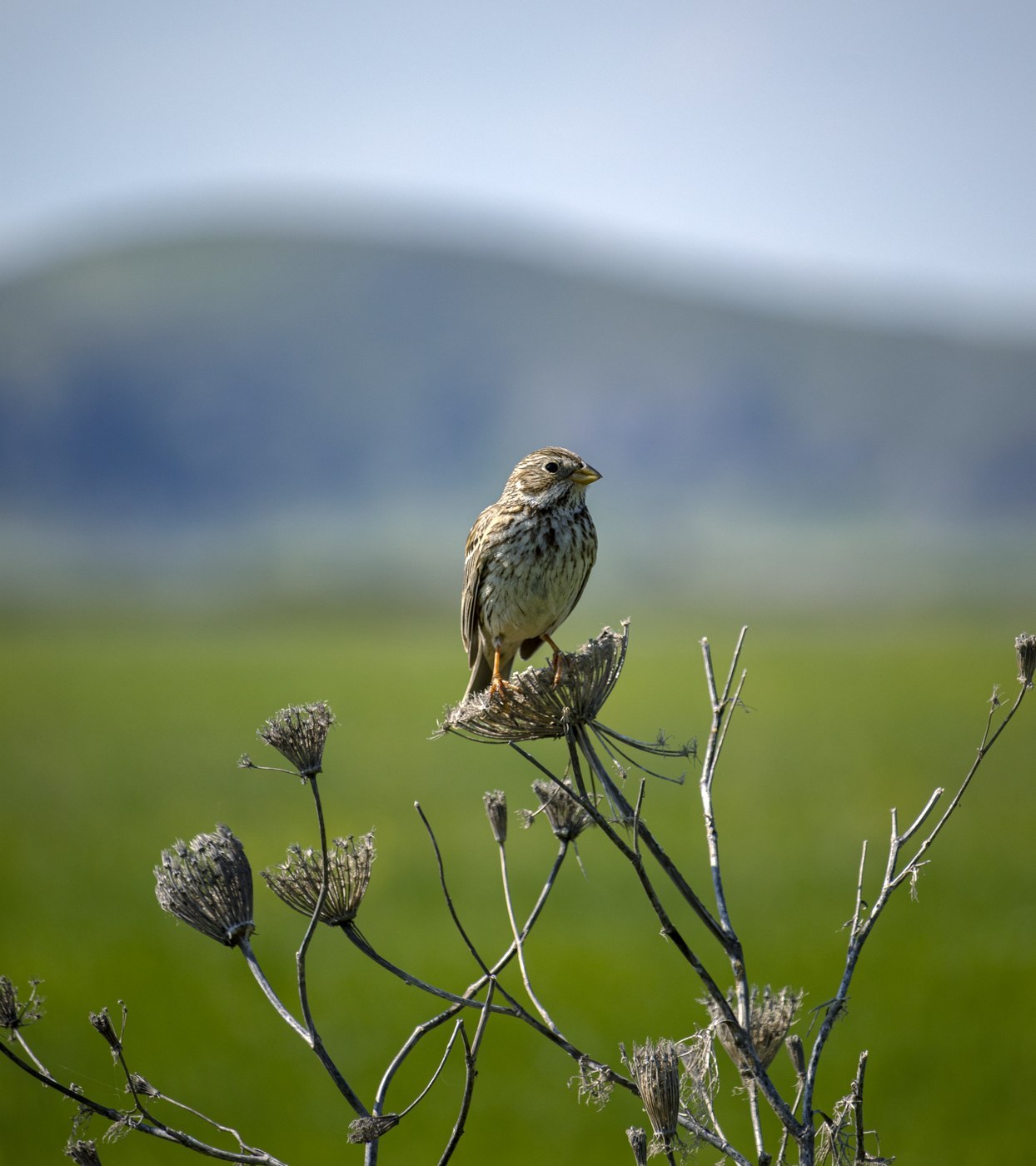
Key Field Marks
- Size & shape: The largest and bulkiest of the European buntings, about 16–19 cm, with a stocky, heavy-set body and a short, slightly notched tail.
- Plumage: Streaky brown above and buffy-white with dark streaking below; notably lacks the strong head pattern shown by most other buntings, giving it a rather plain-faced look.
- Bill: A stout, pale conical bill, larger and heavier than that of similarly streaky sparrows.
- Sexes: Unusually for buntings, males and females look essentially alike.
- Behavior: Frequently perches conspicuously on wires, fence posts, or the tops of bushes to sing; in flight often shows a distinctive "dangling legs" appearance. Some populations are polygynous, with males mating with several females.
Separating It From Similar Species
- House Sparrow (female/juvenile): Sparrows have a different bill shape and structure and lack the bunting's heavily streaked underparts and stocky proportions.
- Skylark: Has a small crest, different jizz, a white trailing edge to the wings, and very different song-flight behavior (high, hovering song-flight versus the Corn Bunting's perched song).
- Other buntings (e.g., Yellowhammer, Reed Bunting): Most show a distinct head pattern and white outer tail feathers that flash in flight; Corn Bunting lacks both of these features, appearing comparatively plain-headed with no white in the tail.
Where & When to See It
- Habitat: Open arable farmland, cereal fields, and grassland with scattered perches such as wires, posts, or hedgerow tops.
- Range: Found across Europe, North Africa, and the Middle East into Central Asia; has declined substantially in parts of western Europe due to agricultural intensification.
- Season: Largely resident in western populations, with some eastern and northern populations showing partial migratory movements.
Voice
- Song: A distinctive, dry, mechanical jangling, often compared to a bunch of keys being shaken — a highly recognizable and diagnostic sound.
- Call: A sharp "quit-it-it-it" note.
Frequently asked questions
What does the Corn Bunting's song sound like?
It's often described as sounding like a bunch of keys being jangled or shaken — a dry, mechanical, accelerating rattle unlike any other European bunting's song.
How do male and female Corn Buntings differ?
Unusually for buntings, the sexes look essentially alike, both showing plain, heavily streaked brown-and-buff plumage without a strong head pattern.
What field marks separate Corn Bunting from other buntings?
Corn Bunting lacks the distinct head pattern and white outer tail feathers shown by most other buntings, and it is notably larger and bulkier with a heavy pale bill.
Where is the best place to find a Corn Bunting?
Look on wires, fence posts, or bush tops in open arable farmland and cereal-growing country, where singing males are often easy to spot.
Why has the Corn Bunting declined in parts of Europe?
Agricultural intensification — including loss of stubble fields, hedgerows, and mixed farming — has reduced nesting and foraging habitat, driving significant declines in western Europe.