
Cordilleran Flycatcher Identification Guide
A small, yellow-tinged Empidonax flycatcher of interior western mountains, virtually identical to Pacific-slope Flycatcher and best separated by its distinctive "pit-peet" call.
Read the full Cordilleran Flycatcher encyclopedia entry →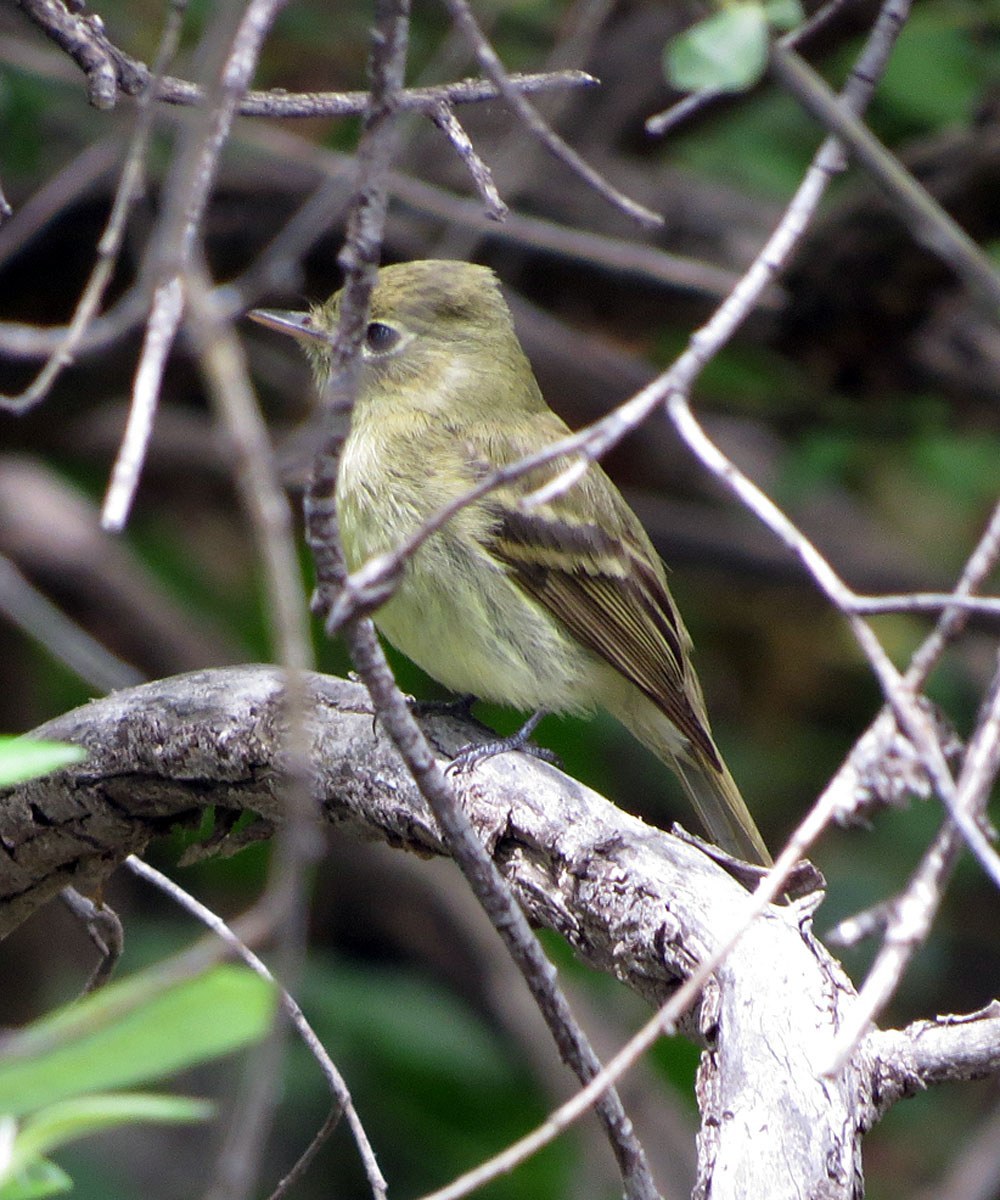
Key Field Marks
- Size & shape: A small flycatcher, about 14 cm, with the typical upright Empidonax posture and a fairly large, teardrop-shaped eye-ring pointed at the rear.
- Plumage: Olive-green upperparts, yellowish underparts (often brightest on the belly), an olive wash across the breast, and two pale buffy-white wing bars.
- Bill: Fairly broad-based bill with a pale lower mandible, typical of the genus.
- Behavior: Forages actively in the forest understory and mid-canopy, sallying out from perches to catch flying insects; often found near streams and canyons in mountainous terrain.
Separating It From Similar Species
- Pacific-slope Flycatcher: Essentially identical in plumage; the two were long treated as a single species ("Western Flycatcher") and are best separated by voice and range rather than appearance — Cordilleran breeds mainly in the interior Rockies and Great Basin ranges, while Pacific-slope breeds along the Pacific coast.
- Dusky and Hammond's Flycatchers: Both show less yellow overall, a more contrasting head pattern, and different eye-ring shapes, plus different vocalizations.
- Willow/Alder Flycatcher: Lack the strong yellow wash and have a less pronounced eye-ring.
Where & When to See It
- Habitat: Coniferous and mixed montane forests, shaded canyons, and streamside woodlands, generally at moderate to high elevations.
- Range: Breeds through the interior mountain ranges of the western U.S. and southwestern Canada, from the Rockies south through the Great Basin ranges into Arizona and New Mexico.
- Season: A summer breeder that winters in Mexico; migration periods offer the best chance of encountering vocalizing birds, since silent individuals are essentially unidentifiable in the field from Pacific-slope Flycatcher.
Voice
- Call: A sharp, distinctive two-syllable "pit-peet" or "ptsick," the primary way to confidently separate this species from Pacific-slope Flycatcher.
- Song: A series of thin, high-pitched notes, subtly different in cadence and pitch pattern from its Pacific-slope counterpart.
Frequently asked questions
How can I really be sure I have a Cordilleran and not a Pacific-slope Flycatcher?
Plumage is essentially identical between the two, so confident identification usually relies on voice — Cordilleran gives a sharp "pit-peet" call — combined with range, since Cordilleran breeds mainly in the interior mountains while Pacific-slope breeds along the coast.
What is the best field mark within the Empidonax genus for this species?
A yellowish wash on the underparts combined with a large, teardrop-shaped eye-ring pointed at the back helps place it in the Western Flycatcher complex, though species-level identification usually needs a vocalization.
What habitat does Cordilleran Flycatcher prefer?
Shaded coniferous and mixed forests in mountain canyons, often near streams, at moderate to higher elevations in the interior West.
Is Cordilleran Flycatcher present year-round?
No, it is a summer breeder in western mountain ranges that migrates to Mexico for the winter.
Was Cordilleran Flycatcher once considered the same species as Pacific-slope Flycatcher?
Yes, both were formerly lumped as "Western Flycatcher" and were split into two species primarily on the basis of vocal differences.